


On the southern edge of Baghdad, about two kilometres east of the Tigris, a low mound called Tell Muhammad holds the remains of a city that was already old when Hammurabi of Babylon took control of the region. This autumn an Italian team, working with Iraq’s State Board of Antiquities and Heritage, uncovered more of the city’s mudbrick defences. They also found a clay tablet recording a loan of barley and beer.
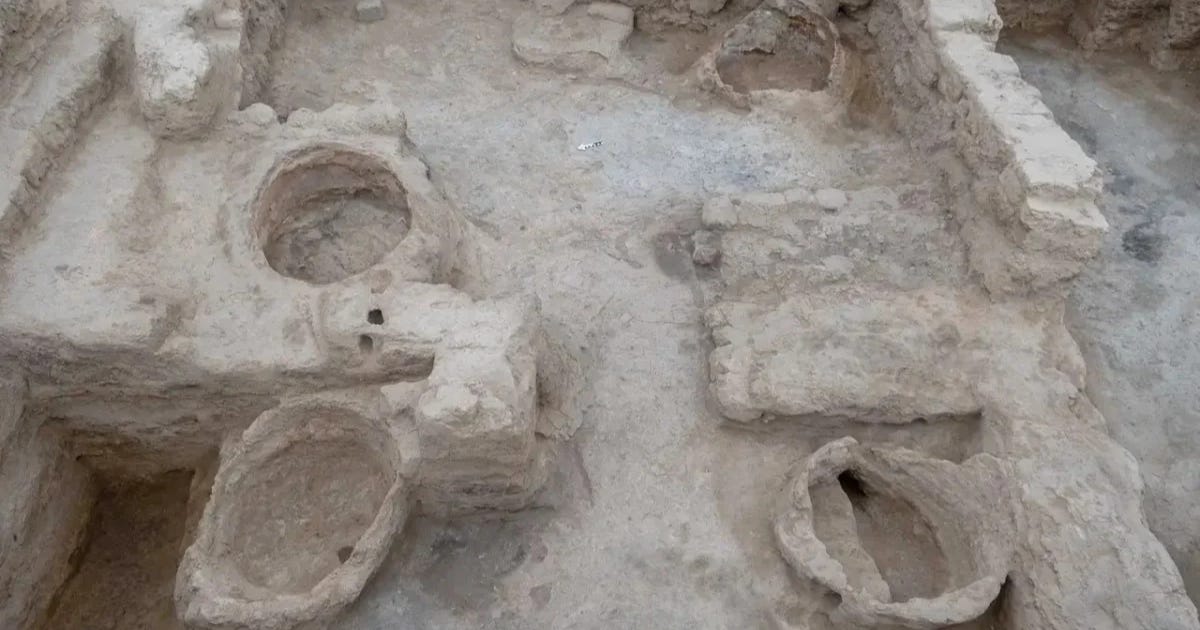
A possible Babylonian tavern dating back approximately 2,500 years before the founding of Baghdad. Image credit: Nicola Laneri & Alice Mendola / University of Catania
The two-month season ended in late October. It was the sixth season of excavation and restoration since the University of Catania launched its Baghdad Urban Archaeological Project five years ago. Nicola Laneri of Catania leads the mission, with researchers from Catania and Sapienza University of Rome, and Italy’s Ministry of Foreign Affairs and International Cooperation supports it. The university published the results on 20 November.
A five-metre wall with a small gate and traces of fire
On the north side of the site the team exposed new stretches of the city wall, including one of its corners. The mudbrick wall is about five metres thick and has now been followed for more than 100 metres. The excavators date it to the Isin-Larsa period, roughly the 20th and 19th centuries BC, and think it was rebuilt in Hammurabi’s time.
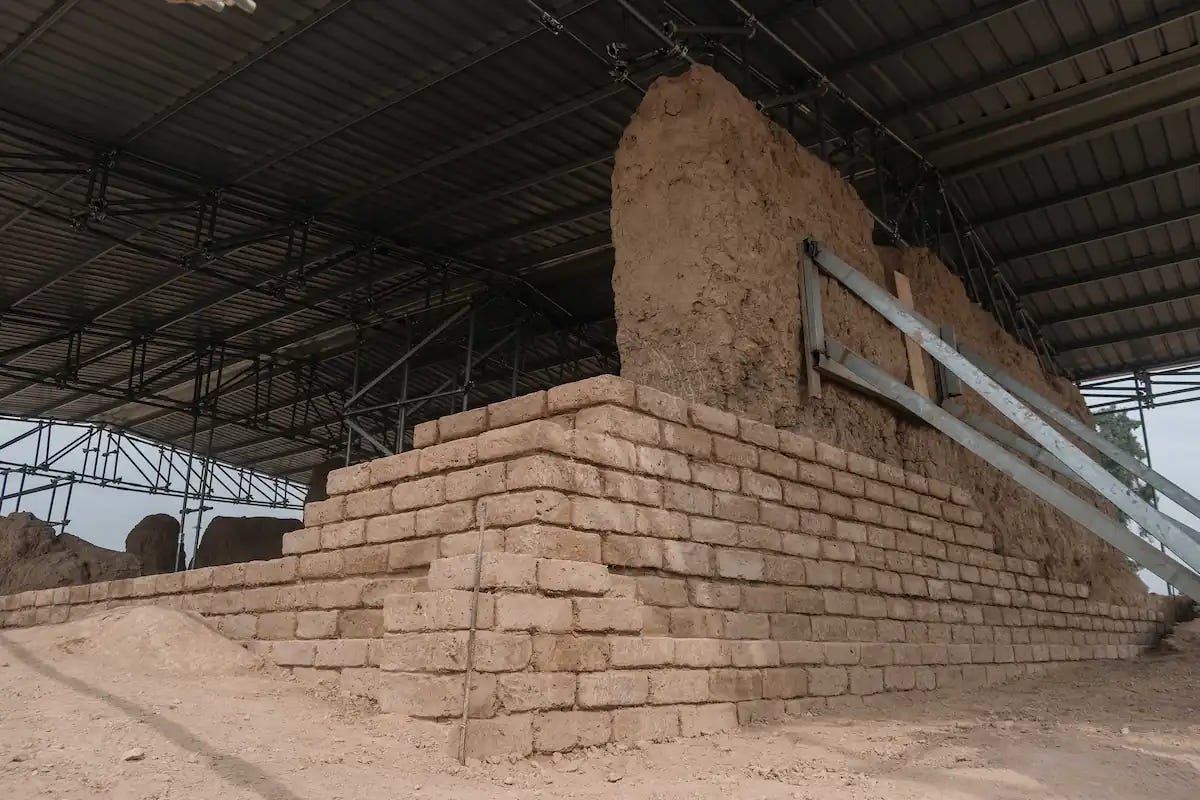
Along the wall they found a postern, a small secondary gate, protected by a bastion. Outside the bastion the wall shows extensive traces of burning. The report gives no cause or date for the fire.
The defences already had a monumental gate, documented in an earlier season and dated broadly to the Old Babylonian period, about 1900 to 1600 BC, in a December 2025 summary from the Italian foreign ministry.
A loan contract for barley and beer on a room floor
The older of this season’s two tablets lay on the floor of a room that the team thinks may have been used to produce food. Its text records a loan of barley and beer, drawn up before two witnesses. The beer is called kurunnum, which the Catania team describes as a prized variety. Judging by the shapes of the cuneiform signs, the tablet may date to the reigns of Hammurabi and his son Samsu-iluna, about 1792 to 1712 BC.
One of the personal names in the contract includes the god Marduk, patron deity of Babylon. According to the team, this is the first such name found in texts from Tell Muhammad.
A counter on the street and four circular installations
The room opens onto the street that ran from the city entrance to the sacred area. A semicircular mudbrick counter faces that street. Inside, the team found four circular features and a mudbrick basin. They say these could be linked to brewing beer or baking bread, and they point to comparable installations at Ur and Nippur.
Some coverage has described the room as a possible Babylonian tavern. The excavators do not use that word. Their report leaves the room’s function open and says residue analysis should show what the installations were used for. A brewery, a bakery and a place that served drink to people passing in the street all fit the evidence so far.
The second tablet is later and poorly preserved, and it was found away from its original context. It records distributions of goods, including barley and sesame.
Reed mats and clay carried rainwater to a cistern
Earlier seasons uncovered a channel built of reed mats and clay that carried rainwater to a large cistern inside the wall. The team compares the way it worked to the perforated pipes used in agricultural drainage today. The project’s first preliminary report, published in 2024, names water management and ritual activity as two of its main research themes.
A city on the frontier of Eshnunna and Babylon
Tell Muhammad once covered about 25 hectares. Around 5 hectares survive, surrounded by modern Baghdad. Its ancient name is uncertain, and scholars have proposed several identifications without agreeing on one. Tell Harmal, ancient Shaduppum, lies a short distance to the north.
In the early second millennium BC this stretch of the Tigris fell within the orbit of Eshnunna, a kingdom centred on the Diyala valley. The excavators note that the site’s tablets show links both with Eshnunna to the north and with Babylon to the south. Hammurabi conquered Eshnunna in his 32nd regnal year, about 1762 BC in the conventional chronology.
The site was first connected with Hammurabi in the 1850s, when James Felix Jones and Austen Henry Layard collected copper-alloy maceheads there inscribed with the words “palace of Hammurabi”. Iraqi archaeologists excavated a sacred area between 1978 and 1985 and recovered hundreds of cuneiform tablets, most of them commercial contracts.
The Italian work is also meant to protect what remains. A separate cooperation project, ArTourBagh, coordinated by Nicolò Marchetti of the University of Bologna, plans to turn Tell Muhammad and Tell Harmal into an archaeological park.
Subscribe for a few dollars a month and get every long read, the short documentaries and the full archive. Cancel anytime.
📍 Explore this discovery on the Ancient Content Atlas:
Sources
Laneri, N., and Mendola, A. (2026). “Tell Muhammad: nuove scoperte raccontano la vita di un’antica città mesopotamica.” UnictMagazine, Università di Catania, 20 November 2026. https://www.unictmagazine.unict.it/tell-muhammad-nuove-scoperte-raccontano-la-vita-di-unantica-citta-mesopotamica
Laneri, N., Rositani, A., Russo, S. G., Mendola, A., Mammana, R. C., Hinks, M. R., and Borgesi, A. (2024). “The Baghdad Urban Archaeological Project. A preliminary report on the first two seasons (2022-2023) of archaeological research at the Old Babylonian site of Tell Muhammad (Baghdad).” Egitto e Vicino Oriente 47, 139-168. DOI 10.12871/97912560815098. https://iris.uniroma1.it/handle/11573/1739269
Ministero degli Affari Esteri e della Cooperazione Internazionale (2025). “Baghdad, a treasure of ancient Mesopotamia.” 12 December 2025. https://www.esteri.it/en/sala_stampa/archivionotizie/diplomazia-culturale/2025/12/baghdad-un-tesoro-della-mesopotamia-antica/
Baghdad Urban Archaeological Project, site page “Tell Muhammad.” Università di Catania. https://buap.unict.it/?p=1610
Carvajal, G. (2026). “16-foot-thick wall and possible Babylonian tavern found in Hammurabi-era city outside modern Baghdad.” La Brújula Verde, 20 November 2026 (secondary). https://www.labrujulaverde.com/en/2026/11/16-foot-thick-wall-and-possible-babylonian-tavern-found-in-hammurabi-era-city-outside-modern-baghdad/
Further reading, not checked in full: Laneri et al. (2026), Heritage 9(2), 47. https://www.mdpi.com/2571-9408/9/2/47
So, beer is very old! That is 4000 years ago and they already brew beer. It is surprising how old some foods are. Some years ago I read that bread has been made for 13000+ years! We know that wine has been made for 2000+ years as it is mentioned in the Bible. It is funny to find how people lived in these old times, it seems less different than we may think (apart from phones and computers that is).
Four thousand years later, we're still borrowing money for alcohol and arguing about who owes whom. I suspect somewhere in ancient Babylon there was a fellow named Nebuchadnezzar who conveniently forgot his wallet every time the bill arrived. Human nature really is remarkably consistent!