


Ruling Rome and ruling China during antiquity meant facing very different odds of survival. A new comparative study shows that 60.8 percent of Roman emperors died violently, against 31.0 percent of their Chinese counterparts, a gap of nearly 30 percentage points that the author argues comes down to one institutional difference, the corporate power the Roman army had accumulated to make and unmake its rulers.
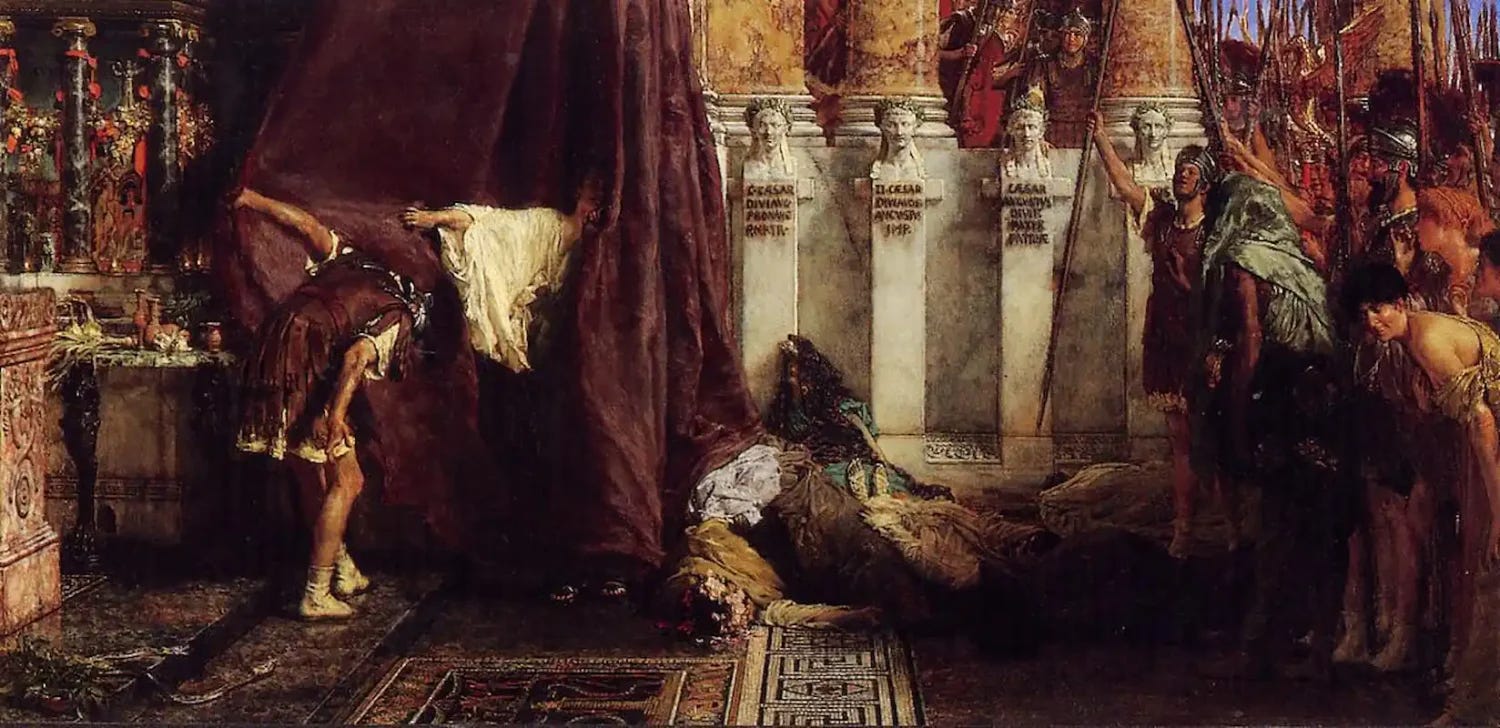
The Proclamation of Emperor Claudius, by Lawrence Alma-Tadema. Credit: Public domain / Wikimedia Commons
The research, by Zhao Dong of the University of Oxford, was published in the journal Economics Letters. It offers the first systematic comparison of its kind, tracking 97 Roman emperors and 58 Chinese emperors across the five centuries in which both empires coexisted, from 27 BC to AD 476.
The numbers
Of the 97 Roman emperors in the dataset, 59 died violently, through assassination, execution, military revolt, defeat in civil war, or forced suicide. Among the 58 Chinese emperors, only 18 met the same fate. Roman rulers also held power for a much shorter time. The average Roman reign lasted 7.5 years against 11.7 years in China, and the gap widens further in the median figures, 3 years for Rome against 6.5 years for China, indicating that a typical Roman emperor’s rule could end abruptly at almost any point.
The pattern held up across every phase of both empires’ histories. During the Principate, the early centuries of Roman rule, the violent death rate reached 62.1 percent, while China’s contemporaneous Han Dynasty saw just 17.6 percent. Rome’s worst stretch was the Crisis of the Third Century, from AD 235 to 284, when 26 emperors held the throne in fifty years and more than 80 percent of them were murdered. China’s roughly contemporaneous Wei-Jin and Northern and Southern Dynasties period of fragmentation, which stretched across 257 years, produced a violent death rate of 36.6 percent, itself elevated by Chinese standards but still far below Rome’s peak. Even in the later Roman Empire, from AD 284 to 476, after Diocletian’s reforms had reorganized the imperial system, the rate remained high at 47.6 percent, while China’s violence declined sharply once its own period of crisis passed.
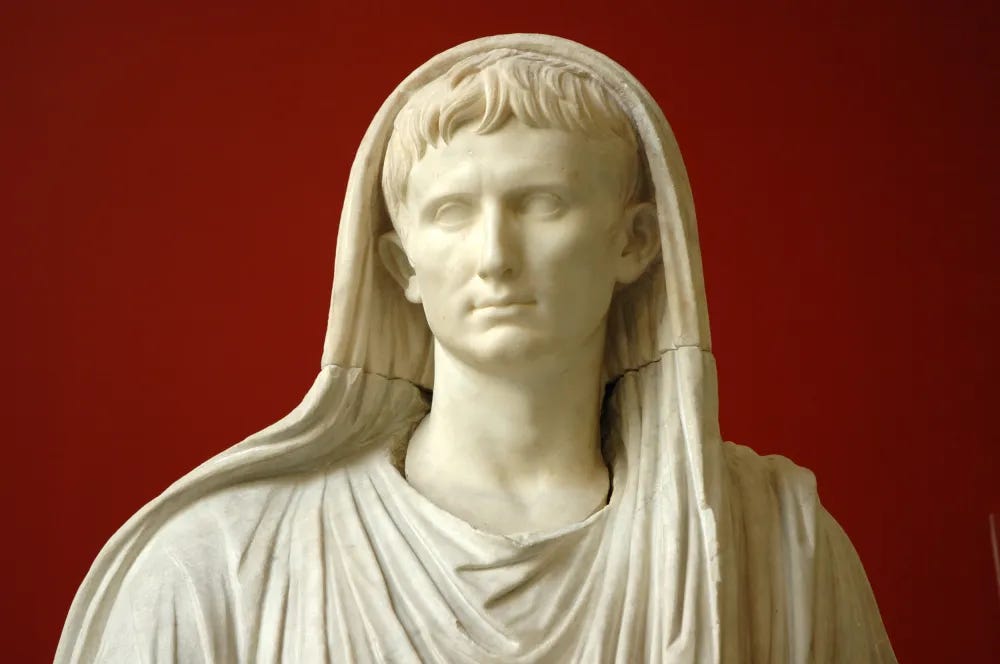
The Via Labicana Augustus depicts Augustus as Pontifex Maximus, with his head veiled during a sacrifice. Augustus was the first emperor of the unified Roman Empire and one of the few to die a peaceful death. | Werner Forman Archive, N. J. Saunders, Palazzo Massimo alle Terme, Getty Images
The military trap
Dong’s explanation centers on what he calls the military trap. In Rome, the legions developed a corporate identity of their own and a settled belief that they held the right to choose and depose emperors. An acclaimed general was expected to reward his troops with donatives, land, or better conditions of service, and an emperor who failed to deliver risked being replaced, usually violently, by whichever rival his own soldiers preferred next.
The data bear this out sharply. Among Roman emperors who took power through military acclamation or usurpation, 75.7 percent died violently, compared with 51.7 percent of those who came to the throne through inheritance, appointment, or co-rule, a statistically significant gap. More strikingly, 62.7 percent of all violent deaths among Roman emperors trace directly to military conflict, whether revolt, civil war, or battle abroad. As the study puts it, Roman emperors died violently at roughly twice the Chinese rate, and the difference survives after controlling for historical period and mode of succession.

Emperor Commodus ruled for 12 years before being assassinated on 31 December 192 CE. He was strangled in his bath by the wrestler Narcissus as part of a conspiracy that also involved his mistress, Marcia. Credit: Joseph Saleh/Georgia Institute of Technology.
China’s palace conspiracies
Imperial China operated on an entirely different logic. Across the full 500 years studied, only seven Chinese emperors reached the throne through what Dong terms military-style elevation, and every one of them was a dynasty founder. Within any already-established dynasty, no emperor came to power through military acclamation or troop mutiny.
Violent removals in China instead took the shape of palace conspiracies, orchestrated by regents, the families of imperial consorts, or court eunuchs, factions that commanded troops but never as autonomous forces with a corporate identity of their own, using them instead as instruments of court intrigue. Dong cites the murder of Emperor Taiwu in AD 452 by the eunuch Zong Ai, and the poisoning of Tuoba Hong, known as Emperor Xiaowen, in AD 476 by the Empress Dowager Feng, as cases where the killers were court insiders acting with their own followers rather than commanders answering to a mutinous legion. Among the seven Chinese founder-emperors who did rise through military means, only one, Tuoba Gui, died violently, murdered by his own son in a palace incident, and none died from directly military causes. In Rome, by comparison, 18 of the 37 emperors elevated by the army died in battle or during military revolt.
Data and method
Dong built the Roman side of his dataset from the catalog compiled by Kienast, Eck, and Heil, supplemented by the work of Campbell and Southern, and drew the Chinese side from the Basic Annals of the Twenty-Four Histories, China’s official dynastic chronicle. He applied identical coding rules to both empires, counting violent death as assassination, execution, death in military revolt, defeat in civil or foreign war, lynching, or suicide under political pressure, with poisonings counted only where political intent could be established.
The statistical analysis relied on chi-square tests, Fisher’s exact tests, comparisons of means, and linear probability models, controlling for mode of succession and historical period. Dong is careful about the limits of the design. Because there is no exogenous variation in military policy to exploit as a natural experiment, the models are associative rather than causal, and he acknowledges that unmeasured factors, such as the age of a dynasty, simultaneous economic crises, or rivalries among non-military elites, could also have shaped the results. He calls for future work to refine the categories of violent death and to examine risk on a year-by-year basis within individual reigns.
Why Rome’s army broke free
Dong traces the precedent to AD 69, the Year of the Four Emperors, when the legions first grasped that they could impose their preferred candidate on the throne. Once established, the practice proved impossible to reverse. Each new emperor raised by military force then had to meet his troops’ expectations, locking the system into a cycle of rewards and rising fiscal demand that ended, again and again, in overthrow whenever the treasury could not keep pace.
China avoided that trap through a different structure entirely. Its bureaucracy and civilian oversight of the armed forces kept soldiers from consolidating into an independent political force, even during its most fragmented periods, leaving palace conspirators, not mutinous legions, as the main threat to an emperor’s life, a form of violence that, however deadly for individual rulers, did not destabilize the machinery of government to the degree Rome’s civil wars repeatedly did.

Bust of Emperor Didius Julianus (reigned 193 CE), a ruler who died a violent death. His reign lasted just 66 days, the shortest in the unified Roman Empire. He was executed a little over two months after purchasing the throne in what became known as the “Auction of the Empire.” Credit: DON EMMERT/AFP/Getty
A wider lesson
Dong situates the study within a growing body of scholarship comparing Rome and China, one that has so far focused mainly on fiscal capacity, trade, and institutions rather than on the survival odds of the rulers themselves. He argues the pattern is not merely a historical curiosity. Political systems in which the military functions as an autonomous power capable of deciding who governs tend toward greater coup risk and instability more broadly, suggesting the military trap may be less a peculiarity of Rome than a general feature of any regime that shares its monopoly on violence with the very soldiers meant to protect the ruler.
Several questions remain open. Why the Roman army developed this corporate identity while China’s did not, whether the emphasis on hereditary legitimacy in Chinese succession played a causal role, and whether army size or geographic deployment mattered, are all left for future research to untangle. What the data make clear is the scale of the difference itself. Across five centuries, the military trap functioned as the death sentence of some fifty Roman rulers, a fate their Chinese counterparts faced far less often, and rarely at the hands of their own soldiers.
Support Independent Ancient Content. Your support helps me create more archaeology posts, articles, and mini history videos:
Source. Dong, Z. (2026). “The military trap. Why Roman emperors died more violently than Chinese emperors.” Economics Letters.
What drove the Roman Republic into the Empire was money lending. Interest rates ranged from 24% to 48%. This meant that business ownership was concentrated among the wealthy, and a huge part of the population were perpetual slaves.
The only institution that provided economic growth was the Army. And this was because wealth was distributed to veterans upon their retirement from the Army. The great achievement of Caesar Augustus was to placate the Senate even as he accumulated political power.
Caesar Augustus created the Praetorian Guard, which became part of the problem. Starting with Caligula, the Praetorian Guard assassinated 13 emperors. The Praetorian Guard was finally abolished by Emperor Constantine after he defeated them in battle.