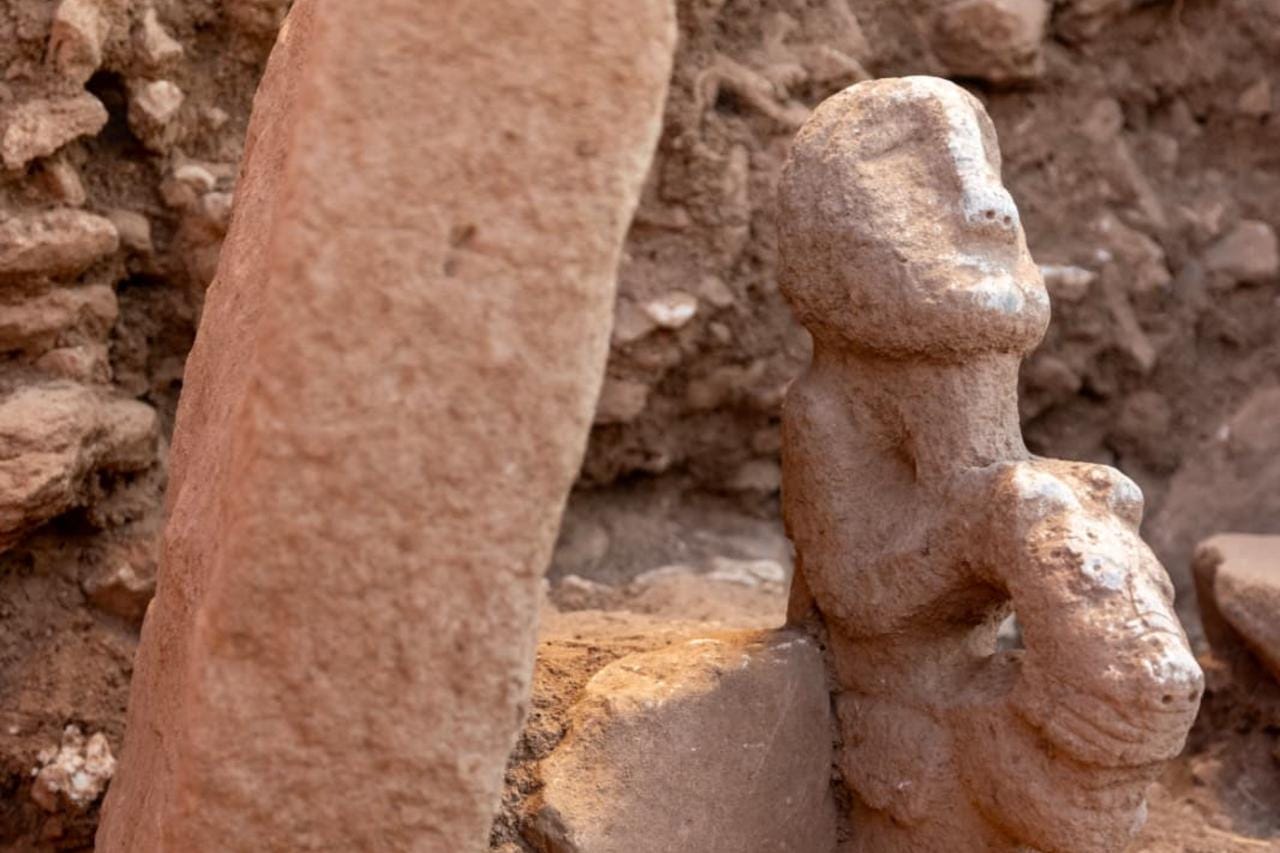
The 11,000-year-old composite statue discovered at Karahantepe, one of the remarkable sculptural finds from the site. (AA Photo)
Archaeologists working at the Neolithic site of Karahantepe in southeastern Türkiye have uncovered a rare 70-centimeter-tall stone composite statue depicting a human figure seated on the back of a leopard. The approximately 11,000-year-old artifact, found in its original position inside a specially prepared structure, represents a previously unattested artistic style at the site and offers fresh insights into the symbolic world of Pre-Pottery Neolithic communities.
Turkish Culture and Tourism Minister Mehmet Nuri Ersoy announced the discovery on August 25, 2026. He described it as a unique composite figure combining human and animal forms in a single composition, unearthed during the 2026 excavation season under the government’s “Heritage for the Future” (Geleceğe Miras) project. The statue was located on a bench running along the wall of a roughly three-meter-diameter structure whose floor was paved with flat stones. According to reports, it rested exactly where it had been left millennia earlier and was found covered with flat stones.
Karahantepe (also known as Karahan Tepe), located near Şanlıurfa and about 30 kilometers from the UNESCO-listed Göbeklitepe, forms part of the broader Taş Tepeler (“Stone Hills”) project. Systematic excavations began there in 2019 under the direction of Prof. Necmi Karul of Istanbul University. The site belongs to the Pre-Pottery Neolithic period, roughly contemporaneous with Göbeklitepe, when communities in Upper Mesopotamia were transitioning from mobile hunter-gatherer lifeways toward more settled patterns of social organization, monumental architecture, and complex ritual practices.
An 11,000-year-old composite statue unearthed at Karahantepe, offering a rare glimpse into the symbolic art of the Neolithic period. (AA Photo)
Unlike Göbeklitepe, which is renowned primarily for its T-shaped pillars with animal reliefs, Karahantepe has yielded a notably higher number of three-dimensional human depictions and composite human-animal sculptures. Earlier finds include a well-known statue of a human carrying a leopard on its back, large realistic human figures such as the so-called “Ribbed Man” (a 2.3-meter seated figure with carefully incised ribs discovered in 2023), human heads carved from bedrock or pillars, and numerous animal representations including leopards, foxes, snakes, and vultures. The new statue’s composition—a human seated or riding atop a leopard—stands out as distinct from these earlier examples.
Leopards appear repeatedly in the iconography of the Taş Tepeler sites and are widely interpreted as symbols of power, danger, protection, or spiritual potency. The deliberate placement of the new composite figure on a bench within a carefully paved circular structure suggests it held ritual or ceremonial significance rather than serving a purely domestic purpose. Such carefully positioned sculptures, left in situ and later sealed or covered, are consistent with broader patterns observed at both Karahantepe and Göbeklitepe, where buildings and statues were often intentionally filled and abandoned.
Minister Ersoy emphasized the discovery’s potential to generate wide scientific interest, stating that it “opens the door to new questions about the earliest periods of human history.” He thanked the General Directorate of Cultural Heritage and Museums, the excavation team, scientists, and field workers involved in the project. The find continues a pattern of annual breakthroughs at Karahantepe that are reshaping understandings of early Neolithic social complexity, artistic capability, and human-animal relationships long before the appearance of writing, pottery, or urban centers.
Further study of the statue, its precise stratigraphic context, and associated architectural features is expected to refine interpretations of symbolism and social organization in one of the world’s earliest monumental landscapes. As excavations under the Taş Tepeler and Heritage for the Future initiatives continue, Karahantepe remains a key site for illuminating the deep roots of human creativity and communal life in the ancient Near East.
A note to readers
Ancient Content is independently researched and written, with no institutional backing or editorial sponsor. Paid subscriptions are what keep the publication independent.
If you find these pieces valuable, consider becoming a paid subscriber. For a few dollars a month:
A new, thoroughly researched piece every day, grounded in primary sources and current scholarship
New discoveries covered from the original-language announcements, ahead of the English press
Short documentaries, plus the full video archive
The complete written archive
Research notes on disputed claims, errors, and where the evidence remains uncertain.


Beautifully done thank you
