


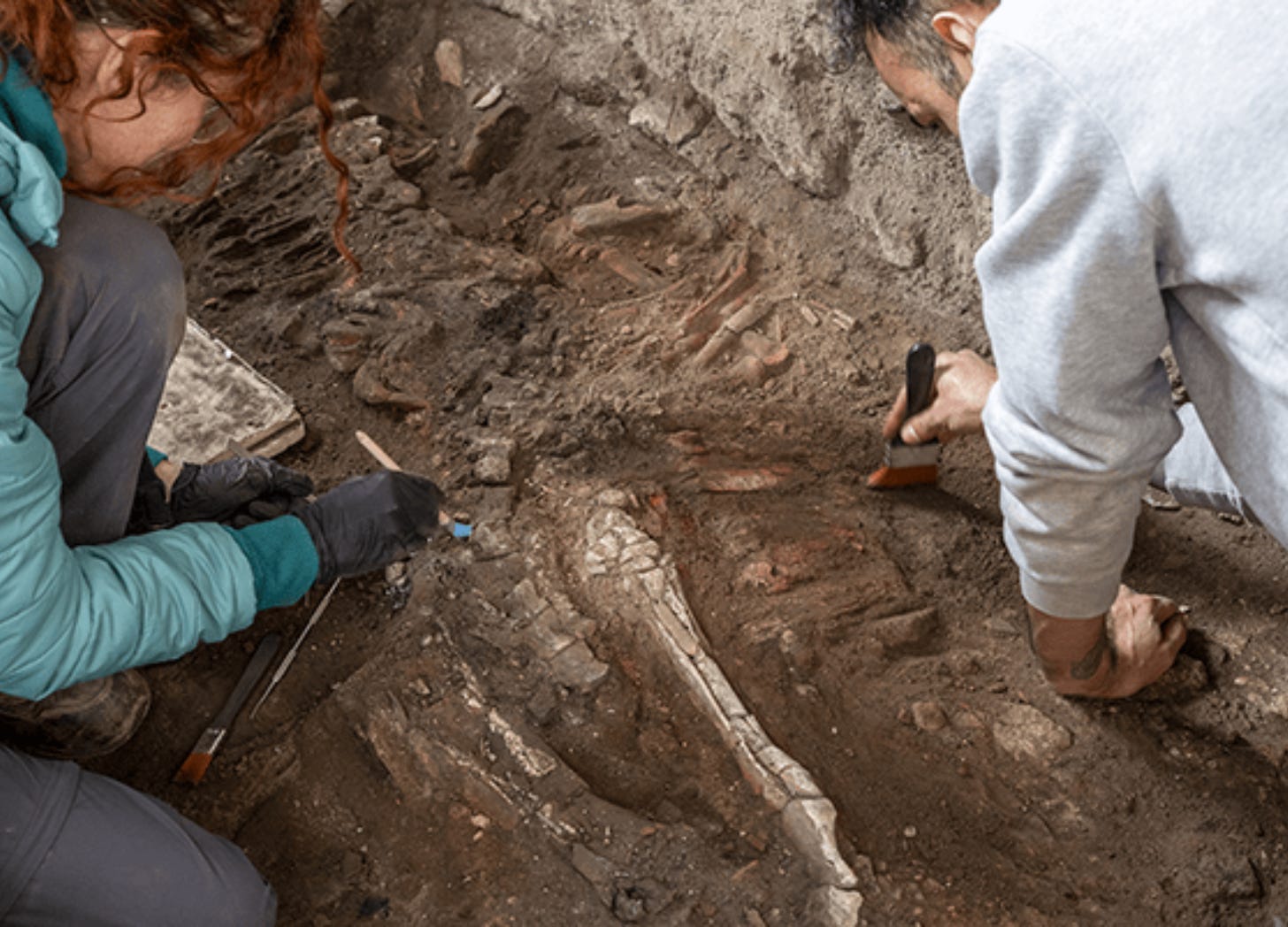
The discovery was made within the Insula of the Chaste Lovers, one of Pompeii’s most significant excavation areas. The complex is not only a decorated residence but also a large production site. It includes a bakery, an oven, storage areas, workspaces, and the owner’s living quarters. Its name comes from a fresco showing a restrained kiss between two lovers, found in a dining room of the house.
The newly investigated room was part of the bakery area. Earlier excavations had already revealed nearby stables, where other equids had been found. These animals were part of the bakery’s working system. They helped turn millstones and transport the grain needed for bread production. The new find expands that picture by showing animals in a different room, away from the known stable area.
The excavation took place in a section that had already been partly explored during campaigns carried out between the late 1980s and early 1990s. However, one deposit had been left untouched in a corner of a room close to the bakery oven. When archaeologists returned to this area, they found that the remaining deposit preserved important evidence. What may have looked like a small unfinished section became a complex archaeological context.
The remains belong to two large herbivores, recorded by researchers as RP1 and RP2. They were not discovered in a normal stable setting. Instead, they were found in a room previously used for bread-making. This detail is important because it suggests that the space had changed function before the eruption. The bakery may not have been operating normally at the time. Evidence points to repair work and reorganization inside the complex.
Researchers believe the animals may have been placed there temporarily while other parts of the bakery and stable area were under repair. Nearby spaces show signs of renovation, and parts of the building appear to have been affected by earlier seismic damage. Pompeii had suffered earthquakes before the AD 79 eruption, and many buildings in the city were still being repaired when Vesuvius erupted.
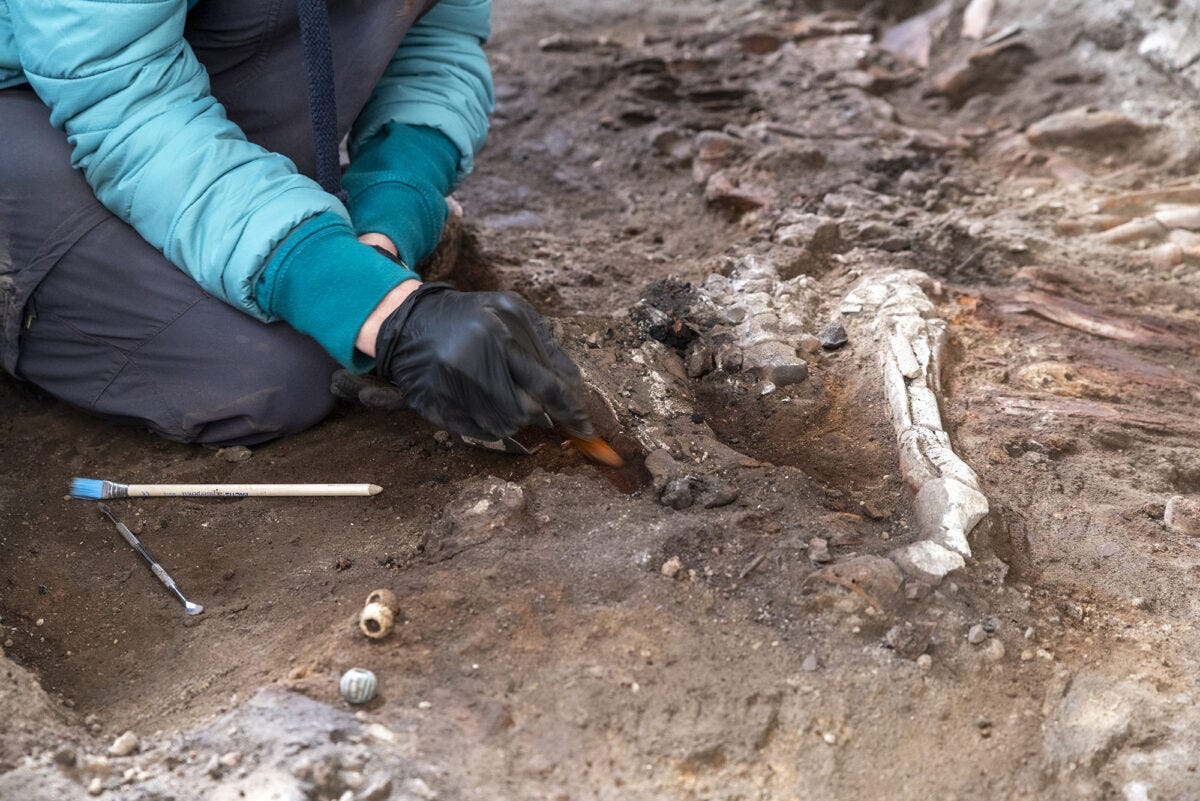
The room where the animals died measured roughly 6.3 by 3.45 meters. It had once been used for bread production, but by the time of the eruption, the large worktable had been removed. Only traces of its supports remained. This open space could then have been used to hold the animals temporarily.
Because the context was disturbed by earlier excavations and partly preserved in micro-layers, the team used a careful microstratigraphic approach. The work required close cooperation between field archaeologists and specialists. An archaeozoologist studied the animal remains, an archaeobotanist examined wood and plant material, and an anthropologist contributed taphonomic and forensic expertise. This interdisciplinary method is now a major part of modern research at Pompeii.
The two animals provide different types of evidence. RP1 was the older and more complete individual. Dental and skeletal observations suggest it was about 10 to 12 years old. RP2 was younger, estimated between about 3.5 and 6 years old. Researchers have not yet confirmed whether the animals were horses, donkeys, or hybrids such as mules. Further biometric, morphological, and genetic analysis is expected to clarify this.
The position of the skeletons and the damage to the bones help reconstruct the moment of death. RP1 was found in the northern part of the room. RP2 lay farther south, near the southwestern corner. Both animals show evidence consistent with crushing from above. A large wooden beam was found above the remains. Analysis identified the wood as maple. The beam had burned and was later buried beneath ash.
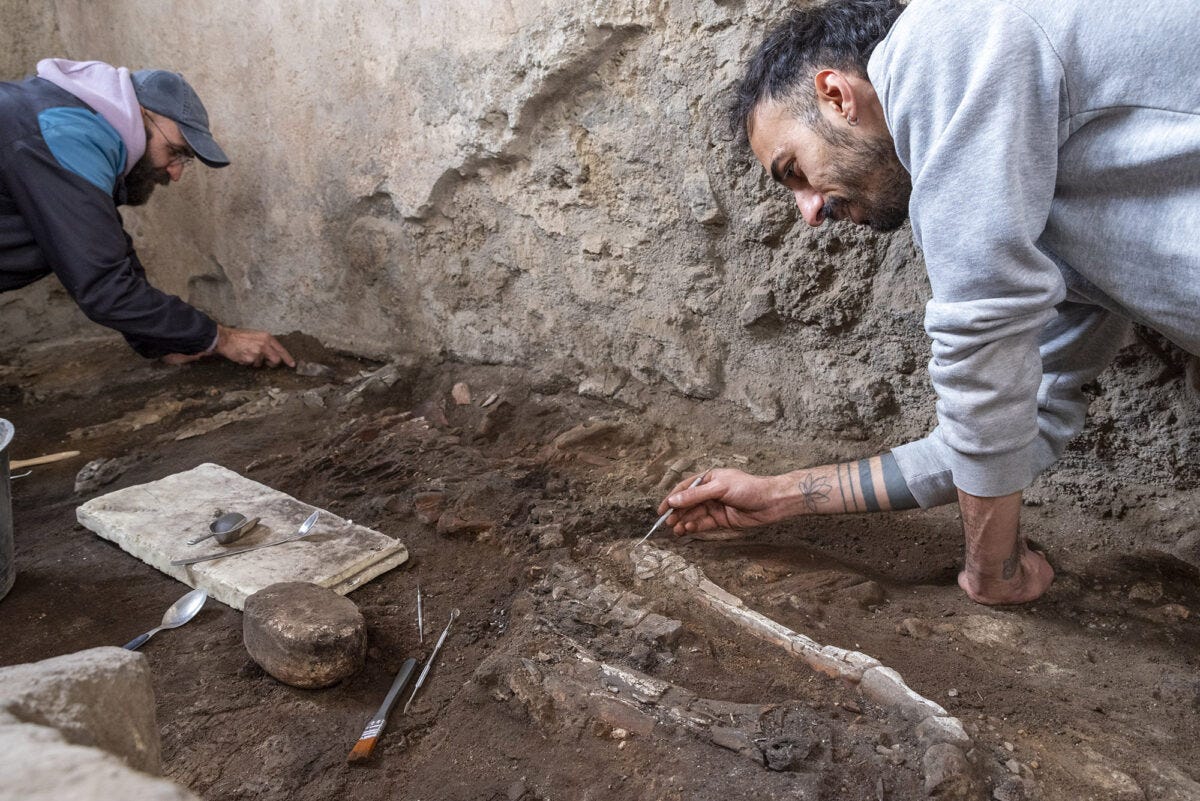
The absence of lapilli around and beneath the bodies is one of the most important observations. Lapilli are small volcanic fragments commonly associated with early eruptive deposits at Pompeii. Their absence in this specific context suggests that the animals died before volcanic debris had accumulated inside the room. The likely cause was the collapse of an upper floor or structural element during the earliest phase of the disaster, possibly triggered by seismic shocks connected with the eruption.
This makes the discovery valuable not only for the study of animals but also for the reconstruction of the eruption sequence. The animals may have died before the room was filled by volcanic material. Their position, the fallen beam, the burned wood, and the surrounding ash all help refine the timeline of destruction inside this part of the city.
One detail from RP1 adds a more personal dimension to the find. Near the neck area, archaeologists found two iron rings, probably connected with a harness system. Close by were three glass-paste beads, one blue and two white. These may have been attached to the mane, collar, or harness. No similar decoration was found with RP2.
This does not change the fact that the animals were working animals used within a commercial production system. However, the beads and harness fittings show that they were not anonymous tools. They were handled, maintained, equipped, and possibly decorated by the people who worked with them. The evidence gives a more detailed view of the relationship between humans and animals in an urban Roman workplace.
The House of the Chaste Lovers therefore offers more than wall paintings and domestic decoration. It preserves the connection between residence, production, labor, and animal use. The bakery was part of an economic system, and the animals were essential to that system. Their remains show how closely human and animal lives were linked in Pompeii’s working spaces.
The discovery also shows why re-excavating older areas can still produce new results. Pompeii has been excavated for centuries, but earlier methods did not always capture the smallest layers, traces, or biological evidence. Modern techniques allow researchers to return to partially explored spaces and extract new information from deposits that were once overlooked.
Ongoing laboratory work is expected to provide more detail about the species, health, diet, and working role of the animals. These analyses may also improve understanding of how animals reacted to the eruption and how they were affected by structural collapse, fire, ash, and volcanic gases.
The find from the House of the Chaste Lovers is a clear example of how Pompeii continues to develop as a research site. The city is not only a place of architecture, frescoes, and objects. It is also a preserved urban environment where archaeologists can study daily labor, food production, repair work, human-animal relationships, and the physical sequence of disaster.
Nearly two thousand years after the eruption, the bakery of the Chaste Lovers now adds another important piece to Pompeii’s history: two working animals, caught inside a production space at the moment when a damaged city was still repairing itself, just before Vesuvius ended that process permanently.
Source:
Archaeological Park of Pompeii, official press release, 5 June 2026.