A drinking vessel carved some 1,700 years ago sits today in the British Museum, and it does something no piece of glass has any obvious business doing.
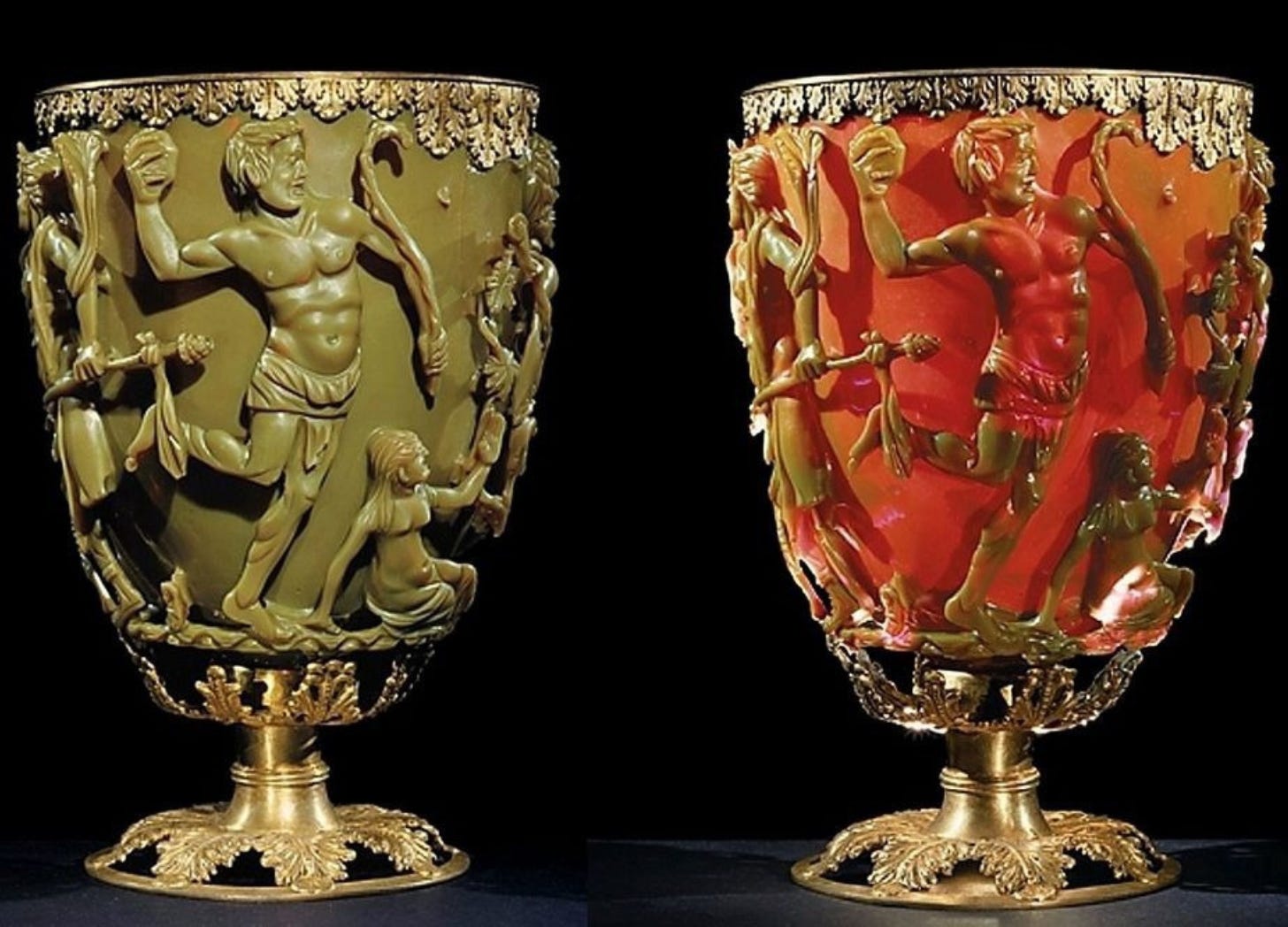
Lit from the front, it glows an opaque jade green. Lit from behind, the very same glass turns a deep, glowing ruby red. The object is the Lycurgus Cup, and the explanation for its trick, discovered only in the twentieth century, turns out to be genuine nanotechnology, built by Roman craftsmen who almost certainly had no concept of atoms, particles, or the physics they were exploiting.
A cage of glass telling a myth of punishment
The cup itself is a masterpiece of Roman glasswork known as a cage cup, or diatretum, a form made by blowing a thick glass blank roughly 15 millimeters deep, then laboriously cutting and grinding away the surrounding material until a free-standing decorative cage remains, connected to the vessel’s inner wall by nothing more than small glass bridges. Standing 165 millimeters tall, the cup carries a high-relief frieze depicting the myth of King Lycurgus of Thrace, shown here entangled and dragged down by vines after attacking Ambrosia, a follower of the god Dionysus who transformed into vegetation to escape him, a fitting punishment for a king who had opposed the god’s cult. The rim carries a silver-gilt mounted band of leaf ornament, likely added sometime after the glass itself was finished. First recorded in 1845 and later acquired by the Rothschild family before entering the British Museum’s collection, its original findspot remains unknown, and its date rests entirely on stylistic grounds, placing it in the fourth century AD.
A secret hiding in the glass itself
The color-changing effect puzzled observers for generations before anyone understood its cause. The breakthrough came in 1959, when a fragment was sent for analysis, and Robert Brill of the Corning Museum of Glass used emission spectroscopy in 1965 to identify the culprits, minute traces of precious metal locked inside the glass itself, roughly 40 parts per million of gold and about 300 parts per million of silver. Both figures have since been confirmed repeatedly by later researchers and remain the standard measurements cited today.
Knowing the metals were there did not yet explain how they produced two entirely different colors from the same piece of glass. That answer arrived in 1990, when researchers D.J. Barber and Ian Freestone examined a fragment using analytical transmission electron microscopy, and finally saw the mechanism directly, tiny metallic particles, typically between 50 and 100 nanometers across, dispersed invisibly through the glass. Chemical analysis of the particles themselves showed them to be an alloy of silver and gold in a ratio of roughly seven to three, with an additional 10 percent copper mixed in.
Nanoparticles that bend light two different ways
The physics at work is a phenomenon called surface plasmon resonance, the same effect modern nanotechnology researchers now deliberately engineer. Particles of gold and silver this small do not behave like the metals do in bulk. Instead, they interact with light at the scale of the light’s own wavelength, absorbing and scattering different colors depending on the particles’ size, composition, and the direction light travels through them relative to the observer.
In reflected light, striking the cup from the same side as the viewer, the silver in these nanoparticles scatters shorter wavelengths strongly, giving the glass its characteristic green. In transmitted light, passing through the glass and out the other side toward the viewer’s eye, the gold component absorbs and scatters green wavelengths out of the beam, leaving mostly red light to pass through, producing the cup’s glowing ruby transmission color. It is the same small population of particles doing both jobs at once, simply responding differently depending on which direction the light happens to be traveling.
Recipe or accident
What remains genuinely unresolved, and actively debated among researchers, is whether Roman glassmakers understood and deliberately engineered this effect, or whether it emerged from something closer to chance, precious metal residue introduced accidentally through the recycling of scrap gold and silver during glass production. Given how vanishingly small the concentrations involved are, tens of parts per million of each metal spread through an entire glass blank, achieving the dichroic effect reliably would have demanded either remarkably precise control over trace additives or a considerable amount of luck. Scholars have not reached a consensus, and the debate remains genuinely open.
What is not in doubt is the cup’s uniqueness. It survives today as the only complete, intact example of ancient dichroic glass known anywhere, a piece of what researchers now openly call Roman nanotechnology, built more than a thousand years before anyone had a word for the atom, let alone the tools to see one. Its legacy has outlived its makers by a considerable margin. In the twenty-first century, the same underlying physics has inspired biosensor research, three-dimensional-printed dichroic materials, and computational models built specifically to reproduce the cup’s optical behavior, a Roman drinking vessel still actively shaping the frontiers of modern materials science.
Support Independent Ancient Content. Your support helps me create more archaeology posts, articles, and mini history videos:
Sources. Brill, R.H. (1965). “The Chemistry of the Lycurgus Cup.” Proceedings of the 7th International Congress on Glass. Barber, D.J., and Freestone, I.C. (1990). “An Investigation of the Origin of the Colour of the Lycurgus Cup by Analytical Transmission Electron Microscopy.” Archaeometry 32(1), 33 to 45. Freestone, I., Meeks, N., Sax, M., and Higgitt, C. (2007). “The Lycurgus Cup, a Roman Nanotechnology.” Gold Bulletin 40, 270 to 277. British Museum collection records.


So glad I found you - love anything to do with ancient history. I've seen this at the British Museum. Planning to visit again next spring. With so much there, there's never enough time. Can't wait to read more of your content.
