


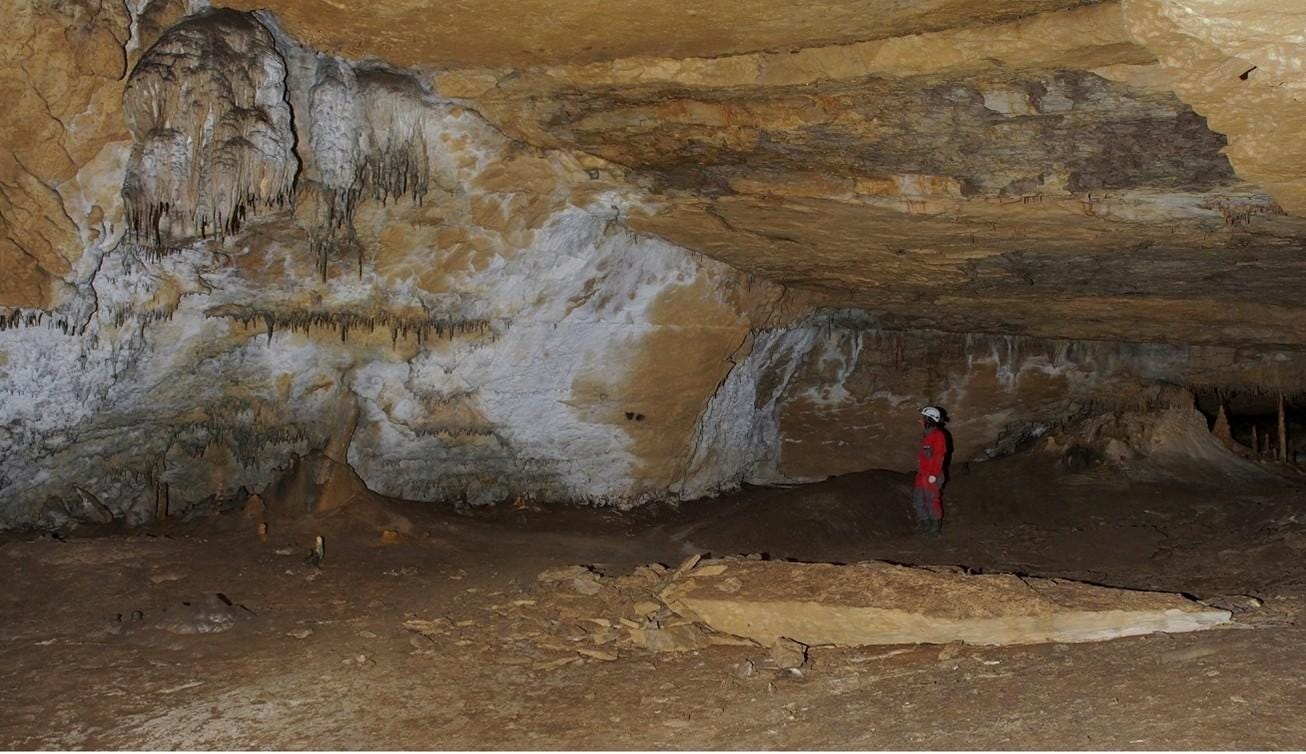
Interior view of the chamber, showing the black geometric figures near the centre of the photograph. Credit: M. Á. Martín
The chamber, known as Sala Keimada, is part of Cueva Palomera, the main cave of the Ojo Guareña system in Burgos. New research published in Journal of Archaeological Science: Reports presents 18 previously unpublished radiocarbon dates from the site. These dates show that people entered and used this hidden space from around 13,500 years ago until more than 2,000 years ago.
Sala Keimada was discovered in 1976 by the Edelweiss Speleological Group. Although it was mentioned in earlier popular publications in 1986 and 2013, it remained largely absent from scientific literature for decades. The reason was practical: the chamber is hard to access and lacked reliable dates. For many years, researchers focused more attention on the nearby Sala de las Pinturas, another decorated area of Cueva Palomera.
The new study changes that picture. Sala Keimada now appears to be another important rock art sanctuary within Ojo Guareña, with evidence of repeated visits across several prehistoric and early historic periods.
The chamber lies about 290 meters from the entrance of Cueva Palomera. Reaching it requires crawling through a very low passage. This access route makes the location especially interesting, because visiting the chamber required planning, effort, lighting, and intention. People entering this space were moving deep into the underground system, away from daylight and ordinary domestic activity.
The main rock art panel in Sala Keimada contains black geometric motifs. These forms closely resemble the triangular figures known from Sala de las Pinturas. The panel has now been dated to around 13,500 years ago, placing it at the end of the Upper Paleolithic.
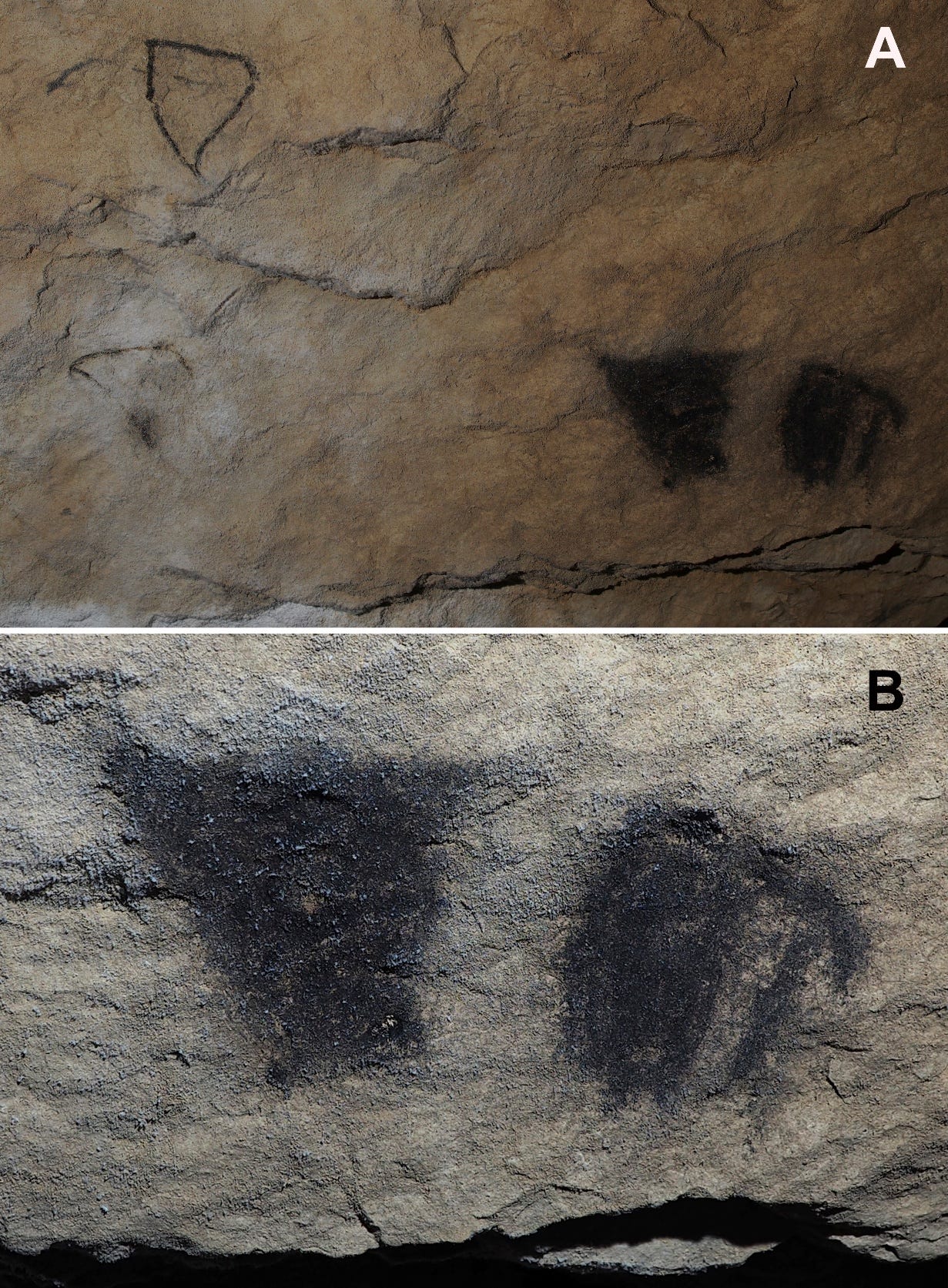
A: General view of the main painted panel in the Keimada Room. B: Close-up of the geometric figures, which together suggest the body of a zoomorphic creature. Photographs by M. Á. Martín.
The chamber also contains many engravings on walls and low ceilings. Most were made by dragging fingertips across the clay film covering the rock surface. Researchers also recorded fine incised engravings and striated marks. This variety shows that people interacted with the chamber’s surfaces in several ways, using fingers, tools, charcoal, and possibly wooden implements.
Some engravings are overlain by charcoal traces left by torches. These charcoal marks provide minimum dates for the images underneath them. This confirms that at least some of the engravings belong to the Upper Paleolithic, while others may date to later periods such as the Neolithic, Chalcolithic, and Bronze Age.
One important example is a zoomorphic head engraving associated with a black outline. This figure has been dated to around 7,500 years ago, during the Early Neolithic. Its presence shows that later communities returned to a decorated Paleolithic chamber and added new marks or images inside the same symbolic space.
The archaeological evidence also includes pits dug with wooden sticks. Some of these pits preserve wood remains dated between the Neolithic and the Bronze Age. The only clearly identified hearth in the chamber dates to the Chalcolithic period.
One of the most unusual discoveries is a built stone structure made from two large limestone slabs placed upright and supported by smaller stones. The main slab measures about 1.5 meters in length. Its upper edge was carefully shaped into a pointed profile that resembles an animal-like form facing the main panel of paintings.
This structure is important because it suggests deliberate construction inside the chamber. The slab and several supporting stones preserve engravings and charcoal marks, showing intensive activity around the feature. Researchers compare it with a Paleolithic slab known from Tito Bustillo Cave in Asturias, although the Sala Keimada example is larger.
The study also documents the remains of a very young domestic pig, about three months old. The bones were found in a small natural calcite pool near the center of the chamber, close to a quadrangular formation that appears to be human-made.
The pig remains date to the period just before Roman control reached the region after the Cantabrian Wars. This places the deposit in the Iron Age, around 2,000 years ago. Researchers suggest that the animal may have been placed there as part of one of the final ritual activities carried out in the chamber. The interpretation is strengthened by the symbolic importance of pigs and wild boar in Iron Age offering practices.
Together, the evidence shows that Sala Keimada was visited in multiple phases. The oldest activity belongs to the late Upper Paleolithic. Later traces belong to the Neolithic, Chalcolithic, Bronze Age, and Iron Age. This long sequence suggests that the chamber remained meaningful to different communities for thousands of years.
The site also raises an important question in rock art studies: how did later people understand older images? In Sala Keimada, later visitors seem to have entered a space already marked by earlier communities. They added new traces, made new interventions, and possibly carried out ritual acts while preserving much of the older visual record.
This pattern fits a wider picture from Ojo Guareña. Previous studies in nearby decorated areas, including Sala de las Pinturas, have also shown repeated human visits across long periods. The new dating of Sala Keimada strengthens the idea that underground decorated spaces could remain active long after their first creation.
The discovery matters because it moves Sala Keimada from a little-known chamber into the scientific record as a major symbolic space. Its art, engravings, stone structure, torch marks, pits, hearth, and animal deposit create a rare archaeological sequence inside a hidden cave chamber.
Rather than a single moment of prehistoric art, Sala Keimada preserves a long history of return. Hunter-gatherers, early farming communities, metal-age groups, and Iron Age people all left traces in the same underground place.
The chamber shows how caves could carry meaning across deep time. For more than 11,000 years, people entered this remote space, marked its surfaces, used fire, built features, and left offerings. Sala Keimada now stands as one of the most important newly studied sanctuaries in the Ojo Guareña cave system.
Sources
CENIEH, Another Palaeolithic sanctuary in Ojo Guareña.
Museo de la Evolución Humana, Otro santuario paleolítico en Ojo Guareña.
Hello ancient content: any chance you can report on the monks? We are getting an incredible knowledge Renaissance from them that's going to change every aspect of everything in our lives. I'm sure people are going to want to know all they can find out about them. Unfortunately I was only 22 at the time and kind of wondering in the wilderness because I'm a hermit. I'm not really the person to do this reporting. Try reading my article titled: the extraordinarily deep roots of this ancient Paradigm of the monks.
This is fascinating and gives us a different insight about our troubled era.