Around 26,000 years ago, during one of the coldest chapters of the Ice Age, a woolly mammoth died in what is now southeastern Germany. Its remains were later sealed in wet sediments near the prehistoric Danube, preserved for tens of thousands of years until modern construction work unexpectedly brought them back into daylight.
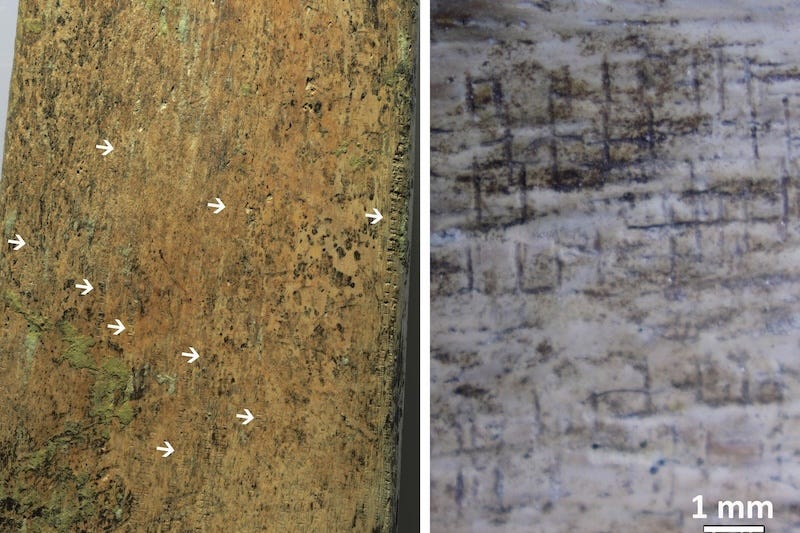
At first, the discovery looked like a rare paleontological find. Then researchers noticed something more unusual: several of the mammoth’s ribs carried cut marks. These marks were not random scratches from sediment, trampling, or animal damage. They were traces of human activity, probably made by stone tools during butchery.
That detail turned the Taimering mammoth into an Ice Age mystery.
The animal was found in 2020 during construction work in the village of Taimering, near Regensburg in Bavaria. Archaeologists recovered a nearly 2.5-meter-long spirally twisted tusk, along with more than 70 bones and bone fragments. Most of the remains came from the ribcage, hands, and feet, while many of the large limb bones were missing.
The wet soil environment helped preserve the tusk and bones in remarkable condition. After recovery, the remains were prepared and studied by researchers from several German institutions, including the Bavarian State Collections of Natural History, the Bavarian State Office for the Preservation of Historical Monuments, Friedrich-Alexander University Erlangen-Nürnberg, the University of Augsburg, LMU Munich, the University of Cologne, and others.
The paleontological study showed that the bones and tusk belonged to one individual. It was a very large woolly mammoth, Mammuthus primigenius, but not yet fully grown. Researchers estimate that it stood around three meters at the shoulder. Its bones were so well preserved that the scientists could rule out long-distance transport by water or heavy disturbance by predators. This suggests the animal died at, or very close to, the place where it was found.
Radiocarbon dating placed the mammoth between about 27,000 and 25,000 years ago. This was the time of the Last Glacial Maximum, when ice sheets and glaciers reshaped much of Europe. The landscape around the Danube Valley would not have looked like modern Bavaria. Pollen analysis indicates a cold, open, tundra-like steppe with herbaceous vegetation and scattered dwarf shrubs.
This environment belonged to the wider “mammoth steppe,” a vast treeless ecosystem that stretched across parts of Eurasia during the peak of the last glacial period. It supported cold-adapted animals such as mammoths, reindeer, horses, and other large herbivores. For the mammoth, this landscape could still provide food. For humans, however, it was becoming increasingly difficult to inhabit.
That is what makes the Taimering mammoth so important.
Between roughly 29,000 and 25,000 years ago, western and central Europe saw a dramatic reduction in human presence. Archaeological evidence suggests that many hunter-gatherer groups withdrew toward southern and eastern refuges as the climate worsened. In Germany and nearby regions, previously established human populations largely disappear from the archaeological record around this time.
Yet the Taimering mammoth shows that someone was still there, at least briefly.
The strongest evidence comes from the ribs. Researchers identified numerous cut marks found only on the rib bones. These marks are consistent with butchery by Paleolithic hunter-gatherers using stone blades. One broad rib may even have served as a kind of cutting surface, where other materials were sliced on top of the bone.
This does not necessarily prove that humans hunted and killed the mammoth. The researchers cannot yet determine whether the animal was actively killed by people or whether humans found it already dead and processed the carcass afterward. Both scenarios remain possible.
What is clear is that humans interacted with the mammoth after death.
The mystery deepens because no tools, campsites, hearths, ornaments, or other cultural objects were discovered near the skeleton. There is no obvious settlement, no visible hunting equipment, and no wider archaeological context that explains who these people were. The mammoth is therefore not only a fossil discovery, but also a rare and isolated trace of human behavior in a region where evidence for human activity is almost absent during this period.
The researchers suggest that these people may have been among the last Late Gravettian hunter-gatherers to enter Bavaria before the harsh conditions of the Last Glacial Maximum caused a major interruption in human activity there. The Gravettian culture, known across parts of Ice Age Europe, is associated with mobile hunter-gatherer groups, sophisticated stone tools, personal ornaments, and in some regions, mammoth exploitation.
One possibility is that the people who processed the Taimering mammoth came from the east, where mammoth hunting and mammoth use were more common than in western Europe. But without tools or other cultural material at the site, this remains a cautious hypothesis rather than a firm conclusion.
The find also raises questions about mobility. Even if humans were not permanently living in this part of Bavaria, small groups may still have crossed the region during short hunting or scavenging trips. The Taimering mammoth may represent one of these brief excursions, a moment when people moved into a cold and sparsely inhabited landscape, processed a massive animal, and then disappeared from the archaeological record.
The missing long bones may also be significant. Large limb bones contain marrow and useful raw material, and they may have been removed by humans. However, researchers must be careful. Bone absence can result from many processes, including preservation conditions, excavation limits, natural disturbance, or later geological activity. The evidence for butchery is strongest on the ribs, where the cut marks are directly visible.
The animal’s burial environment adds another important layer. The mammoth appears to have been deposited in sediments from a pond or a slow-flowing tributary of the prehistoric Danube. Such wet conditions protected the bones and tusk from destruction. This allowed researchers not only to study the skeleton, but also to reconstruct part of the surrounding Ice Age environment through sedimentology and pollen analysis.
The Taimering mammoth is exceptional for two reasons. First, mammoth skeletal remains are rare in this latitude of central Europe, especially compared with areas farther east in Eurasia. Second, the evidence for human activity comes from a time and place where humans are almost invisible archaeologically.
That combination makes the discovery feel like a cold case from prehistory. There is a victim, a scene, and marks left by human hands. But there is no tool, no camp, no name, no group identity, and no clear answer to whether this was a hunt or scavenging event.
What survives is a small but striking scene from life at the edge of the Ice Age world.
In a frozen landscape where human groups were becoming increasingly rare, Paleolithic hunter-gatherers came across this mammoth, or perhaps brought it down themselves. They cut into the carcass, likely taking what mattered most: meat, fat, marrow, hide, or bone. Then they left.
No camp was found nearby. No tools. No hearth. Only the mammoth’s ribs remained, marked by blades and sealed in the ground for around 26,000 years.
That is what makes the Taimering mammoth so important. It shows that even when Bavaria had become almost unlivable, people still passed through this harsh landscape. They were mobile, opportunistic, and skilled enough to survive in places where evidence for human life is nearly absent.
A few cuts on a rib may be a small trace, but in this case, it is enough to place human hands back into one of the coldest moments of Ice Age Europe.


