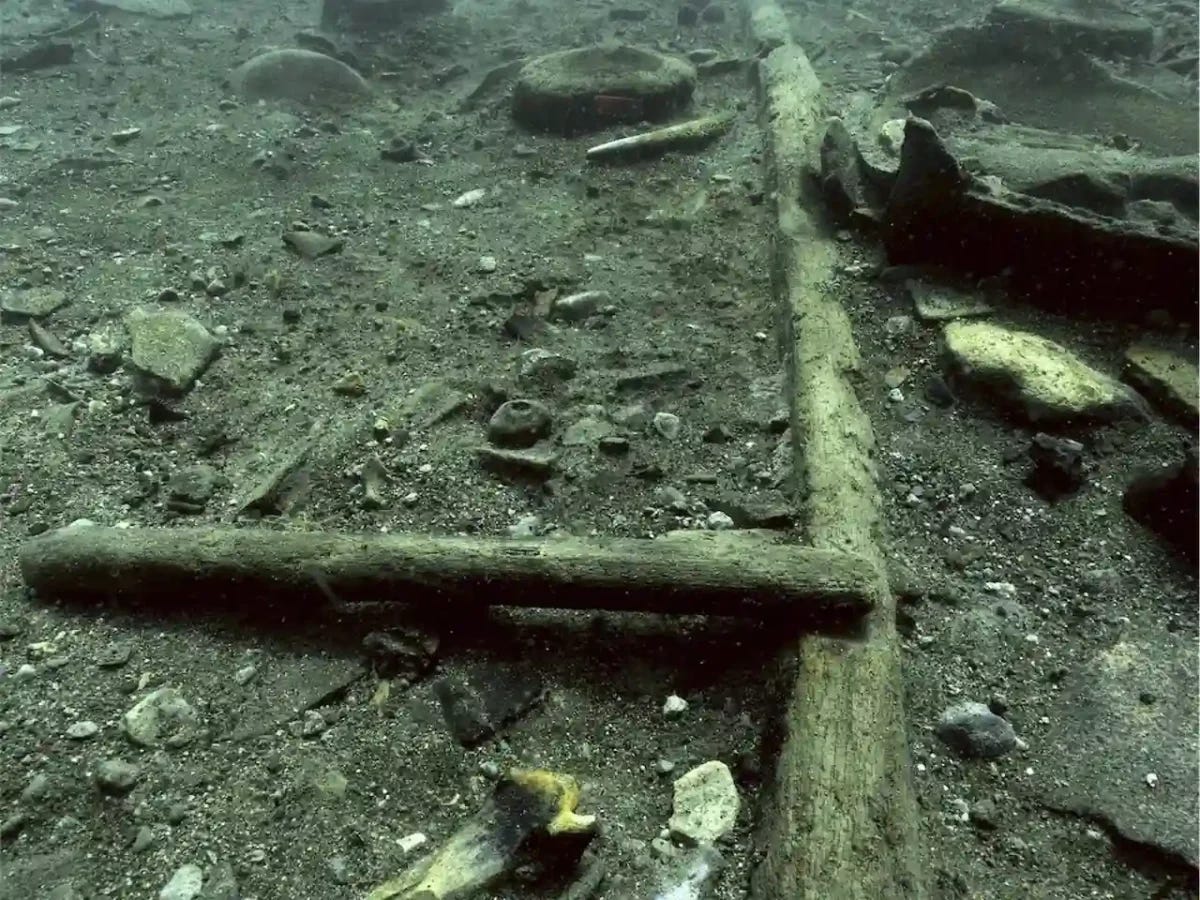
The underwater archaeological site of Gran Carro in Lake Bolsena. Credit: Soprintendenza Archeologia, Belle Arti e Paesaggio per l’Etruria Meridionale
Beneath the waters of Lake Bolsena, in Italy’s Viterbo province, archaeologists have recovered something the submerged Iron Age settlement of Gran Carro had never given up before, an actual fragment of woven fabric. It is the first piece of textile ever documented at the site since systematic underwater exploration began there in the 1960s.
The find came during a week-long excavation campaign led by the Underwater Archaeology Service of the Superintendency of Archaeology, Fine Arts, and Landscape for the metropolitan area of Rome, the province of Viterbo, and Southern Etruria, working with the companies Anfora SRL Archeologia Mare Ambiente and CSR Restauro Beni Culturali. The campaign forms part of a broader three-year public works program dedicated to safeguarding the site.
A diver from Italy's Underwater Archaeology Service at work on the lakebed of Lake Bolsena, at the submerged site of Gran Carro. Photo Soprintendenza Archeologia Belle Arti Paesaggio Etruria Meridionale.
A loom reconstructed from wood, weights, and floor marks
Much of the season’s work centered on piecing together how textiles were actually produced at Gran Carro. By carefully mapping the arrangement of surviving wooden remains and loom weights, together with support marks pressed into the settlement’s ancient clay floor, researchers were able to reconstruct the general form of a vertical, warp-weighted loom with considerably more precision than before. The loom’s presence at the site had already been suspected from earlier finds, wooden spindles still fitted with their whorls, and what researchers believe were weaving combs, both recovered during earlier phases of the project.
It was in an area right next to this reconstructed loom, however, that the campaign’s most significant discovery emerged, among the charred remains of one of the settlement’s burned habitation structures. There, underwater archaeologists recovered the fragment of fabric, an object that had eluded more than sixty years of prior research at the site.
Textile recovered from the Gran Carro archaeological site. Credit: Soprintendenza Archeologia, Belle Arti e Paesaggio per l’Etruria Meridionale
Wood and other finds preserved by the lakebed
The textile discovery adds fresh significance to a broader body of material recovered in earlier campaigns. The anaerobic conditions of the lakebed have preserved an unusually rich array of wooden objects at Gran Carro, including axe handles and door lock mechanisms, organic materials that would have decayed entirely at almost any dry archaeological site but survive here in genuinely exceptional condition.
An official diagram from the Soprintendenza showing the reconstructed Iron Age loom at Gran Carro, alongside the terracotta weights, spindle whorls, and combs used in its operation. Credit Soprintendenza Archeologia Belle Arti Paesaggio Etruria Meridionale.
A settlement with a long and violent history
Gran Carro’s own story stretches back to the Middle Bronze Age, around the fifteenth century BC, though the settlement reached its fullest development during the Early Iron Age, in the late tenth and early ninth centuries BC, generally associated with the early Villanovan culture that would eventually give rise to the Etruscans. Excavation has shown the settlement’s structures were repeatedly burned, collapsed, and rebuilt over time, a pattern of destruction and renewal that has left behind unusually rich stratified deposits for archaeologists to study. The site eventually came to lie underwater as changes in the lake’s water level submerged what had originally been dry land, sealing its remains beneath the lake for roughly three thousand years.
The current excavation project extends well beyond recovering individual artifacts. Plans include the creation of an accessible underwater visitor route and a full three-dimensional virtual reconstruction of the settlement, with the goal of eventually opening the site to the public, an ambition organizers hope to realize as early as 2026. It stands as one of the most ambitious efforts currently underway in Italy for both preventive underwater archaeology and the public presentation of submerged cultural heritage, gradually bringing a landscape frozen since prehistory back into view, one careful meter at a time.
Support Independent Ancient Content. Your support helps me create more archaeology posts, articles, and mini history videos
Source. Soprintendenza Archeologia, Belle Arti e Paesaggio per l’area metropolitana di Roma, la provincia di Viterbo e l’Etruria meridionale.


