Rare Jesus Fresco Found in Türkiye May Rewrite Early Christian Art History
Archaeologists in Türkiye have uncovered a remarkable early Christian fresco that may change how scholars understand the visual world of Christianity before it became the dominant religion

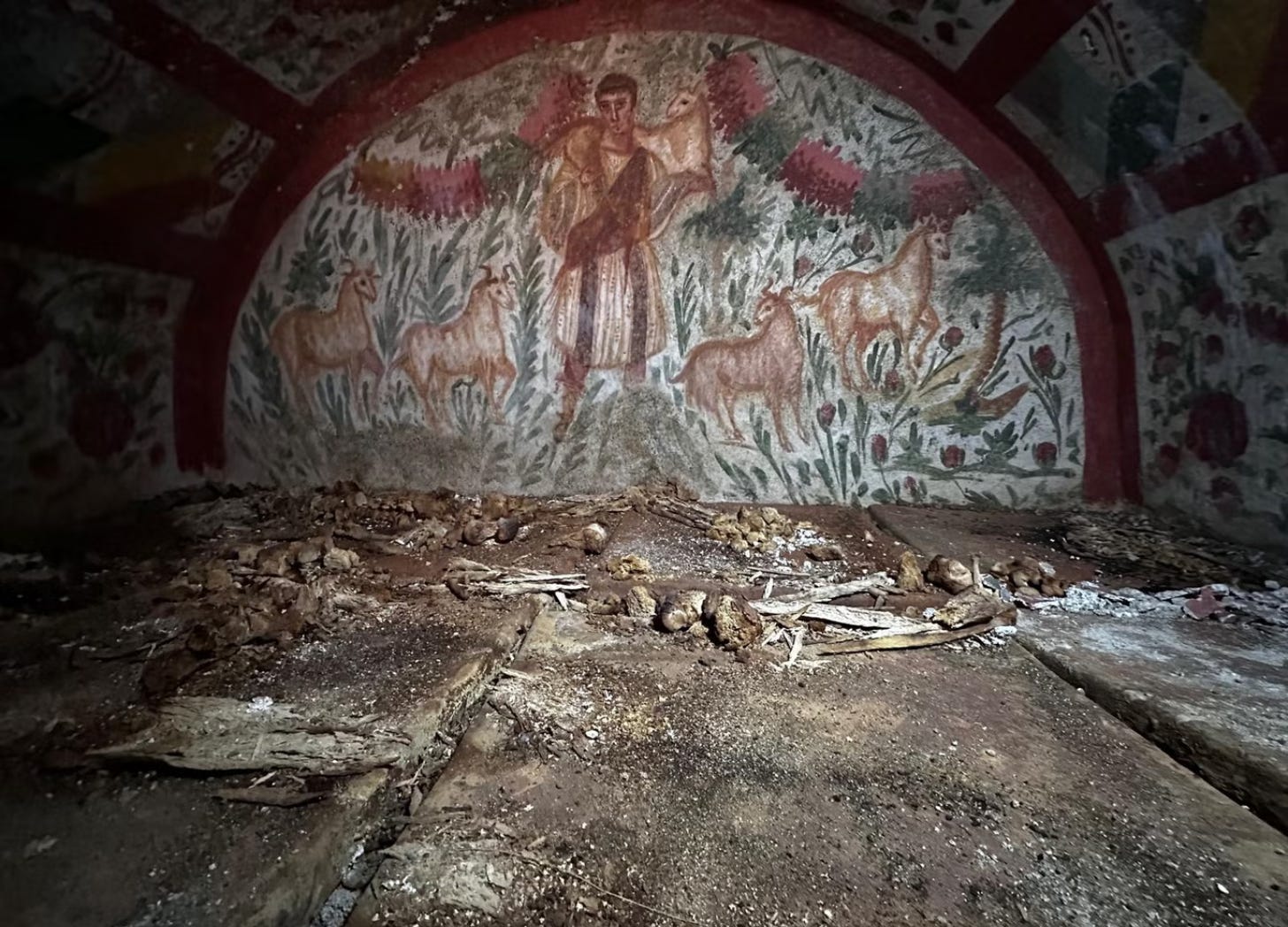
The discovery was made in İznik, ancient Nicaea, a city already central to Christian history because it hosted the First Council of Nicaea in AD 325. That council helped define key Christian doctrine and produced the foundations of the Nicene Creed, still recited by millions of Christians today. Now, the same region has produced another important witness to Christianity’s early centuries: a rare depiction of Jesus as the Good Shepherd inside a Roman-era tomb.
The fresco was found in the Hisardere Necropolis, a burial area near İznik that was used between the 2nd and 5th centuries AD. The newly documented tomb is believed to date to the 3rd century, placing it before the Council of Nicaea and before Christianity became legally protected and politically powerful under Constantine.
What makes the image extraordinary is not only its age, but also its condition. The painting survived inside an underground family tomb, where the sealed environment helped preserve the pigments and details. The figure of Jesus remains visible as a youthful, beardless shepherd carrying a goat or ram across his shoulders. Around him are other animals, arranged in a composition that reflects one of the most meaningful symbols of early Christian art.
This is not the later, familiar image of Christ with long hair, a beard, a halo, and imperial authority. Instead, the fresco shows Jesus in a Roman visual language. He appears young, clean-shaven, and dressed in Roman-style clothing. That detail matters because it reveals how some early Christian communities imagined Jesus before later Byzantine iconography became standardized.
The Good Shepherd motif was especially important in the centuries before the cross became Christianity’s most dominant public symbol. For early believers, the shepherd represented protection, salvation, care, and divine guidance. In a period when Christians could still face suspicion or persecution within the Roman world, such imagery allowed faith to be expressed through symbols that were meaningful but not always aggressively public.
The Hisardere fresco is considered one of the rare known examples of this theme in Anatolia. Researchers have described it as possibly unique in the region because of its Roman-style presentation of Jesus and its unusually strong preservation. This makes the tomb especially valuable for the study of early Christian art outside Italy, where many of the best-known early Christian frescoes come from catacomb contexts.
The tomb itself adds another layer to the story. Its walls and ceiling were not decorated only with Christian imagery. Archaeologists also documented birds, plants, human figures, and banquet-style scenes. Some figures appear to represent elite individuals, possibly the deceased or members of the family, accompanied by attendants. This mixture of imagery suggests a transitional funerary world, where older Roman and late pagan visual traditions existed alongside emerging Christian beliefs.
That blend is important. Early Christianity did not develop in isolation from Roman culture. It grew inside it. The art of the Hisardere tomb shows a community using familiar Roman forms to express new religious meaning. The Good Shepherd was not just a biblical idea placed on a wall. It was a visual bridge between the old symbolic language of the Roman world and the developing identity of Christian communities in Anatolia.
Inside the tomb, archaeologists also identified a raised burial platform known as a kline. This platform, covered with terracotta slabs, was likely where the deceased were placed. The Good Shepherd fresco was preserved on the wall behind this area, making the image part of the funerary experience. In that setting, the message was powerful: the dead were being placed under the care of a divine shepherd.
Human remains were also recovered from the tomb. Specialists reported that five individuals were found, though poor preservation made some details difficult to determine. Among the identifiable remains were two young adults and an infant about six months old. The presence of a family group deepens the emotional and social importance of the site. This was not simply a painted chamber. It was a family burial space, shaped by belief, memory, and hope for the afterlife.
The discovery comes at a time when Türkiye has been producing a growing number of important finds connected to early Christianity. In recent years, archaeologists across Anatolia have documented churches, tombs, inscriptions, and Christian objects that show how deeply the region was involved in the formation of the religion’s early history.

Anatolia was not a peripheral zone in early Christianity. It was one of the movement’s most important landscapes. Cities such as Nicaea, Ephesus, Antioch, Tarsus, Smyrna, Pergamon, and others played major roles in Christian memory, theology, travel, and community formation. The apostle Paul was associated with Tarsus. Ephesus became one of the most important Christian centers of the eastern Mediterranean. The Seven Churches of Revelation were all located in western Anatolia.
İznik’s importance is especially strong because of Nicaea’s role in the 4th century. The First Council of Nicaea was convened by Emperor Constantine in AD 325 and brought together bishops to address major theological disputes, especially over the nature of Christ. The council became one of the defining events in Christian history. But the Hisardere fresco shows that Christian life in the region was already visually and socially developed before that council took place.
This is what makes the fresco so historically useful. It pushes attention away from imperial councils and official doctrine and back toward ordinary communities, burial customs, family memory, and local belief. It shows Christianity not only as a theology debated by bishops, but as a lived faith expressed in paint, tomb architecture, and funerary ritual.
The image also helps challenge simplified assumptions about early Christian art. Many people imagine that Christian visual culture began with crosses, halos, and church mosaics. In reality, the earliest Christian imagery was often symbolic, indirect, and deeply connected to the artistic habits of the Roman world. Fish, anchors, shepherds, vines, birds, and banquet scenes could all carry layers of meaning.
The Good Shepherd fresco from İznik belongs to that world. It captures a moment when Christian identity was still forming its public visual language. The Jesus shown here is not yet the enthroned Pantocrator of later Byzantine domes. He is a young shepherd, placed in a tomb, carrying an animal across his shoulders, promising care beyond death.
The discovery also gained wider attention because of İznik’s renewed global visibility during the 1,700th anniversary of the Council of Nicaea. Pope Leo XIV visited the town as part of that commemoration, and the fresco became a symbol of Anatolia’s deep Christian past. Turkish President Recep Tayyip Erdoğan reportedly presented the pope with a tile image inspired by the Good Shepherd discovery, underlining the cultural and religious significance of the find.
For archaeology, however, the greatest value of the fresco lies in the material evidence itself. It is a rare survival from a fragile period. Paintings from the 3rd century are vulnerable. Tombs can collapse, pigments can decay, and later construction can erase earlier contexts. The survival of this image gives scholars a direct look into the beliefs of a community living in Roman Anatolia before Christianity’s legalization and before the great church councils reshaped the public face of the faith.
The Hisardere tomb does not answer every question. Researchers still need to study the painting, the architecture, the burial context, and the wider necropolis in greater detail. The dating is based mainly on architectural comparison with other tombs in the area, since no directly datable objects were reportedly found inside the chamber. That makes careful future study essential.
Still, the discovery is already important. It shows that early Christian belief in Anatolia was not only textual or theological. It was visual. It was domestic. It was funerary. It belonged to families, graves, pigments, and symbols.
The young Good Shepherd of İznik is therefore more than a beautiful survival. It is a rare window into the moment when Christianity was still finding its face.


