Egyptian archaeologists have announced a significant new discovery at the Panehsy cemetery in Matariya, Ain Shams, revealing a rare funerary cache from the ancient necropolis of Heliopolis.
The discovery was made by an Egyptian archaeological mission working under the Supreme Council of Antiquities. According to Egypt’s Ministry of Tourism and Antiquities, the excavation has revealed what is believed to be the first nearly complete funerary furniture assemblage ever found in this part of the site.
The find adds a new layer to the history of Heliopolis, one of ancient Egypt’s most important religious centers and a major place of worship for the sun god Ra. Known in antiquity as On or Oun, Heliopolis played a central role in Egyptian religious thought, solar theology, and elite burial traditions across several historical periods.
Excavations at the Panehsy tomb first uncovered a mudbrick burial containing human skeletal remains. As archaeologists continued careful work beneath the burial, they identified a concealed cache containing a rare group of personal, ritual, and symbolic objects connected with ancient Egyptian funerary customs.
Among the most notable artifacts is a copper mirror, an object often associated with both daily life and ritual symbolism in ancient Egypt. The cache also contained two alabaster kohl containers that still preserve traces of cosmetic material. These vessels provide a direct link to ancient Egyptian practices of personal adornment, protection, and preparation for the afterlife.
A third kohl container was made from black obsidian, a material rarely found in comparable archaeological contexts. Its presence makes the discovery especially important, as obsidian was prized for its appearance and was often connected with prestige, exchange networks, and high-status use.
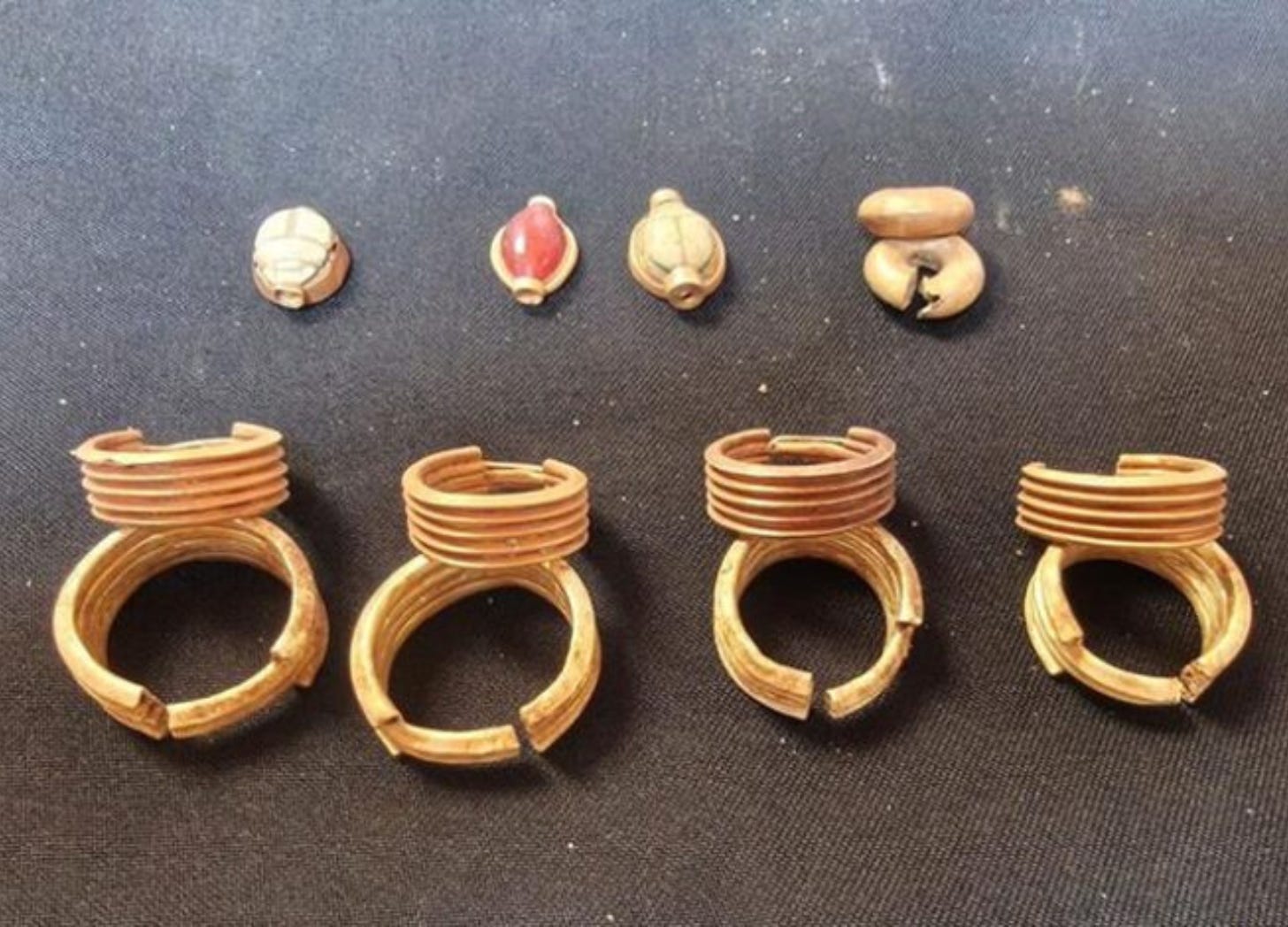
The mission also uncovered two light-blue faience vessels. One of them contained six carefully inscribed scarabs, two of which were set inside yellow metal frames thought to be gold. Scarabs were among the most powerful symbols in ancient Egyptian belief, linked to rebirth, transformation, and the daily renewal of the sun.
Other objects from the cache include faience amulets in symbolic forms, including one shaped like a duck and another representing the Atef crown. The Atef crown was strongly associated with Osiris, the god of the afterlife, making its presence in a funerary setting especially meaningful.
The discovery also included four stones, two of which are believed to be carnelian. One of the stones is pinkish-red and set in a yellow metal frame, likely gold, while another has a greenish-blue color. Such materials may have carried both decorative and protective value, reflecting the ancient Egyptian belief that color, stone, and form could hold sacred meaning.
Archaeologists also recovered five pairs of yellow metal earrings in different sizes. These earrings, believed to be made of gold, measure between roughly 1.5 and 2.5 centimeters in diameter. Their presence suggests that the burial assemblage belonged to individuals of notable status, or at least to people whose funerary preparations included valuable personal ornaments.
Officials said the new cache builds on earlier finds from the same excavation season. Previous work at the site revealed mudbrick and limestone funerary structures, as well as two coffins found in a fragmented and stacked condition. One coffin was made of pottery, while the other was made of plaster with a gilded appearance and red inscriptions.
Inside the gilded-looking coffin, archaeologists found gilded human remains believed to belong to a military figure. A coin recovered from the context may date to the Roman period, suggesting that the site continued to be used, reused, or transformed across different historical eras.
Additional limestone blocks carrying hieroglyphic inscriptions were also discovered at the site. These inscriptions are expected to help researchers better understand the chronological development of the cemetery and the changing cultural identity of the area over time.
The Panehsy cemetery forms part of the larger Heliopolis necropolis, a burial landscape that appears to have served important individuals from the Late Period through the Roman era and into the Christian period. This long sequence makes the site valuable not only for studying ancient Egyptian burial customs, but also for understanding how sacred spaces evolved across centuries.
Egypt’s Minister of Tourism and Antiquities, Sherif Fathy, said the discovery reflects the growing success of Egyptian archaeological missions in re-examining the history of Heliopolis. Rather than treating the area only as a religious center, new excavations are helping researchers reconstruct its social life, burial traditions, and cultural continuity.
The discovery is important because it connects personal objects, funerary symbolism, and sacred geography in one archaeological context. Mirrors, kohl vessels, scarabs, amulets, earrings, stones, coffins, and inscriptions together create a more complete picture of how people in ancient Heliopolis prepared the dead for eternity.
For archaeologists, the find is not only a collection of beautiful artifacts. It is a rare glimpse into the beliefs, identities, and social structures of a community that lived beside one of Egypt’s most sacred cities.
As excavation continues at Matariya, the Panehsy cemetery may offer further evidence of how ancient Egyptians combined daily life, personal beauty, ritual protection, and solar religion in their vision of the afterlife.


