


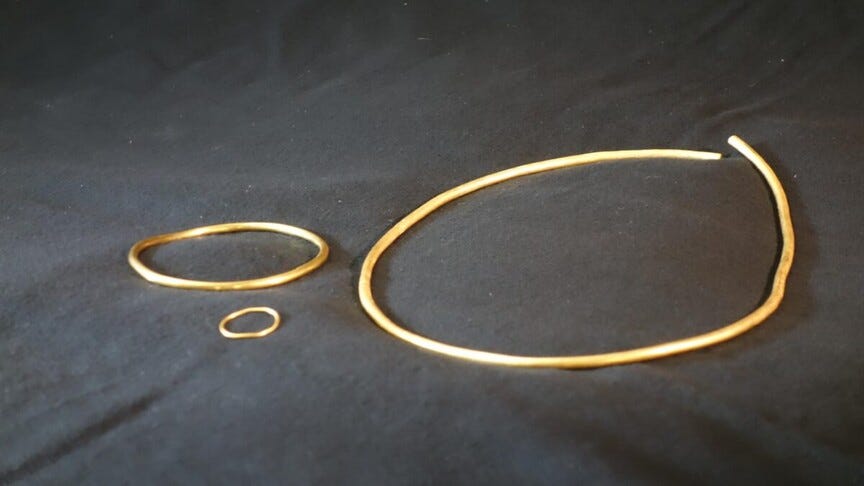
Photos: credit: arkeonews.net / AA
The grave was found during archaeological investigations carried out before the construction of a solar park near the town, in the Limburg-Weilburg district. The find has been presented by hessenARCHÄOLOGIE, part of the State Office for Monument Preservation of Hesse, together with the Hessian Ministry of Science and Research, Art and Culture.
According to Hesse’s state archaeologist Prof. Dr. Udo Recker, the discovery is important because it provides material evidence for the presence of a local Celtic elite in the region. Until now, such an elite presence in this area had only been assumed. The new tomb offers direct archaeological proof that a high-ranking individual lived, died, and was buried with exceptional status in the Taunus region during the Iron Age.
The burial is thought to date to the middle of the first millennium BC, placing it more than 2,000 years in the past. It belongs to the early La Tène period and is associated with the Hunsrück-Eifel culture. This was a time when Celtic communities in Central Europe were developing complex social structures, elite burial traditions, and long-distance connections with the Mediterranean world.
The grave goods found at Bad Camberg point clearly to a person of high rank. Archaeologists recovered massive gold jewelry, imported goods, and weapon remains. Among the most striking objects is an Etruscan beaked jug, likely brought from present-day Tuscany in Italy. Such an imported vessel suggests that the buried individual, or the community around him, had access to long-distance exchange networks reaching far beyond the local region.
The presence of weapon remains also helped archaeologists interpret the burial as likely belonging to a male individual. The grave has therefore been described as the resting place of a Celtic warrior or elite figure. However, further analysis is still needed before researchers can reconstruct the person’s identity, life, and role in the community with greater precision.
One of the most important elements of the discovery is the evidence for a two-wheeled wagon. Archaeologists found wheel hub fittings, axle cap fittings made from non-ferrous metal, and iron tire fittings. These remains show that the deceased was buried with a vehicle, making the tomb a rare example of a Celtic wagon burial.
Wagon burials are closely linked with high status in Iron Age Europe. They were not ordinary graves. They required wealth, labor, technical skill, and social authority. Placing a wagon in a tomb was a strong statement about rank, mobility, power, and identity. In the case of Bad Camberg, the wagon evidence makes the find even more significant.
Only a small number of comparable Celtic wagon burials are known from Hesse. Experts have stated that just a few similar examples exist in the region, and none reaches the quality of the Bad Camberg find. This makes the tomb one of the most important Celtic elite burials discovered in Hesse so far.
The discovery has also drawn comparisons with the famous Celtic prince of Glauberg, another major Iron Age elite burial from Hesse. The Bad Camberg grave appears to belong to roughly the same broad period. Although the grave goods from Bad Camberg are described as simpler than those from Glauberg, the new find still holds major importance for understanding Celtic power structures in the region.
Christoph Degen, State Secretary in the Hessian Ministry of Science and Research, Art and Culture, said the discovery adds to Hesse’s rich Iron Age heritage. Sites such as Glauberg had already shown the important role of today’s Hesse within the Celtic cultural world. The Bad Camberg tomb may now expand that picture by offering new evidence about elites, craftsmanship, long-distance contacts, and burial customs.
The excavation itself was carried out quickly and carefully. Despite the importance of the find, the archaeological work was completed in about two weeks by a team from SPAU GmbH. The work was done without stopping the planned construction project, showing how preventive archaeology can protect major heritage discoveries during modern development.
The grave had already raised interest before excavation. Geophysical prospection of the planned construction area had suggested the possible presence of a Celtic elite burial. However, archaeologists did not expect to find not only a princely tomb but also a wagon burial.
Dr. Kai Mückenberger, district archaeologist for Limburg-Weilburg, described the discovery as an exceptional moment. For archaeologists, a find of this quality is rare. It combines elite jewelry, weapon remains, imported Mediterranean material, and wagon evidence in one context.
The tomb has not yet revealed all its information. After the grave was discovered, parts of it were recovered in blocks of earth and taken for detailed laboratory investigation. X-ray and CT scans have already shown that more objects remain inside the blocks. These finds still need to be carefully exposed, interpreted, and conserved.
The use of modern imaging is especially important. Instead of removing every object immediately in the field, archaeologists can now scan the soil blocks and study the position of hidden artifacts before excavation continues under controlled conditions. This reduces the risk of damaging fragile materials and allows researchers to understand how the objects were originally placed.
The ongoing research involves the restoration workshop of hessenARCHÄOLOGIE, the research center of the Celtic World at Glauberg, and the Leibniz Centre for Archaeology in Mainz. The cooperation with LEIZA allows specialists to use advanced CT technology and conservation methods to study the burial in detail.
The grave goods already visible suggest a burial designed to communicate status. Gold jewelry signaled wealth and rank. The Etruscan jug pointed to contact with the Mediterranean world. Weapons marked the individual as a warrior or elite male. The wagon connected him with one of the most prestigious burial traditions of Iron Age Europe.
Such finds are important because Celtic societies did not leave written records in the same way as later Roman communities. Much of what is known about their social organization comes from settlements, graves, objects, and later written accounts by Greek and Roman authors. Elite tombs therefore play a major role in reconstructing Celtic society.
The Bad Camberg tomb may help researchers understand how power was organized in the Taunus region during the Iron Age. It shows that local elites were not isolated. They took part in broader cultural and exchange networks. Their burial practices also shared features with other high-status Celtic graves in Central Europe.
At the same time, the find raises new questions. Was the person buried at Bad Camberg a local ruler, a warrior aristocrat, a member of a powerful family, or a figure connected with wider trade routes? How did this elite group relate to nearby communities? What role did imported objects play in local status display? Future analysis may help answer these questions.
For now, the discovery is one of the strongest pieces of evidence for a Celtic elite presence in this part of Hesse. It also shows that major archaeological finds can still emerge from areas investigated because of modern infrastructure and energy projects.
Sources:
Anadolu Agency, Princely Celtic tomb dating back over 2,000 years discovered in Germany, 10 June 2026.
hessenARCHÄOLOGIE / State Office for Monument Preservation of Hesse, Der Keltenfürst des Taunus, 8 June 2026.
Hessian Ministry of Science and Research, Art and Culture, hessenARCHÄOLOGIE präsentiert unbekanntes eisenzeitliches Fürstengrab, 8 June 2026.
Euronews, Archaeological sensation: Iron Age Celtic grave discovered in Hesse, 9 June 2026.