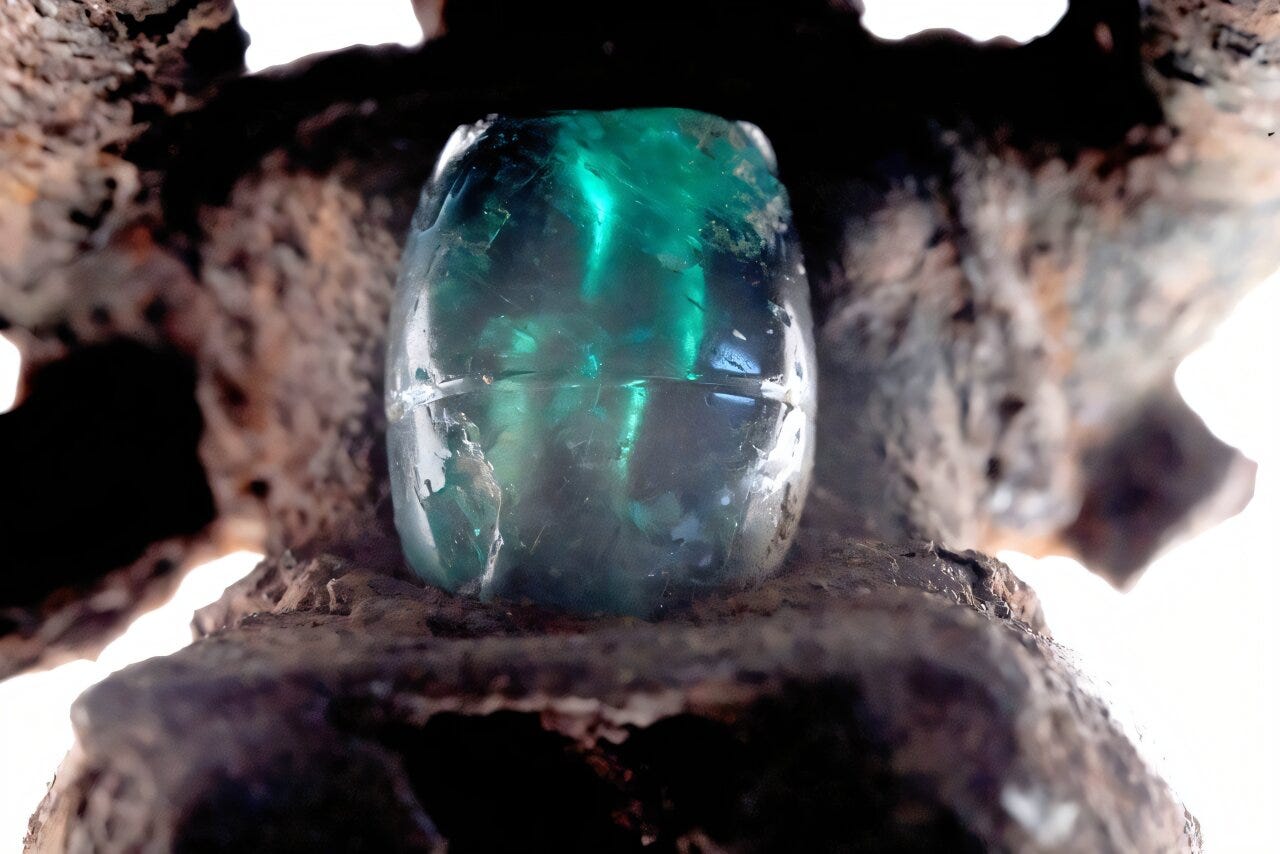
Emerald found in Tomb T4 at El Caño, placed in the belly of a female copper figure (AD 800–1000). Credit: C. Mayo Torn
More than a thousand years ago, powerful leaders on Panama’s Pacific coast were laid to rest with some of the most prestigious objects of their world: gold ornaments, pyrite mirrors, fossilized megalodon teeth, finely worked pendants, and small translucent green stones whose identity had long remained uncertain.
Now, scientific analysis has confirmed what archaeologists had suspected for decades. Five of those green stones, recovered from elite burials at El Caño and Sitio Conte in Panama’s Gran Coclé region, are emeralds. Even more remarkably, their chemical signatures point not to a local source, but to Colombia, more than 700 kilometers away.
The discovery offers rare material evidence for long-distance exchange between Central and South American societies before European contact. It also shows that elite communities in ancient Panama were connected to a much wider world than their tombs alone could reveal.
The research focused on stones from two major archaeological sites on Panama’s Pacific side: El Caño and Sitio Conte. Both are associated with the Gran Coclé cultural region and are known for richly furnished burials dating mainly between the eighth and tenth centuries AD. These were not ordinary graves. They belonged to high-status individuals whose tombs contained elaborate objects connected with power, ritual, ancestry, and social rank.
For years, the small green stones found in these burials were described as emerald-like. Their color and appearance suggested emeralds, but until now, no detailed scientific study had confirmed their mineral identity or origin. To answer that question, researchers used several non-destructive methods, including portable X-ray fluorescence, infrared spectroscopy, photoluminescence, UV-Vis-NIR spectroscopy, and optical microscopy.
The results showed that the stones were indeed emeralds. Their geochemical profile was consistent with Colombian sources, especially the emerald-producing regions known as the Western Emerald Belt and the Eastern Emerald Belt. These areas include famous mining zones such as Muzo and Chivor, which have long been associated with some of the world’s finest emeralds.
This makes the Panamanian examples especially important. They represent the northernmost confirmed occurrence of emeralds in the precolonial Americas. Their presence in elite Coclé burials suggests that these gemstones were not merely decorative objects. They were rare, valued, and powerful enough to be placed among the dead as prestige goods.
The emeralds were likely not moved through a simple direct trade between Colombian mining communities and Panamanian chiefs. Instead, researchers suggest they probably passed through a down-the-line exchange system. In such a network, objects move gradually from one community to another, often along riverine and coastal routes, before reaching their final destination.
This kind of exchange would have linked many different groups across the Isthmo-Colombian region. The emeralds may have traveled through a chain of communities connected by rivers, seaways, ritual relationships, political alliances, and prestige exchange. By the time they reached Coclé society, they had already crossed a cultural landscape that joined South America and Central America long before the arrival of Europeans.
The stones also reveal something about local craftsmanship. Some emeralds appear to have arrived in Panama already finished or partly worked. Others seem to have been modified by local artisans after reaching the Coclé region. Evidence of cutting, drilling, damage, repair, and reworking suggests that these objects continued to have value even when the fragile crystals cracked or were imperfectly shaped.
That detail is significant. Emeralds are difficult to drill, especially with ancient tools. Failed drilling could easily damage the stone. Yet the damaged examples were not discarded. They were repaired, reused, and eventually buried with elites. This strongly suggests that the value of the emeralds went beyond beauty. Their rarity, color, origin, and association with distant lands may have given them symbolic force.
In ancient Coclé society, imported prestige goods may have played a role in displaying power and maintaining political relationships. Exotic materials could signal access to distant networks, alliances beyond the local community, and the authority of chiefs who controlled or participated in exchange. In this sense, an emerald was not just a gemstone. It was a visible sign of connection, status, and influence.
The emeralds also fit into a broader pattern of elite burial wealth in central Panama. Tombs at El Caño and Sitio Conte have yielded goldwork, ornaments, ceramics, mirrors, pendants, and other objects that point to complex social organization. These burials show that Coclé elites invested heavily in funerary display, using rare materials to express identity, lineage, and sacred power.
Researchers also note that emeralds and some other imported luxury items seem to disappear from the central Panamanian archaeological record after around AD 1000. This change may be linked to broader transformations in funerary customs, political centers, and regional exchange systems. However, the exact cause remains uncertain and requires further study.
The next step for researchers is to investigate the possible routes by which these emeralds moved from Colombia to Panama. Future work may combine archaeological evidence with spatial modeling to reconstruct the ancient pathways that linked mining zones, rivers, coasts, and chiefdoms.
For now, the five emeralds from El Caño and Sitio Conte open a vivid window into a lost world of movement and exchange. They show that ancient Panama was not isolated. Its elites were connected to distant landscapes, rare materials, and interregional networks that stretched across hundreds of kilometers.
In the end, these small green stones tell a much larger story. Buried in tombs more than a thousand years ago, they preserve evidence of trade, craftsmanship, power, and belief in the pre-Columbian Americas. Their journey from Colombian emerald belts to Panamanian burial chambers reminds us that ancient societies were often more connected, more mobile, and more sophisticated than modern assumptions allow.
Source: phys.org


