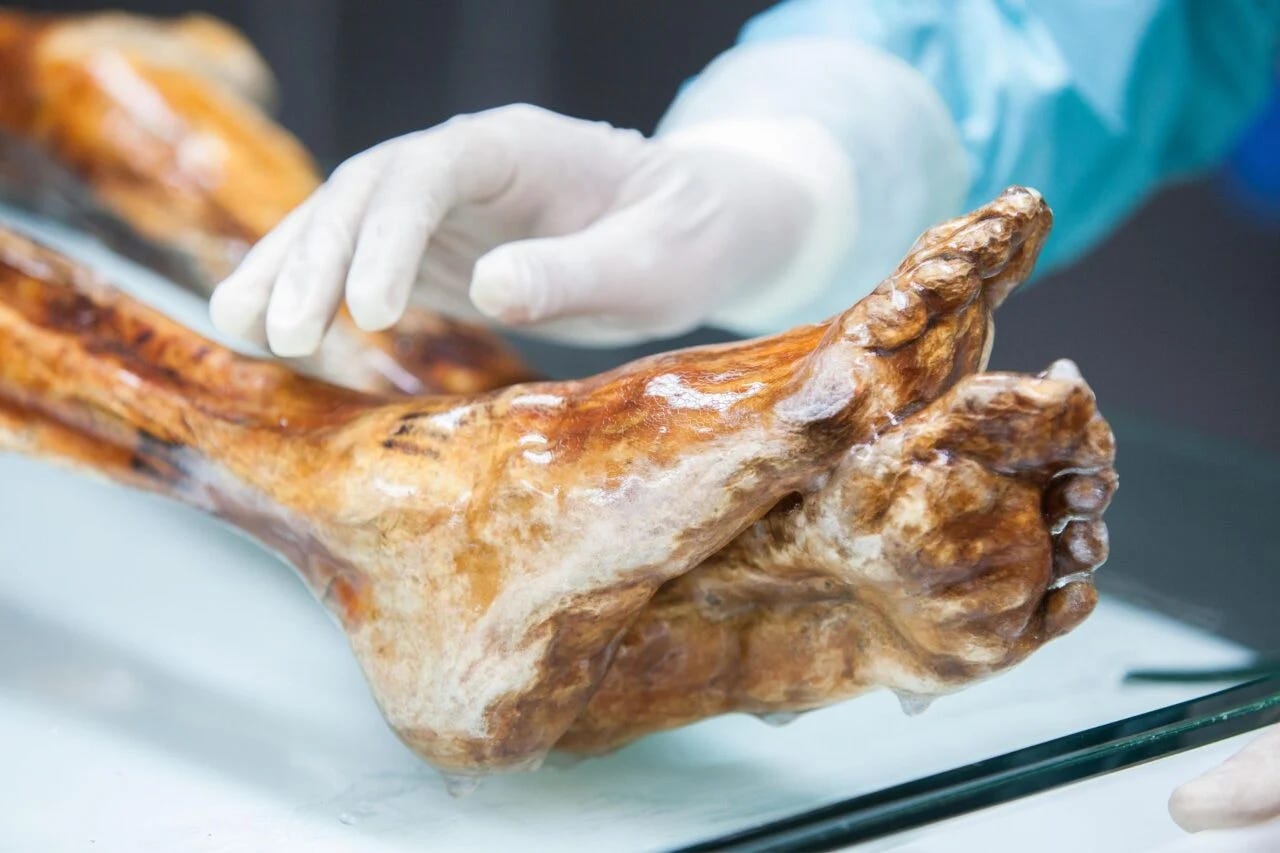
Otzi The Iceman. Credit: South Tyrol Museum of Archaeology/Eurac Research/Marion Lafogler
More than 5,300 years after his death in the Alps, Ötzi the Iceman is still teaching scientists something new. This time, the discovery is not about his weapons, his tattoos, his final meal, or the violent arrow wound that likely ended his life. It is about the microscopic world that still survives on and inside his ancient body.
A new study published in the journal Microbiome reveals that Ötzi is not simply a frozen relic from the Copper Age. Instead, researchers describe him as a complex biological ecosystem, one where ancient gut bacteria, glacier-adapted organisms, and modern microbes introduced after discovery all exist together.
Ötzi was found in 1991 in the Ötztal Alps, near the modern border between Italy and Austria. His body had been naturally preserved by ice for thousands of years, making him one of the most important archaeological finds ever recovered from a glacier. Since then, scientists have studied nearly every aspect of his life, from his diet and equipment to his ancestry, health, and cause of death.
But his microbiome, the community of bacteria, fungi, and other microorganisms associated with his body, has remained a more difficult puzzle. Ancient bodies are easily contaminated after discovery, especially when they are handled, moved, treated, stored, and displayed for decades. The challenge for researchers was to separate what truly belonged to Ötzi’s ancient biological world from what arrived later.
To solve this, scientists from Eurac Research and their collaborators carried out one of the most detailed microbial studies ever performed on the Iceman. They analyzed samples taken from the mummy, his preservation environment, previous tissue samples, meltwater from inside the body, surface ice, museum-related water, and even soil collected from the original discovery site in 1991.
The results showed that Ötzi carries three different microbial stories at once.
The first belongs to his life. Inside his intestinal tract and stomach contents, researchers identified genetic material from ancient gut bacteria. Some of these microbes are now rare in people living modern industrialized lifestyles, but they resemble bacteria still found among non-industrialized human populations. This makes Ötzi’s gut a rare biological snapshot of the human microbiome before processed foods, antibiotics, modern sanitation, and industrial living reshaped it.
The second story began after death. Once Ötzi’s body became trapped in the alpine environment, cold-adapted bacteria and yeasts from the glacier likely colonized parts of the mummy. These organisms were not part of his living gut microbiome, but they may have accompanied his body through thousands of years of frozen preservation.
The most surprising part of the study concerns cold-loving yeasts. Researchers isolated several specialized yeast species from skin samples, internal body water, and stomach material. Genetic analysis connected these yeasts to organisms known from extremely cold places, including polar and alpine environments. Their presence suggests that they may have come from the glacier and remained associated with the body across millennia.
Even more striking, some of these yeasts may still be biologically active under the mummy’s current preservation conditions. Ötzi is kept at the South Tyrol Museum of Archaeology in Bolzano, Italy, in a chamber maintained at about minus 6 degrees Celsius with very high humidity. These conditions are designed to mimic the glacier and slow decomposition, but they may not fully stop all microbial life.
The study found that some yeast DNA from more recent samples appeared better preserved and less damaged than expected for ancient material. One yeast group, Glaciozyma, became especially dominant in samples compared across time, suggesting that it may have continued to grow slowly under cold-storage conditions. This does not mean Ötzi himself is alive. It means that certain microorganisms living on or inside the mummy may still be capable of survival, dormancy, or slow activity.
The third microbial story is modern. Since Ötzi was recovered in 1991, his body has been preserved, monitored, and kept humid through museum conservation procedures. The new study suggests that these necessary preservation efforts may also have introduced modern microbes to the mummy’s external surfaces. In particular, the spray water used to regulate humidity appears to have left a strong microbial signature on the skin.
This matters because conservation is not just about keeping the mummy cold. It is also about understanding which microbes are present, whether they are active, and whether they could damage tissue over time. Some of the microorganisms identified in the study carry genes linked to the breakdown of proteins, fats, and even collagen, one of the key structural components of skin and connective tissue.
The researchers also found that certain microbes possess genetic pathways for breaking down phenol, a chemical used in earlier conservation efforts after Ötzi’s discovery to prevent fungal growth. Ironically, such treatments may have created conditions that favored microbes capable of tolerating or metabolizing those substances.
For archaeology, the study is valuable because it opens a window into the ancient human microbiome. Ötzi’s internal gut bacteria preserve traces of a world before industrialization changed the microbial communities inside the human body. These bacteria may help researchers better understand what has been lost from many modern Western microbiomes.
For conservation science, the message is more urgent. Ötzi cannot be treated as a motionless artifact sealed outside biology. His body remains a delicate environment where ancient and modern microorganisms interact with temperature, humidity, oxygen, preservation treatments, and the tissues of the mummy itself.
The discovery also has possible future applications beyond archaeology. Cold-adapted yeasts that can function at very low temperatures may one day be useful in food production or industrial processes, including low-temperature fermentation. Researchers have already begun exploring whether such organisms could help in processes like bread-making or brewing, though this remains at an experimental stage.
Ultimately, the study changes how we should imagine Ötzi. He is not only a man from the Copper Age, preserved by an extraordinary accident of nature. He is also a living archive of microbial history, carrying traces of his own body, the glacier that held him, and the modern museum world that now protects him.
After more than five millennia, Ötzi is still not finished speaking. This time, his story is being told by the smallest life forms that survived with him.


