


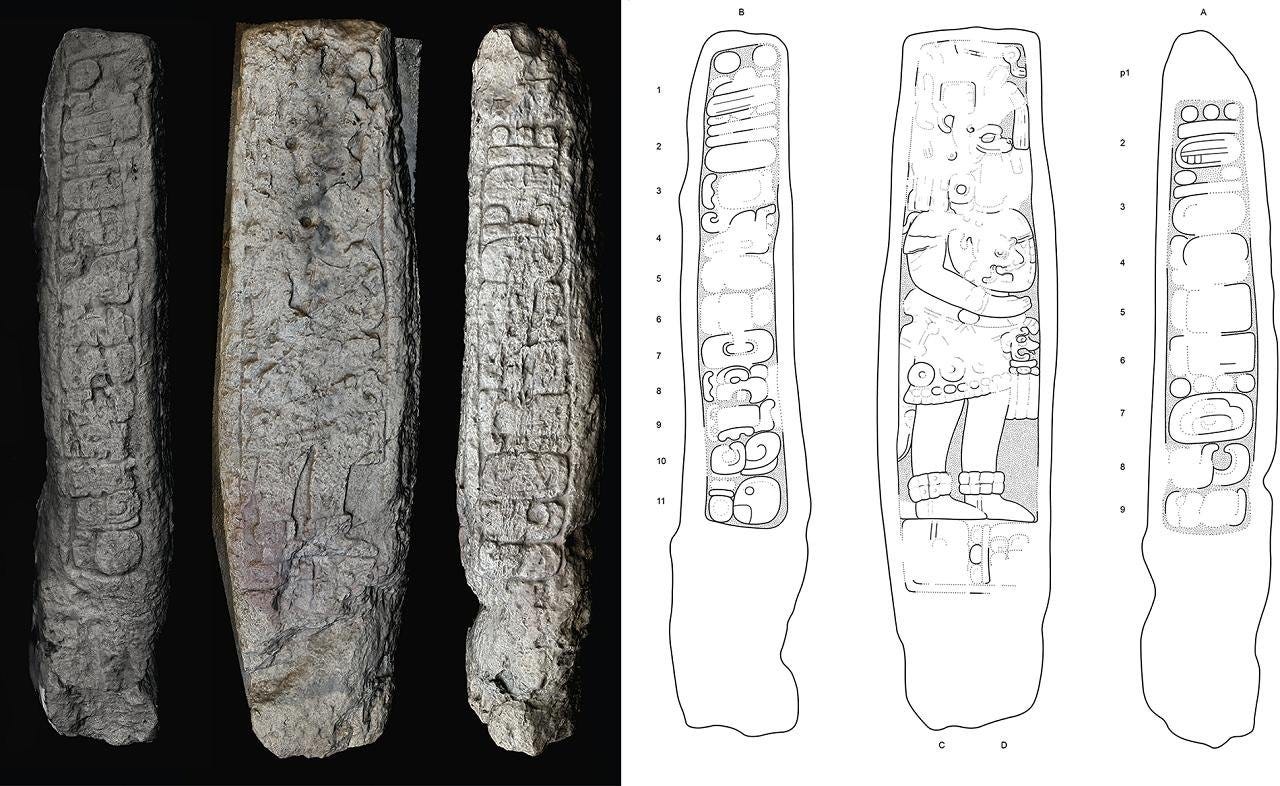
Stela 46, showing the left side, front face, and right side. 3D model by Kenichiro Tsukamoto, epigraphic drawing by Octavio Q. Esparza Olguín and Kenichiro Tsukamoto, and iconographic drawing by Daniel Salazar Lama. © PAEP / Tsukamoto et al., Ancient Mesoamerica (2026). Licensed under CC BY-NC 4.0.
The date was found on Stela 46, one of three El Palmar monuments studied by a research team led by Kenichiro Tsukamoto. Using high-resolution 3D scanning, photogrammetry, epigraphic analysis, iconographic study, and archaeological excavation, the team identified a likely Long Count date of 8.7.1.0.0, corresponding to August 31, AD 180.
This is significant because the earliest previously secure Long Count inscription in the central Maya Lowlands was on Tikal Stela 29, dated to AD 292. If the reading of Stela 46 is correct, the El Palmar inscription pushes the lowland Maya record of the Long Count back by 112 years.
The Long Count was a continuous dating system used by the Maya to place events within a linear historical framework. During the Classic period, from about AD 250 to 900, Maya rulers used it to record royal births, accessions, deaths, marriages, victories, and important rituals. It allowed rulers to connect their personal histories to sacred time, political order, and dynastic legitimacy.
The new study is important because it shows that this political use of time may have begun earlier than previously proven in the Maya Lowlands. Stela 46 does not simply contain a date. It appears to connect that date with royal events, including succession and ritual action. That makes it more than a calendar record. It is evidence for how early Maya kings used time as part of public authority.
El Palmar is located in southeastern Campeche, Mexico, in the central karstic upland. This region includes important Maya sites such as Calakmul, Becan, Yaxnohcah, Nakbe, and El Mirador. The site of El Palmar includes a Main Group, several outlying architectural groups, plazas, temples, reservoirs, altars, and carved stone monuments.
Earlier research at El Palmar had documented many carved monuments, but most known inscriptions belonged to the Late Classic period. The new study focuses on earlier monuments: Stelae 20, 45, and 46. These monuments preserve evidence for a much deeper dynastic history at the site.
The problem was preservation. The stelae were carved from limestone, a soft material that becomes worn and difficult to read after long exposure to weather. Many glyphs and images had become faint, damaged, or nearly invisible. Traditional photography and visual inspection were not enough to resolve many of the details.
To overcome this, the team used several digital methods. Earlier photographs taken with a Nikon D70 were combined with later high-resolution photography from a Sony Alpha 7R. The researchers also used photogrammetry to build 3D models from hundreds of images. For Stela 46, they used an Artec Spider II high-resolution scanner, which recorded surface details at about 0.1 millimeter resolution.
These methods allowed the team to digitally relight the carved surfaces from different angles. Marks that were almost invisible on the stone became clearer in the 3D models. This was especially important for reading damaged numbers and glyphs on Stela 46.
Stela 46 produced the most important result. The researchers identified an incomplete but highly significant Long Count sequence: 8.7.?.?.0 with the 260-day calendar date 4 Ajaw. After testing possible combinations, they concluded that the most likely reading is 8.7.1.0.0 4 Ajaw 8 Sotz, equivalent to August 31, AD 180.
The authors remain cautious. They note that another possible reading, 8.7.0.5.0, corresponding to December 15, AD 179, cannot be completely excluded. However, the 3D models make the AD 180 reading more probable. This careful approach is important because the inscription is damaged, and some details remain provisional.
Even with that caution, the discovery is major. The inscription predates the famous early Long Count on Tikal Stela 29 by more than a century. It also belongs to a monument that appears to record historical royal events, not only a calendar formula.
The iconography of Stela 46 adds another layer of evidence. The monument shows a ruler, identified in the study as Ajaw K’al Ubaah, holding the head of a deity. The deity is probably the Jaguar God of the Underworld, a figure associated with the night and the feline aspect of the sun. Such imagery was part of royal regalia and ritual performance.
The text on Stela 46 also suggests that El Palmar kingship may have already been established by AD 131, if not earlier. The monument appears to connect Ajaw K’al Ubaah with royal titles and events that helped define the early political identity of the kingdom.
This places El Palmar’s early kingship in the Terminal Preclassic period, roughly 75 BC to AD 250. This was a period of major change in the Maya Lowlands. Some large Preclassic centers declined, while new forms of kingship and political authority emerged in other places. The El Palmar evidence suggests that the central karstic upland was one of the regions where these transformations were taking place.
Stela 45 provides evidence from the fourth century AD. The researchers read its date as likely October 12, AD 342, although this remains tentative because the monument is mounted in a museum in a way that limits direct examination. The stela shows a king named Tz’u Chak Ahk holding a ceremonial bar from which two deities emerge. This continues the theme of royal authority expressed through divine imagery.
Stela 20 adds further evidence for El Palmar’s long dynastic history. It was found in Plaza E, paired with Altar 4. Earlier, the monument had seemed almost completely eroded. During later fieldwork, researchers turned it over and identified inscriptions and iconographic imagery on the back face.
The text on Stela 20 suggests that its protagonist was the seventeenth ruler in succession. This is a striking detail. If the average length of Maya reigns is used as a rough guide, the dynastic sequence may reach back to the early second century AD, aligning with the accession date of Ajaw K’al Ubaah recorded on Stela 46.
This means El Palmar may preserve one of the longest dynastic histories known from the Maya world. The kingdom appears to have continued until around AD 884, when the latest known monument, Stela 41, was erected at the K’awiil Plaza. However, the researchers also note that a possible break in the sequence may have occurred in the later history of the kingdom.
The connection between Stelae 46, 45, and 20 is not only chronological. Their imagery shows continuity in royal symbols over several centuries. Stela 46 shows Ajaw K’al Ubaah holding the head of the Jaguar God of the Underworld. Stela 45 shows Tz’u Chak Ahk carrying a ceremonial bar with emerging deities. Stela 20 also includes a double-headed ceremonial bar with serpent heads, from which divine figures appear.
This continuity suggests that El Palmar rulers maintained a recognizable set of royal symbols for more than 500 years. The imagery was not random decoration. It was part of a political and religious language that connected kingship, ritual performance, lineage, and cosmic order.
The study also highlights the importance of public monuments in early Maya political life. Stelae were placed in plazas and other public settings where ceremonies could be seen by gathered audiences. These monuments recorded dates, titles, rituals, and royal imagery. They made political authority visible and tied rulers to sacred calendars.
In this context, the Long Count was not just a technical calendar system. It was a tool of power. By linking accessions, rituals, and royal identities to a precise chronological framework, Maya rulers could present their authority as part of a larger sacred order.
The El Palmar evidence suggests that this strategy was already developing before the Classic period fully began. Instead of appearing suddenly in the Classic period, the political use of the Long Count seems to have deeper roots in the Terminal Preclassic transformation of Maya kingship.
The discovery also changes how scholars view the central Maya Lowlands. The rise of kingship was not limited to one major center. Carved monuments with early dates appear in several communities across the central karstic upland. El Palmar now stands out because its monuments combine early calendrical evidence with royal events and dynastic history.
The researchers argue that the emergence of kingship in this region was a broader regional phenomenon. El Palmar was one part of a larger political landscape in which rulers experimented with monuments, calendars, public rituals, and divine imagery to establish their authority.
The study also demonstrates the value of new imaging methods in archaeology. Stela 46 had been known before, but its damaged surface made it difficult to interpret. High-resolution 3D modeling made it possible to revisit the monument and recover details that earlier documentation could not fully capture.
This does not mean the interpretation is final. The authors state that some readings remain provisional. Future imaging technology, new finds, or improved comparative data may clarify parts of the inscriptions that are still uncertain. But even with these cautions, the evidence from Stela 46 is strong enough to make it one of the most important early Long Count inscriptions in the Maya Lowlands.
The discovery is also a reminder that many major historical details may still be hidden on already known monuments. Some inscriptions are not lost because they were never found, but because they are too damaged to read with older methods. Digital scanning can reopen these objects to study.
For Maya archaeology, the El Palmar research adds an important chapter to the history of time, kingship, and political authority. It shows that rulers were already using the Long Count, the 260-day divinatory calendar, and public ritual to build dynastic legitimacy in the second century AD.
Nearly 1,850 years after Stela 46 was carved, its worn surface still preserves a moment when Maya rulers were learning to turn time itself into political power.
Sources:
Archaeology News Online Magazine, Oldest known Long Count inscription from the Maya lowlands found at El Palmar, 11 June 2026.
Tsukamoto, Kenichiro, Octavio Q. Esparza Olguín, Daniel Salazar Lama, Luz Evelia Campaña Valenzuela, Adriana Velázquez Morlet, and José Luis López Camacho, The Emergence of Kingship and Early Long Counts in the Maya Kingdom of El Palmar, Campeche, Mexico, Ancient Mesoamerica, 2026.
Phys.org, Oldest Maya Long Count calendar date may reveal how royalty turned time into power, 9 June 2026.
Cambridge Core, Ancient Mesoamerica, DOI: 10.1017/S0956536126100984.