


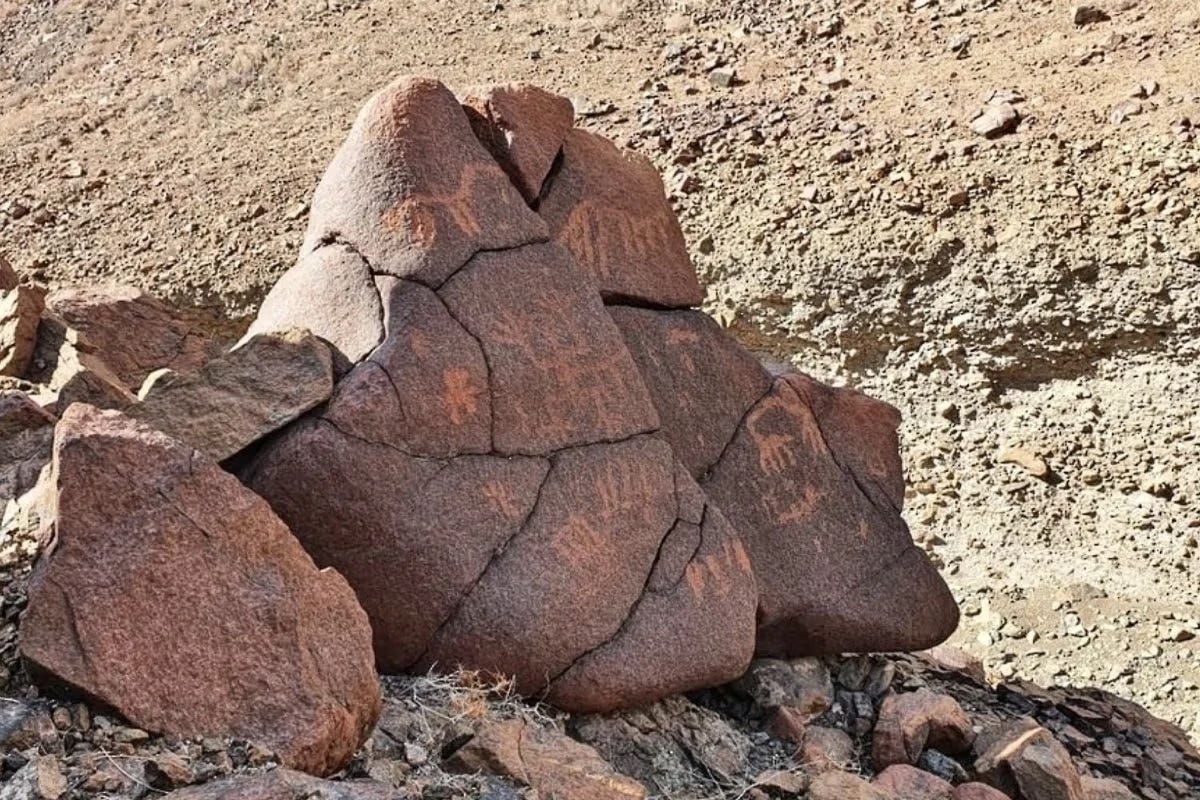
Researchers suggest the rock art discovered in northern Oman may have been carved over many generations, possibly spanning thousands of years.. Image courtesy of the Omani Ministry of Heritage and Tourism
The discovery centers on a large rock surface covered with engravings made directly into the stone. According to the ministry, the motifs include animal forms, human-like symbols, and geometric shapes. These images were produced using a pecking technique, in which the surface of the rock is repeatedly struck to create lines, figures, and patterns.
This technique is well known in rock art studies across the Arabian Peninsula. It leaves a physical mark that can survive for long periods, especially in dry and rocky environments. At Hajar Al Sinanat, the density of the engravings suggests that the site was not a casual marking place. It was a location people returned to, possibly over multiple generations.
Initial assessment has linked the carvings to ancient historical periods. The Art Newspaper reported that preliminary studies by Angelo Eugenio Fossati, an Italian specialist in rock art and professor of prehistory and protohistory at the Catholic University of the Sacred Heart in Milan, suggest the site may date to the first millennium BC. This dating remains preliminary, because rock art sites often develop over long periods rather than in one single phase.
Researchers are approaching the chronology cautiously. The dating is based on comparisons with other documented rock art in Oman and the wider region, along with the study of motif types, surface weathering, patination, and archaeological context. These indicators help specialists separate older carvings from more recent marks, although further work is still needed before the site can be placed securely within Oman’s archaeological sequence.
The subjects carved into the rock are especially important. Animal figures can offer clues about the environment, movement, hunting, herding, or symbolic associations. Human-like and geometric motifs are harder to interpret, but they may relate to identity, memory, ritual, territory, communication, or social activity. At this stage, the safest reading is that the carvings preserve visual evidence of how ancient communities interacted with their landscape.
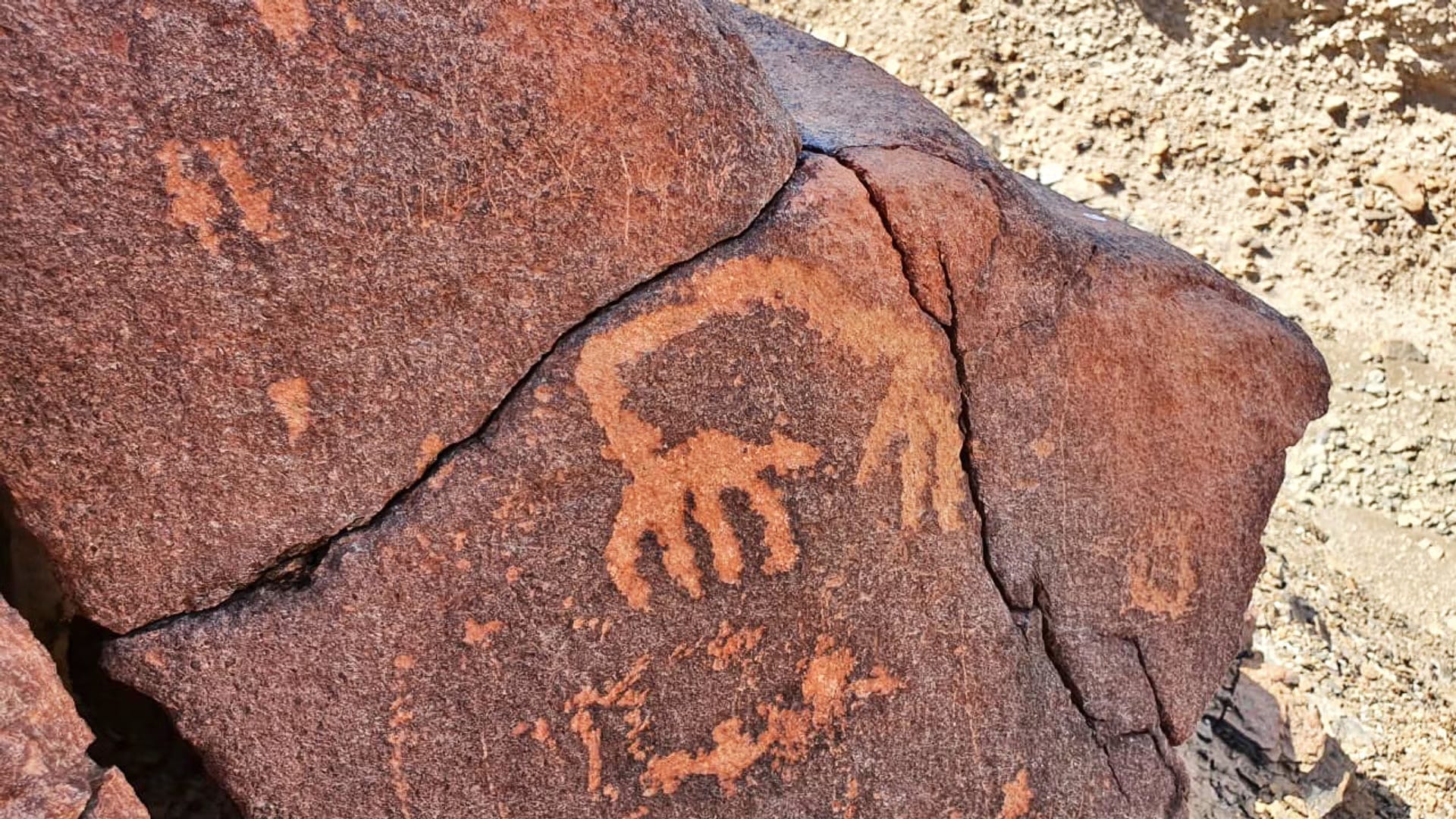
A close up of the rock art discovered in northern Oman. Credit: Omani Ministry of Heritage and Tourism
Oman has a long and underdocumented rock art tradition. Petroglyphs and pictographs have been recorded in mountains, valleys, deserts, and coastal zones, showing that rock surfaces were used as visual media across different periods and environments. Earlier research in northern Oman has shown that rock art can include animals, weapons, riders, abstract signs, and inscriptions. Some regional traditions may extend back thousands of years, while others belong to later historical phases.
This wider background makes the Hajar Al Sinanat discovery more significant. It is not an isolated curiosity, but part of a larger pattern of human expression across the Oman Peninsula. Rock art is especially valuable in areas where ancient communities may have left fewer permanent buildings or portable objects. A carved rock face can preserve direct human activity in a place where other evidence has disappeared.
The site also highlights the importance of documentation. Rock art is exposed to erosion, temperature changes, water movement, vandalism, and accidental human damage. Even touching a carved surface can contribute to gradual wear. For this reason, recording the site through photography, mapping, and technical study is a major part of its protection.
The Ministry of Heritage and Tourism has said that archaeological and artistic studies of the site are continuing. Conservation measures are also being prepared to protect the carvings and preserve their historical and tourism value. This is important because newly publicized archaeological sites can attract attention quickly, but without controlled protection, that attention can become a risk.
For Oman, the discovery strengthens the country’s position as one of the key landscapes for studying rock art in southeastern Arabia. From northern mountain regions to central and southern zones, Oman’s rock art record shows long-term human engagement with animals, movement routes, belief systems, and changing environments.
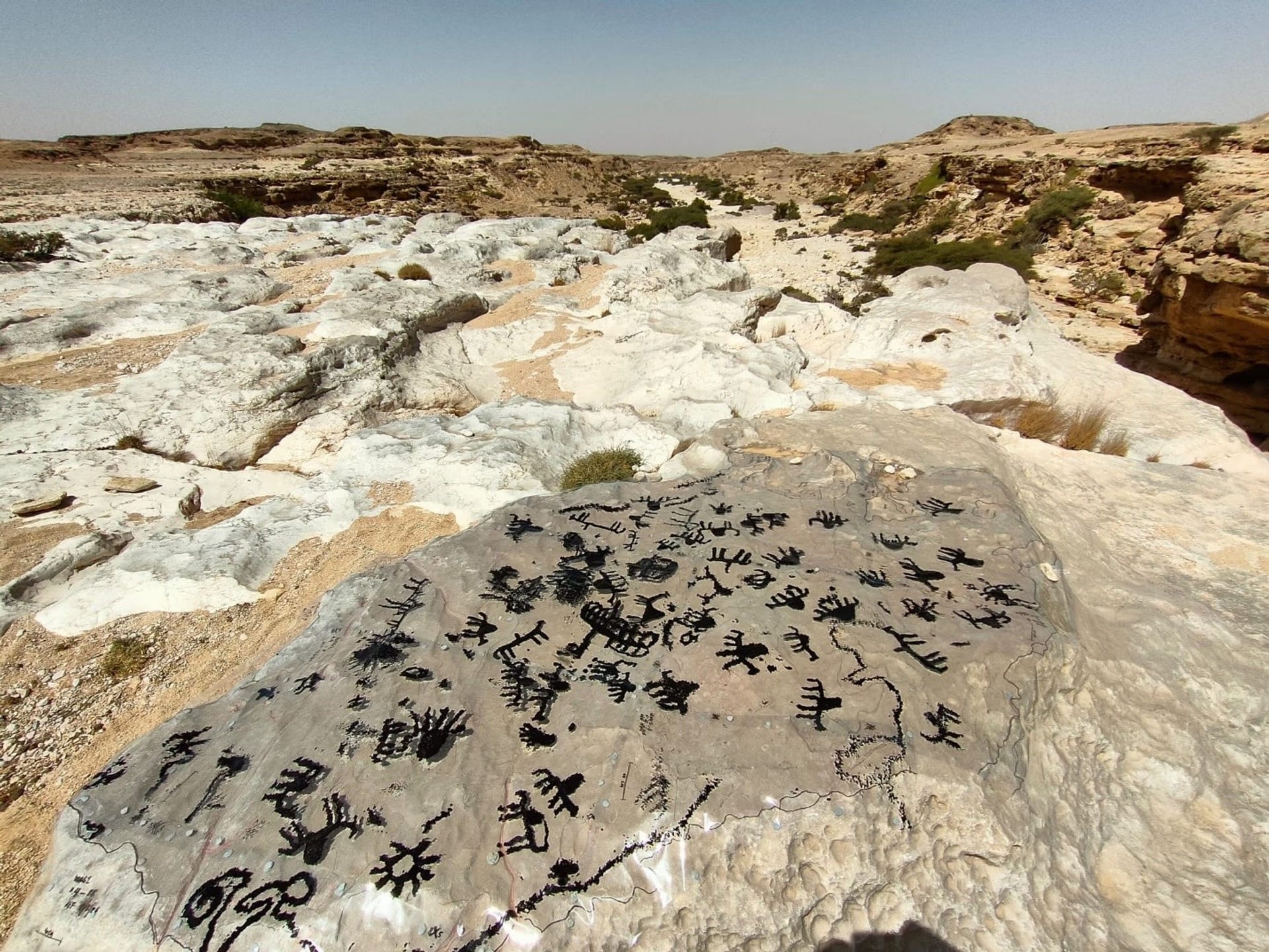
Previously discovered rock engravings associated with human settlements in the Oman desert spanning from 5000 BC to 1000AD. Credit: Omani Ministry of Heritage and Tourism
The Hajar Al Sinanat carvings do not provide every answer yet. Their exact date, full meaning, and relationship to nearby archaeological activity still require further research. But the discovery is already important because it expands the known visual archive of ancient Oman.
In simple terms, this rock face is evidence of people making deliberate marks in a meaningful place. Whether the images recorded animals, identity, memory, ritual, or movement through the landscape, they show that ancient communities in Oman were using stone as a surface for communication long before modern writing and documentation.
The next stage will depend on careful archaeological study, comparison with other Omani rock art sites, and long-term preservation. Until then, Hajar Al Sinanat stands as a newly recorded chapter in Oman’s ancient visual history.