


More than seventy years after Bedouin shepherds first stumbled onto them in the Judean Desert, the Dead Sea Scrolls still guard one of their most basic secrets, where exactly they were made. A newly funded European Research Council project intends to change that, combining artificial intelligence with chemistry, ancient handwriting analysis, and manuscript studies to trace individual scrolls and scribes back to the places and communities that produced them.
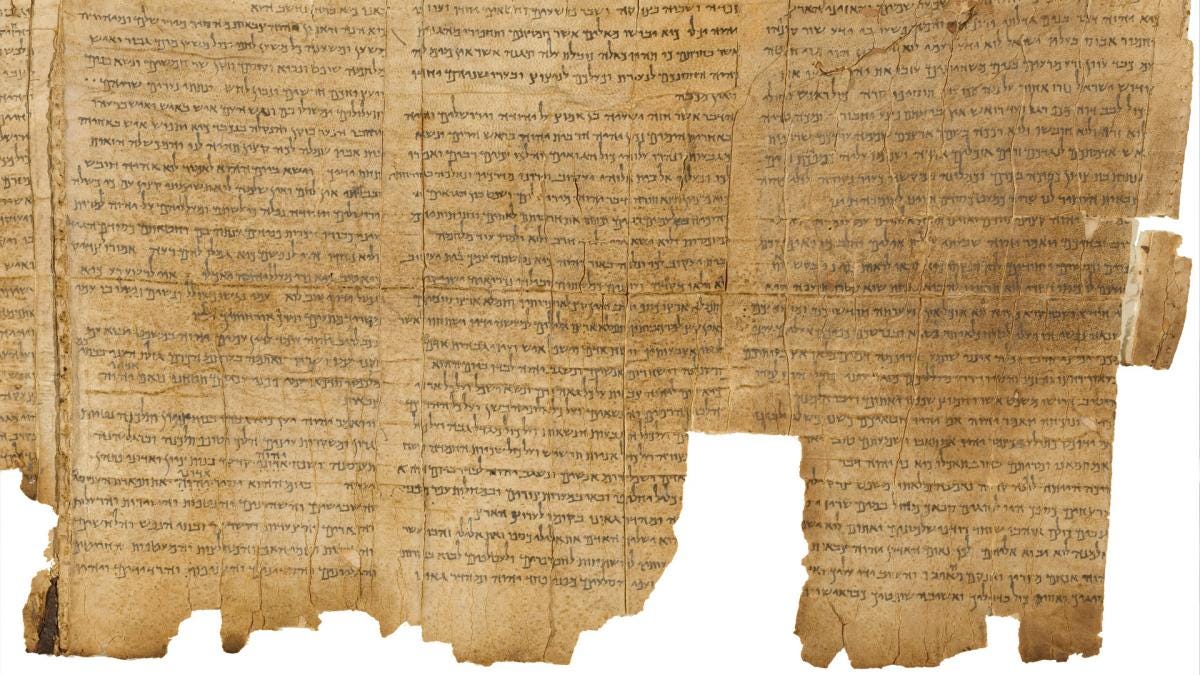
The Dead Sea Scrolls. Image credit: Israel Museum, Jerusalem
The Dead Sea Scrolls, discovered in the 1950s, remain one of the twentieth century’s most significant archaeological finds, preserving the earliest known manuscripts of the Tanach alongside a broader collection of Jewish literary works from the late Second Temple period. Despite decades of scholarship, the precise locations where the scrolls were manufactured and copied have stayed unknown.
A five-year effort with a five-year predecessor
The ERC has awarded a 2.5 million euro Advanced Grant to Professor Mladen Popović of the University of Groningen, one of the world’s leading authorities on the scrolls, to lead the new five-year project, titled Tracing Scribes and Scrolls. It brings together the University of Groningen, the Israel Antiquities Authority, and several other European laboratories and institutions in a joint international effort.
The project builds directly on Popović’s earlier ERC-funded work, The Hands That Wrote the Bible, which pioneered the use of artificial intelligence to identify individual scribes responsible for copying different scrolls. Tracing Scribes and Scrolls pushes that work further, moving past the question of who wrote each manuscript to ask where those scribes actually worked, what materials they used, and what broader cultural and intellectual networks carried the manuscripts into circulation across ancient Judea and potentially beyond.
New ERC-funded international research project to trace the origins of the Dead Sea Scrolls set to launch, June 30, 2026; AI dubbing. (CREDIT: YOLI SCHWARTZ/SHAI HALEVI/ISRAEL ANTIQUITIES AUTHORITY)
Chemistry, handwriting, and the physical scroll itself
The research plan centers on roughly 250 samples of parchment, papyrus, and ink drawn from the Israel Antiquities Authority’s own collection, examined through a combination of state-of-the-art chemical analysis, artificial intelligence, paleography, the study of ancient handwriting, and codicology, the study of manuscripts as physical, cultural artifacts.
One strand of the work is genuinely unprecedented. The chemical signatures extracted from scrolls found at Qumran and other sites across the Judean Desert will be compared directly against ancient Egyptian papyri, the first time such a comparison has been attempted at this scale. Researchers expect the comparison to help identify each scroll’s material fingerprint, trace the origins of its raw materials, recognize distinct production practices, and uncover connections between where a scroll was made and the broader network of known scribal centers across the region.
The chemical data will then be processed using AI tools built to detect complex patterns that conventional analysis tends to miss, results the team plans to combine with paleographic study of the actual handwriting, codicological analysis of physical construction details such as sheet preparation, column layout, margins, and stitching technique, and the existing body of linguistic and literary evidence built up around the scrolls over decades of prior research.
Building a database with no precedent
Popović described the scope of the undertaking plainly, calling it the largest research project to date to apply artificial intelligence to the cultural context of the Dead Sea Scrolls. These manuscripts, he said, offer an extraordinary window into the intellectual world of ancient Judea. By combining advanced laboratory analysis with handwriting study and recent advances in artificial intelligence, he added, the team can now approach questions that were previously out of reach entirely, who actually copied these manuscripts, where they were produced, how knowledge moved between communities, and what role the texts played within the society that produced them.
Dr. Ilit Cohen-Ofri of the Israel Antiquities Authority, a key participant in the project, said the coming research will assemble what she called an unprecedented database of the chemical composition of scroll samples. The authority is entrusted with preserving, documenting, and studying the Dead Sea Scrolls, she said, and continues to invest heavily in advancing their scientific investigation, noting that the IAA has only relatively recently come to appreciate how much information the scrolls’ raw materials, parchment, papyrus, and ink, actually have to offer. Taking part in an international project of this scale, she added, lets the authority contribute its expertise in material analysis to some of the field’s most important open questions, benefiting scholars and the wider public alike.
A wide international network
The project draws together research teams led by Cohen-Ofri at the Israel Antiquities Authority, Popović and Dr. Maruf Dhali at the University of Groningen, Ilaria Degano at the University of Pisa, Leila Birolo at the University of Naples Federico II, and Kaare Rasmussen and Frank Kjeldsen at the University of Southern Denmark in Odense. It also includes collaborations with the Egyptian Museums in Berlin and Turin and with KU Leuven in Belgium, partnerships built specifically around the comparative study of papyri from Egypt alongside manuscripts from the Judean Desert.
Source. The Jerusalem Post.
Ai is second hand info programmed by human intelligence good for only doing math problems