


On Turkey's Mediterranean coast, in a cave barely the size of a studio apartment, two different human species lived out remarkably similar lives across tens of thousands of years, hunting the same animals, making the same stone tools, and even collecting the same tiny seashells for decoration.
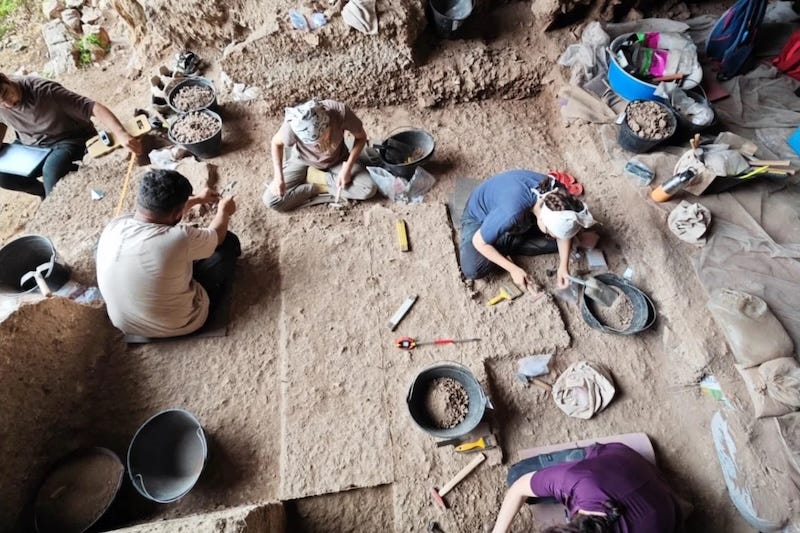
A new study of Üçağızlı II Cave in Hatay province argues that when Homo sapiens replaced the Neanderthals who had occupied the site before them, daily life there barely changed at all.
The research, led by İsmail Baykara of Gaziantep University’s Department of Archaeology, with Naoki Morimoto of Kyoto University and a wider international team, was published in the Proceedings of the National Academy of Sciences.
A small cave with a long memory
Üçağızlı II sits near the mouth of the Orontes River in the northern Levant, a region long used as a corridor for early human movement between Africa and Eurasia. Archaeologists have known of the site for years, but systematic excavation only began in 2020, and the cave itself is modest, its floor covering roughly 56 square meters.
What it lacks in size it makes up for in continuity. Fossil remains recovered from multiple occupation layers, four individual teeth and a partial jawbone with two more teeth still attached, allowed the team to establish a clear chronology. Neanderthals occupied the cave from roughly 77,000 to 59,000 years ago. Homo sapiens then took over the same space from about 59,000 to 47,000 years ago, giving the site a combined occupation history spanning some 30,000 years.
The same tools, the same prey
Alongside the fossils, the excavation recovered 19,252 stone tools and 24,236 animal bone fragments, distributed across every layer of occupation. The pattern that emerged surprised the researchers. Rather than showing a shift in technology or subsistence strategy when Homo sapiens arrived, the record shows both species making the same types of stone tools from the same local flint sources, and hunting the same prey, wild goats, fallow deer, roe deer, and wild boar, using what appear to be the same techniques.
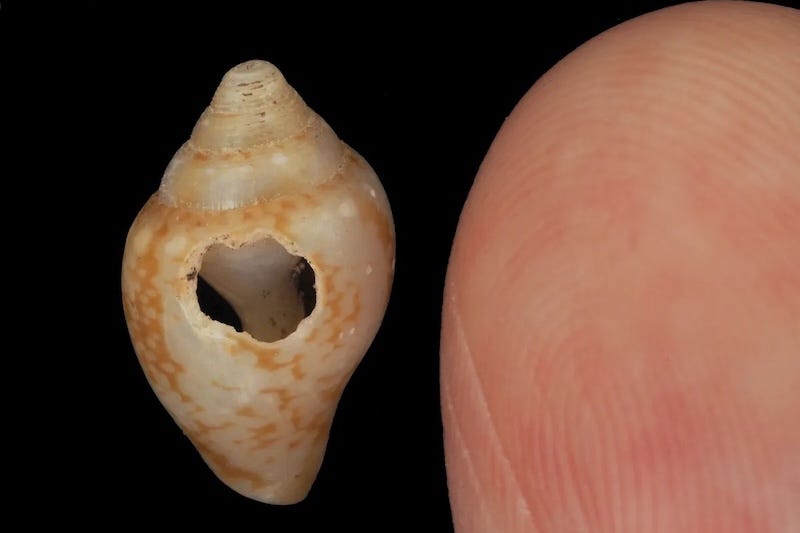
A tiny Columbella rustica shell discovered alongside Neanderthal fossils in Üçağızlı II Cave. It was likely not collected as food, but worn as an ornament. Credit: Naoki Morimoto
Seashells that meant nothing to eat
The clearest signal of shared culture, however, came from something that had nothing to do with survival. Researchers recovered 59 mollusk shells scattered through the occupation layers, 29 of them from a small sea snail called Columbella rustica. These shells carry little to no food value, which points toward a different purpose entirely. Several bore small deliberately made holes, suggesting they were strung and worn as ornaments, and one shell recovered from the Neanderthal layers had clearly been heated on purpose, a treatment that altered its color before use.
Because Columbella rustica shells turned up consistently across the entire occupation sequence, both Neanderthal and Homo sapiens layers alike, the researchers argue that the incoming modern humans used these shells in essentially the same way the cave’s earlier Neanderthal occupants had, thousands of years before. As the study’s authors put it, this points to shared behaviors between Neanderthals and modern humans that go beyond mere subsistence and extend into non-utilitarian practices.
Baykara did not hide his surprise at the finding. Speaking to IFLScience, he said the result was genuinely striking, since the team had not expected this level of continuity between Neanderthals and modern humans, though he added that it makes sense given what is already known about interbreeding between the two groups. In a separate interview with CNN, he put it more directly, saying the findings suggest Neanderthals and Homo sapiens likely shared more than just the same landscape. While direct contact between the two populations at the cave cannot yet be proven, he said, the remarkable continuity in technology, hunting practices, and the transport of shell beads is consistent with populations that interacted and passed cultural traditions between one another over time.
Co-author Naoki Morimoto, speaking to Discover Magazine, called the shell preference one of the study’s biggest surprises specifically because Neanderthals sharing a strong attachment to Columbella rustica was previously thought to be a behavior exclusive to modern humans, a finding he said forces researchers to reconsider the nature of cultural boundaries, and perhaps cognitive capacities, among different human groups in the Levant.
A contested question, not a settled one
The Üçağızlı findings fit into a wider and still unsettled debate about how much Neanderthals and Homo sapiens actually had in common. At Mandrin Cave in France, researchers have documented a very different pattern, with occupation layers linked to the two species showing distinct cultural artifact types rather than continuity, a contrast some specialists point to as evidence of multiple, quite different Homo sapiens populations and cultural trajectories moving through Eurasia at different times. By contrast, excavations at Tinshemet Cave in Israel had already turned up shared funerary traditions and technology between Neanderthals and modern humans, a pattern Üçağızlı II now appears to echo and extend.
Baykara is careful not to overstate what the Hatay evidence proves. The discovery does not mean the two groups lived identical lives in every respect, only that certain everyday practices, and some non-essential ones, remained remarkably stable even after a different human species took over the cave. Whether that stability reflects direct cultural transmission, coincidental convergence, or something in between remains, in his own words, a topic that is still somewhat speculative. Determining how cognitive capacities, ultimately a matter of brain structure and function, actually differed or overlapped between Neanderthals and modern humans, he says, will require further research still to come.
Sources. IFLScience (July 6, 2026); CNN; Live Science; Scientific American; Discover Magazine. Baykara, İ., Turan, D., Eren Kural, E., Silibolatlaz, D., Agras, M.K., Şahiner, E., Kavak, S., Zanolli, C., Ishihara, Y., Morita, W., and Morimoto, N. (2026). “Long-term cultural continuity across the Neanderthal-modern human sequence at Üçağızlı II Cave, northern Levant.” Proceedings of the National Academy of Sciences 123(29). doi.org/10.1073/pnas.2609061123
And apparently brains, too. 😉