More Than 2,000-Year-Old Greek Theater Mask Discovered in a Croatian Cave
A rare archaeological discovery from southern Croatia is opening a new window into the religious world of the ancient Adriatic.
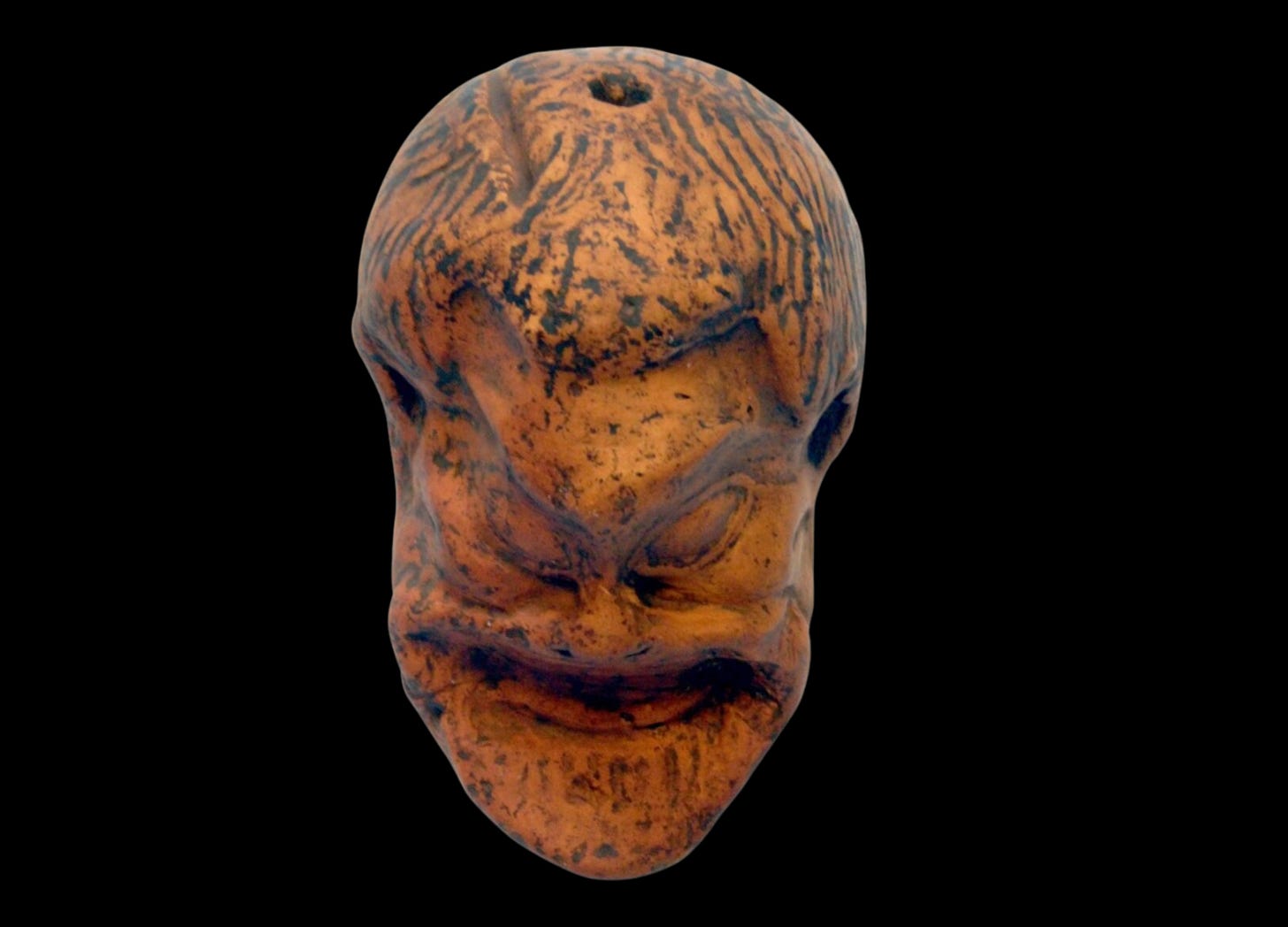
Terracotta head of a Greek theatrical mask from the 4th–3rd century BC. Credit: Dubrovački muzeji / Dubrovnik Museums
Inside Crno Jezero Cave on the Pelješac peninsula, archaeologists have uncovered a remarkably preserved terracotta head representing a Greek theatrical mask more than 2,000 years old.
The object was found during archaeological work carried out between April 23 and May 4, 2026, under the organization of the Archaeological Museum of Dubrovnik Museums. Researchers date the mask to the 4th or 3rd century BC, placing it in the Classical or early Hellenistic period, when Greek cultural influence was spreading through trade, colonization, ritual exchange, and elite networks along the eastern Adriatic coast.
The artifact is complete, made of terracotta, hollow on the inside, and pierced with a small suspension hole at the top. This detail suggests that it was not simply discarded pottery or a broken decorative object. It was probably designed to hang, possibly on a wall, within a ritual or sacred setting.
For archaeologists, the symbolism is especially important. In the Greek world, theatrical masks were closely connected with performance, religious festivals, and the sphere of Dionysus, the god associated with wine, theater, ecstasy, transformation, and ritual experience. Because Crno Jezero Cave has also produced wine-related vessels and votive objects, the discovery raises an important question: was this cave sanctuary connected to Dionysus, to a local Illyrian equivalent of the god, or to a blended religious tradition that combined Greek and local beliefs?
A Mask Found in a Hidden Part of the Cave
The context of the discovery makes the mask even more significant. According to archaeologist Domagoj Perkić, head of the Archaeological Museum and leader of the research, many of the finds connected with the sanctuary were located in the entrance area and in a side part of the cave that had been almost hidden and filled in before excavation.
Because the deposit remained protected in this concealed section, the objects survived in exceptional condition. Perkić described the scene as something close to a frozen image from more than two millennia ago. The mask appears to have remained in place for an extraordinary length of time, shielded from later disturbance.
This means the object is not important only as a rare piece of Greek-inspired terracotta art. Its value also comes from its archaeological context. It was found within a cave that appears to have functioned as a sacred space, where local Illyrian communities used Greek and local objects in rituals whose exact meaning is still uncertain.
The mask therefore belongs to a broader story of cultural contact. It shows how Greek symbols did not simply remain inside Greek cities or theaters. They could travel through exchange networks, enter local ritual landscapes, and take on new meanings among communities living along the Adriatic.
Crno Jezero Cave Had Several Lives
Finds suggest that from the late 4th century to the middle of the 1st century BC, Crno Jezero was used as an Illyrian sanctuary. Credit: Dubrovački muzeji / Dubrovnik Museums
Crno Jezero Cave was not used in only one period, nor for only one purpose. Research carried out in 2025 showed that different parts of the cave were used across a long span of time, from the Bronze Age to the end of the later Iron Age.
During the Bronze Age, especially in the 2nd millennium BC, the cave appears to have served as a kind of shelter or temporary living place. It may have been used during periods of conflict, bad weather, seasonal movement, or other moments when people needed protection.
Later, the cave’s function changed. From the Late Bronze Age into the early Iron Age, parts of Crno Jezero became a burial place for a larger number of individuals. Radiocarbon analysis of human bones shows that this funerary use lasted from around 1012 to 481 BC. In other words, the cave served as a necropolis for more than five centuries.
After the burial phase ended, the cave seems to have taken on a new religious role. Archaeological finds indicate that from the late 4th century BC to the middle of the 1st century BC, Crno Jezero was used as an Illyrian sanctuary.
This long sequence matters because it shows that the cave was not an ordinary hidden cavity in the landscape. It was a place repeatedly returned to by different communities over many centuries. Its meaning changed over time, but it remained significant.
Greek Vessels, Local Offerings, and Illyrian Rituals
The sanctuary phase is marked by numerous miniature vessels, many of them Greek in origin, alongside objects of local manufacture. These include small amphorae, bowls, and kantharoi, vessel types often connected with drinking, storage, offering, and ritual deposition.
Such items were commonly left in sacred spaces as votive offerings. A votive object was not simply an item placed somewhere by accident. It was a gift given within a religious act, often dedicated to a deity or used as part of a ceremony.
Credit: Dubrovački muzeji / Dubrovnik Museums
Other fragments from the cave belonged to fine Greek vessels used for wine storage and wine drinking. These were not everyday objects in the life of local Illyrian communities. Imported Greek ceramics, especially fine vessels, would have carried associations of prestige, wealth, power, and contact with the wider Mediterranean world.
Their presence inside Crno Jezero suggests that ritual activity in the cave may have included wine, feasting, offering, or symbolic drinking ceremonies. The exact form of these rituals cannot be reconstructed with certainty, but the combination of wine vessels, miniature offerings, and the theatrical mask strongly points to a sacred setting where Greek imagery and Illyrian practice overlapped.
Dionysus, Theater, and the Adriatic Cave Sanctuary
The discovery naturally brings Dionysus into the discussion. In Greek religion, Dionysus was not only the god of wine. He was also deeply tied to theater, altered states, masks, music, procession, and boundary-crossing experiences. A Greek theatrical mask inside a cave sanctuary therefore carries strong Dionysian associations.
However, archaeologists are careful not to overstate the evidence. Perkić has emphasized that it remains uncertain whether the cave was dedicated specifically to Dionysus, to an Illyrian deity with similar qualities, or to a local god whose worship absorbed Greek symbols over time.
That uncertainty is one of the most interesting aspects of the find. The mask does not give a simple answer. Instead, it shows how ancient religion could be fluid, especially in contact zones like the Adriatic coast.
Local Illyrian communities were not passive recipients of Greek culture. They selected, adapted, and reinterpreted foreign objects according to their own ritual needs. A Greek mask in an Illyrian cave sanctuary may represent exactly that process: not imitation, but transformation.
A Wider Sacred Landscape Near Dubrovnik
Crno Jezero is part of a larger pattern of Illyrian cave sanctuaries in the wider Dubrovnik region. At present, three such sanctuaries are known in the area: Crno Jezero Cave, Spila in Nakovana, and Vilina Cave above the Ombla spring.
The sanctuary at Nakovana existed during roughly the same period as the one at Crno Jezero. Vilina Cave appears to have begun somewhat earlier, in the late 5th century BC, and continued into the early 3rd century BC.
Together, these sites provide rare evidence for Illyrian religious life and its relationship with Greek civilization. They show that caves were not merely shelters or burial places. In some periods, they became sacred spaces where offerings, vessels, imported objects, and local traditions came together.
The mask from Crno Jezero also follows another notable discovery from the previous year’s research. In 2025, archaeologists found ceramic fragments of a head with part of a bust and hair, probably representing a Greek deity from the Classical period. This earlier find already suggested a strong Greek religious or artistic element inside the cave. The newly discovered theatrical mask now strengthens that interpretation.
The Team Behind the Discovery
The 2026 excavations at Crno Jezero Cave brought together archaeologists, conservators, and speleologists. The research team included archaeologists Domagoj Perkić and Krešimir Grbavac, conservator Sanja Pujo from Dubrovnik Museums, speleologists Hrvoje and Nataša Cvitanović from the Ursus Spelaeus speleological club in Karlovac, and archaeologist and speleologist Mirna Šandrić from the Speleological Section of HPD Željezničar in Zagreb.
Their work shows how cave archaeology often requires more than standard excavation methods. Sites like Crno Jezero can be difficult to access, physically unstable, and filled with complex deposits shaped by both natural processes and human activity. Properly understanding such a place requires archaeological expertise, conservation work, and speleological knowledge.
A Small Mask With a Large Historical Meaning
The terracotta mask from Crno Jezero is small, but its significance is far larger than its size. It was found in a cave that had served different communities in different ways: first as shelter, then as a burial place, and later as a sanctuary.
Its Greek style links it to the world of theater and Dionysian symbolism. Its location ties it to Illyrian ritual practice. Its preservation allows archaeologists to study not only the object itself, but also the sacred environment in which it was left.
More than two thousand years after it was placed inside the cave, the suspended terracotta face still raises the same question that now stands at the center of the discovery: what ceremonies once took place in the hidden chambers of Crno Jezero?
The answer may never be complete. But the mask makes one thing clear: ancient Pelješac was not isolated from the wider Mediterranean world. It was part of a living network of trade, belief, ritual exchange, and cultural adaptation, where Greek symbols could enter Illyrian sacred spaces and become part of local religious life.


