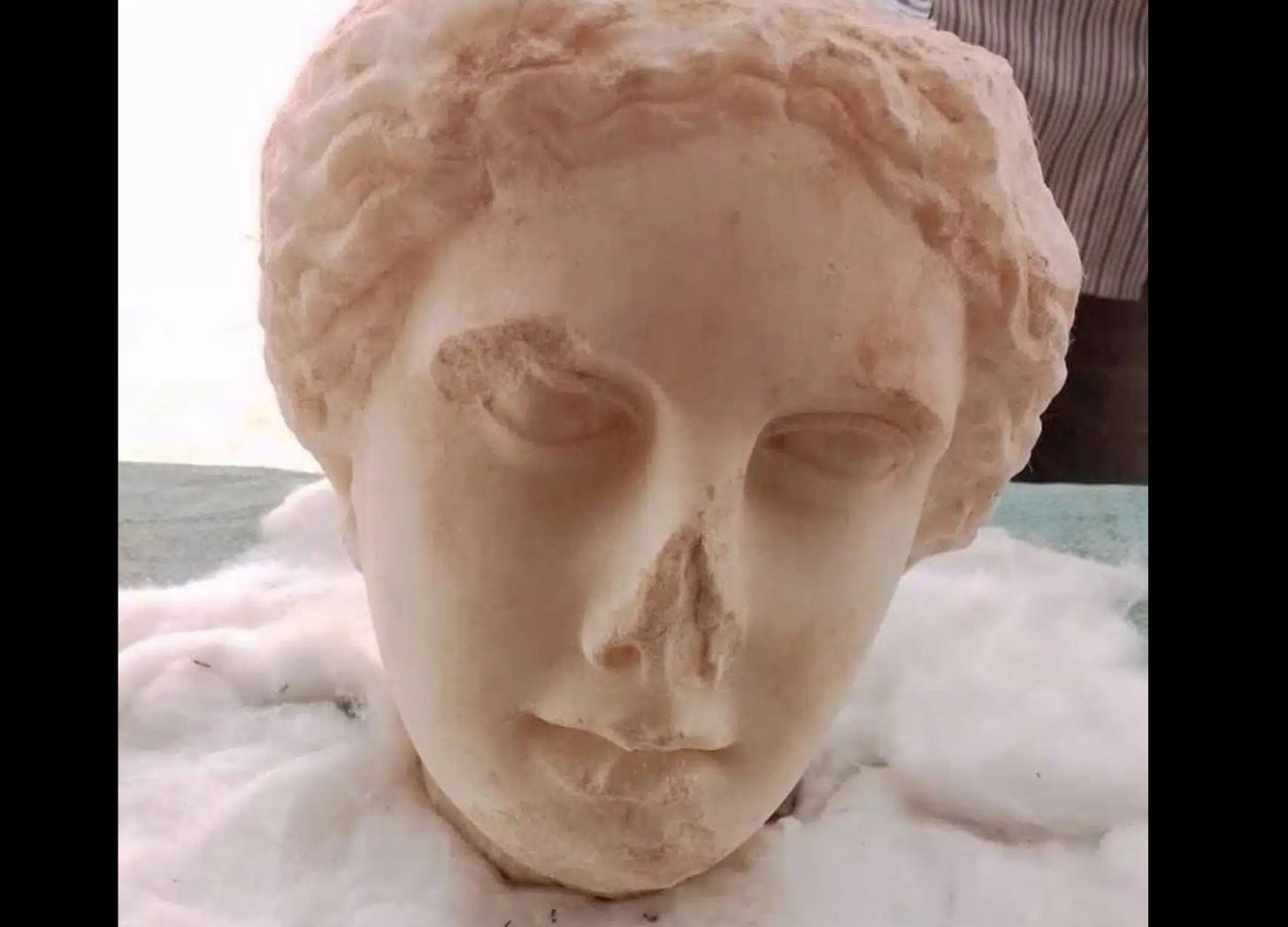
A rare marble head identified as Aphrodite was uncovered during excavations at Herakleopolis Magna. Credit: Ministry of Tourism and Antiquities
Archaeologists in Egypt have uncovered a rare marble head believed to represent Aphrodite, the Greek goddess of love and beauty, during excavations at Ihnasya Al-Madina in Beni Suef Governorate. The site, known in the Greco-Roman world as Heracleopolis Magna, has once again revealed evidence of its long and layered history, stretching from ancient Egyptian dynasties into the Greek, Roman, and early Christian periods.
The discovery was made by an Egyptian archaeological mission working under the Supreme Council of Antiquities. The team is led by Dr. Mohamed Ibrahim, director general of antiquities in Beni Suef. According to Egypt’s Ministry of Tourism and Antiquities, the latest finds add important new information about the city’s religious, artistic, architectural, and economic role across several historical eras.
Ihnasya Al-Madina was not an ordinary settlement. In ancient times, it held major political and religious importance. It served as Egypt’s capital during the Ninth and Tenth Dynasties and was also the capital of the 20th nome of Upper Egypt. The city remained significant through the Middle Kingdom, New Kingdom, and Third Intermediate Period, before flourishing again under Greek and Roman rule as Heracleopolis Magna, meaning the Great City of Heracles.
The excavation area at Ihnasya Al-Madina. Credit: Ministry of Tourism and Antiquities
One of the most striking objects recovered is the marble head of Aphrodite. The piece measures about 24 by 25 centimeters and is described as a rare artistic find. Its carefully carved face, delicate features, and curled hair reflect the classical sculptural style associated with divine and elite figures in the Greek and Roman periods.
A rare marble head identified as Aphrodite was uncovered during excavations at Herakleopolis Magna. Credit: Ministry of Tourism and Antiquities
Mohamed Abdel Badie, head of the Egyptian Antiquities Sector at the Supreme Council of Antiquities, said the sculpture is significant not only because of its artistic quality, but also because it reflects the classical traditions that became visible in Egypt after the pharaonic period. The find shows how Greek and Roman artistic language entered older Egyptian sacred landscapes, creating a complex cultural environment where different traditions existed side by side.
The Aphrodite head was not the only major discovery. Archaeologists also found a reused stone block bearing a raised inscription connected to King Senusret III, one of the most powerful rulers of Egypt’s Middle Kingdom. The inscription includes both the king’s throne name and birth name, making it an important piece of evidence for the royal presence and activity at the site.
Another cartouche was found with the name of Osiris-Naref, a deity worshipped in Ihnasya during ancient Egyptian and Ptolemaic times. This adds to the understanding of the city as a sacred place where older Egyptian religious traditions continued even as new cultural influences arrived.
Hisham El-Leithy, secretary-general of the Supreme Council of Antiquities, emphasized the importance of the Senusret III cartouche. The king is already associated with several monuments in Ihnasya, and the new inscription strengthens the evidence that Middle Kingdom rulers gave special attention to the city. It also reinforces the idea that Ihnasya held a sacred position in the religious geography of ancient Egypt.
The excavations also uncovered architectural remains that point to major changes in the city during the Greek, Roman, and early Christian periods. Among the finds are extensions of a Roman basilica and the remains of an older Doric-style temple. The Doric elements are especially important because they show a clear architectural connection with the Greek world.
Preliminary studies suggest that parts of the earlier Doric temple were reused during the sixth century AD in the construction of the basilica. Large stone blocks from the older structure appear to have been rearranged to form strong foundations and flooring capable of supporting massive columns. Some of these columns weighed around 45 tons, and three still stand in their original positions.
Reused stone blocks and architectural remains show how builders later incorporated earlier temple elements into the basilica structure. Credit: Ministry of Tourism and Antiquities
This reuse of older architectural material tells an important story. It shows how sacred and civic spaces changed over time, with one religious or public building being adapted into another. In the Greek period, basilicas often served as public buildings used for administrative, commercial, and social activities. Later, during the early Christian era, such buildings could be transformed into churches and used for worship and community gatherings.
A clay mold used for minting coins. Credit: Ministry of Tourism and Antiquities
The discoveries also include fragments of wall statues and terracotta molds used for minting coins during the Roman period. These finds reveal that Ihnasya was not only a religious center, but also a city with economic strength. The presence of coin-minting molds suggests organized production and commercial activity, helping confirm the city’s prosperity under Roman rule.
Dr. Sami Dardiri, head of the Central Administration for Middle Egypt Antiquities, said the statue fragments and coin molds reflect Ihnasya’s continued cultural and economic importance in the Roman era. The archaeological mission is now continuing scientific studies, conservation work, and dating analysis to better understand the newly discovered material and its wider historical context.
Egypt’s Minister of Tourism and Antiquities, Sherif Fathy, described the finds as an important scientific and archaeological addition. He said they help highlight the great historical value of Ihnasya Al-Madina and demonstrate the cultural diversity that shaped Egypt across different periods.
The ministry also noted that work at the site forms part of a broader effort to study, protect, develop, and promote Egypt’s archaeological heritage. By revealing new evidence from a city that moved through pharaonic, Greek, Roman, and Christian phases, the excavation helps show how Egypt’s ancient sites often preserve many civilizations in one place.
The marble head of Aphrodite is therefore more than an isolated sculpture. It is part of a wider archaeological picture: a Middle Kingdom royal inscription, a local deity’s cartouche, Greek-style temple remains, a Roman basilica, and evidence of coin production all emerging from the same ancient city.
Together, these finds show that Heracleopolis Magna was a place where Egyptian, Greek, Roman, and later Christian traditions overlapped. Each layer left something behind: a royal name carved in stone, a goddess shaped in marble, reused temple blocks beneath a basilica, and small clay molds connected to the economy of Roman Egypt.
The latest discoveries at Ihnasya Al-Madina remind us that ancient cities were rarely frozen in one era. They changed, adapted, and absorbed new identities while preserving traces of older ones. In this case, a single excavation has opened a window onto centuries of religious devotion, political authority, artistic exchange, and urban life in the heart of Egypt.


