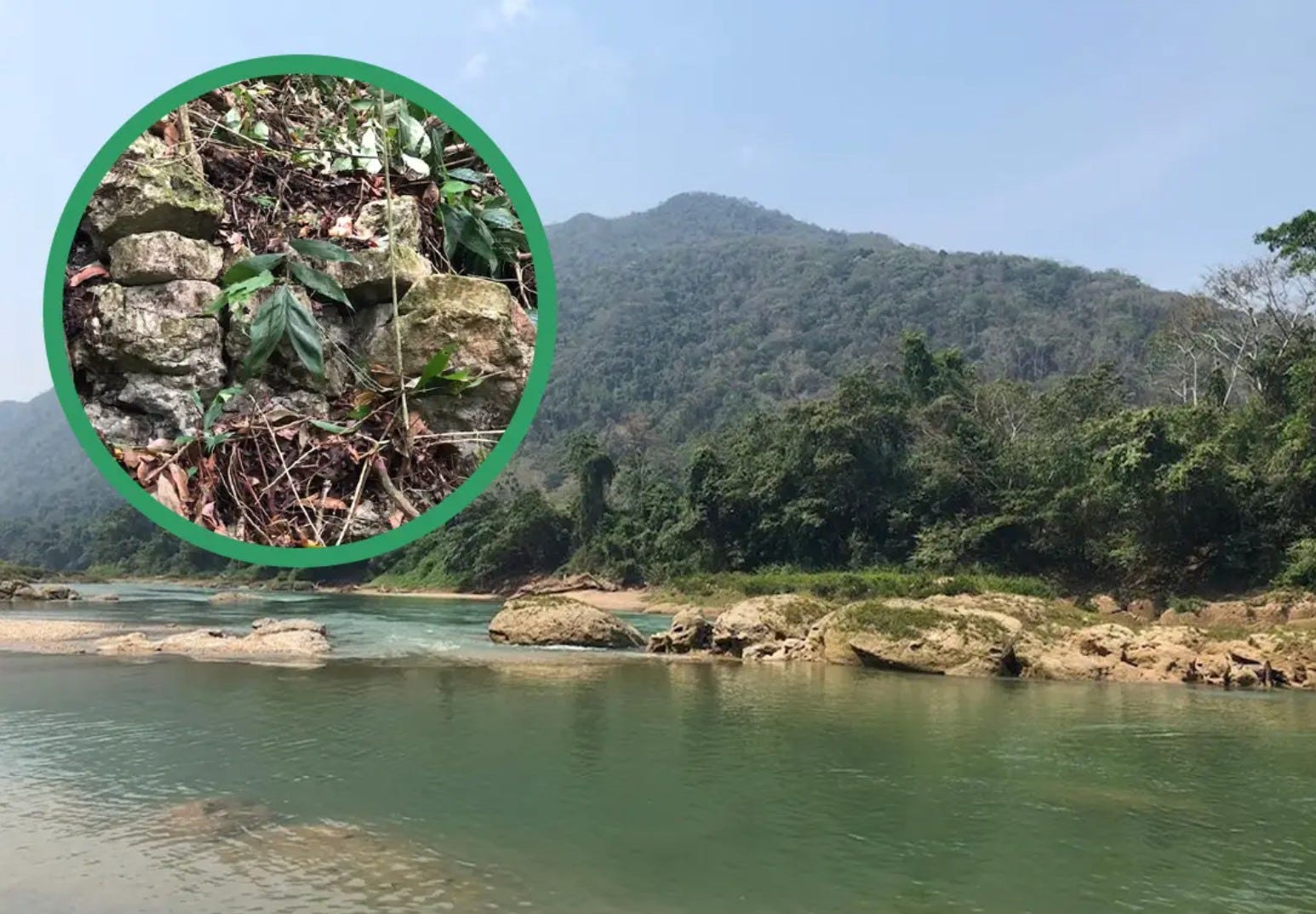
Deep inside the dense forests of Chiapas, Mexico, archaeologists may have located one of the most elusive Maya settlements of the colonial period: Sac Balam, also known as Sak-Bahlán, the Land of the White Jaguar.
The site has long occupied a powerful place in Maya and colonial history. It was not simply another ancient settlement hidden by the jungle. Sac Balam was remembered as one of the last refuges of the Lakandon Chʼol Maya, a community that resisted Spanish domination for more than a century after the fall of their earlier capital, Lakam Tun.
New archaeological evidence now suggests that researchers may finally be closing in on this lost stronghold.
According to reports from the research team, the possible site lies in a remote part of the Lacandon Jungle, within the wider landscape of the Montes Azules Biosphere Reserve. This region is difficult to access, heavily forested, and environmentally protected, which has made archaeological work both challenging and slow. Yet those same conditions may also explain why the city remained hidden for so long.
Sac Balam was founded around 1586, after Spanish forces took Lakam Tun, a regional center of the Lakandon Chʼol. Rather than surrender fully to colonial authority, surviving groups withdrew deeper into the forest and established a new settlement. From there, they maintained a remarkable level of independence for roughly 100 years.
For the Spanish colonial administration, Sac Balam represented more than a hidden town. It was a political and symbolic problem. The settlement stood outside direct colonial control, preserving Indigenous autonomy in a region that Spanish maps and documents often described as difficult, dangerous, and resistant.
In 1695, Spanish forces finally reached and subdued the city. Afterward, it was renamed Nuestra Señora de los Dolores. Historical sources indicate that the settlement continued for a short period under colonial control before being abandoned in the early 18th century. Over time, the forest reclaimed it, and its precise location disappeared from living memory.
The new investigation combines historical records with modern archaeological methods. Researchers used Spanish colonial accounts, especially descriptions of travel routes through rivers and forest paths, to narrow down the possible location. These documents described journeys involving several days of walking and canoe travel, including references to the Lacantún River and its connections with other waterways.
By placing these clues into a Geographic Information System, archaeologists were able to create a predictive model. This model considered terrain, vegetation, water routes, walking speed, travel difficulty, and the likely weight of supplies carried by people moving through the jungle. The result was not a random search area, but a carefully calculated zone where Sac Balam was most likely to have stood.
Fieldwork then brought researchers to a site with features that match important parts of the historical record. One of the most striking discoveries is a wall about 16 meters long and around 1 meter high. This structure may correspond to the type of large communal architecture described in Spanish accounts of Sac Balam.
Such a wall is important because Sac Balam was not only a place of shelter. It was a functioning community. Historical documents mention houses, public buildings, and organized settlement life. If the newly found wall proves to be part of a larger building foundation, it could become one of the strongest architectural clues linking the site to the lost city.
The team also found ceramic fragments and a small monkey figurine, both of which may belong to the period when Sac Balam was occupied. These finds are promising, but researchers remain cautious. Archaeology does not confirm a lost city through one object or one wall alone. The identification must be built from many layers of evidence, including artifacts, architecture, soil deposits, dating results, and historical comparison.
One key question is whether the wall belongs to a building from the correct period. To answer that, archaeologists hope to recover associated materials such as incense burners, datable charcoal, and other objects found in secure archaeological contexts. AMS radiocarbon dating could help establish whether the occupation matches the known timeline of Sac Balam.
Another important clue may lie in the soil. Spanish records suggest that Sac Balam was burned during the conquest. If excavations reveal a clear ash layer from the correct period, this could provide powerful evidence that the site experienced the destruction described in colonial documents.
Even with these clues, the discovery is still best described as probable rather than fully proven. The language used by specialists is careful because the site must still be tested through further excavation and dating. For now, the evidence points strongly toward Sac Balam, but final confirmation will depend on whether the material record matches the historical story in detail.
The possible rediscovery also matters because it reframes how people understand the final centuries of Maya resistance. Popular narratives often speak of the Maya world as if it collapsed completely long before the arrival of the Spanish. In reality, Maya communities continued to adapt, resist, negotiate, relocate, and survive under extremely difficult conditions.
Sac Balam belongs to this later and often overlooked chapter. It shows that Maya history did not end with the decline of Classic-period cities, nor did it disappear instantly under Spanish conquest. Instead, Indigenous communities continued shaping their own political and cultural futures, sometimes in places deliberately chosen for their remoteness and defensibility.
The jungle setting is also central to the story. To outsiders, the Lacandon forest may have appeared as an obstacle. For the Lakandon Chʼol, it could serve as protection, homeland, and strategy. Rivers, forest paths, and hidden settlements created a landscape where colonial power was harder to impose.
This makes the possible identification of Sac Balam more than an archaeological headline. It is a rediscovery of resistance, survival, and memory. The city was not lost because it lacked importance. It was lost because it existed in a difficult landscape, because colonial records were incomplete, and because the forest slowly erased its visible traces.
Future research may include more detailed mapping, additional excavations, radiocarbon dating, ceramic analysis, and possibly lidar surveys to detect structures beneath the tree canopy. If confirmed, the site could become one of the most important finds for understanding the last independent Maya communities of Chiapas.
For now, Sac Balam remains suspended between history and confirmation. The wall, ceramics, figurine, historical routes, and geographic model all point in the same direction. But archaeology moves carefully. The strongest discoveries are not only exciting; they are tested patiently, layer by layer.
If this site is truly Sac Balam, then the Land of the White Jaguar has returned to the map after more than three centuries, not as a legend, but as a place where Maya resistance once endured in the shadow of empire.


