


A new ancient DNA study has found that Iberian communities in the northeast of the Iberian Peninsula remained genetically stable for around six centuries before the arrival of Roman rule brought stronger outside influences into the population.
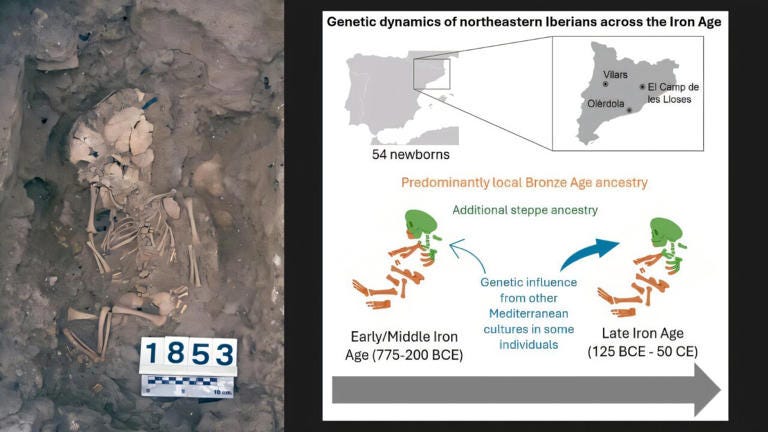
Left: Newborn remains from Els Vilars in Arbeca, Lleida, analyzed in the study. Credit: ARQHISTEC-GIP, UdL. Right: Overview graph from the iScience 2026 study. DOI: 10.1016/j.isci.2026.116186
The research, led by a team from the Universitat Autònoma de Barcelona, examined the genomes of 54 newborns from three archaeological sites in present-day Catalonia. The study follows the genetic history of Iberian communities from the Early Iron Age to the beginning of the Roman period, roughly between 2,700 and 2,100 years ago.
The findings were published in the journal iScience under the title The genetic landscape of northeastern Iberian communities from the early to late Iron Age. The research gives one of the clearest genetic pictures so far of the Iberian peoples who lived in the northeast of the peninsula before and during the first stages of Roman influence.
The main conclusion is direct: despite contact with Phoenicians, Greeks, Punics, Carthaginians, and other Mediterranean groups, northeastern Iberian communities did not experience a major genetic replacement during most of the Iron Age. Their DNA remained largely rooted in earlier local Bronze Age populations.
This is important because archaeology has long shown that Iberian culture was deeply connected with the wider Mediterranean world. Imported amphorae, foreign objects, trade goods, and cultural influences appear in Iberian settlements. Based on that material evidence, researchers expected to find stronger signs of outside ancestry. Instead, the genetic results show a more gradual picture.
The Iberian culture developed along the Mediterranean coast around the 6th century BC and flourished especially between about 450 and 200 BC. It was one of the major pre-Roman cultures of the Iberian Peninsula. These communities had fortified settlements, social hierarchy, trade connections, writing systems, and distinctive burial and ritual practices.
However, studying Iberian DNA is difficult. Adult human remains are rare because cremation was the main funerary practice in many Iberian communities. Cremation usually destroys usable ancient DNA. This has limited direct genetic research on these populations.
The new study was possible because Iberian communities sometimes buried newborns inside domestic and productive spaces, including beneath houses or within settlement areas. These infant burials preserved genetic material that adult cremations usually do not. For that reason, newborn remains became one of the most valuable sources for reconstructing Iberian population history.
The researchers analyzed 54 newborns from three sites: Els Vilars in Arbeca, Lleida; Sant Miquel d’Olèrdola in Olèrdola, Penedès; and El Camp de les Lloses in Tona, Barcelona. These sites represent different moments in the Iron Age and different Iberian groups in northeastern Iberia.
Els Vilars, linked with the Ilergetes, helped researchers examine the transition from the Bronze Age to the Iron Age. Sant Miquel d’Olèrdola, associated with the Cossetani area, provided evidence from the Middle Iron Age. El Camp de les Lloses, linked with the Ausetani, offered material from the final Iron Age and the beginning of Roman influence.
The study recovered more than 20,000 genetic variants from the genome of 22 individuals, using the 1240k panel commonly applied in ancient DNA research. The team also recovered mitochondrial DNA from additional individuals, including almost complete mitochondrial genomes in some cases.
All the individuals studied carried the main genetic components already known from prehistoric Iberian populations: Western Hunter-Gatherer ancestry, Anatolian Neolithic farmer ancestry, and Steppe or Yamnaya-related ancestry that entered the peninsula during the Bronze Age.
This result supports the idea that Iberian culture did not arise from a sudden mass migration. Instead, it developed from local populations already present in the region. The cultural changes visible in archaeology, including new forms of settlement, hierarchy, trade, and material culture, were not matched by a major genetic replacement.
In other words, Iberian society changed, but the people were largely descended from earlier local groups.
This does not mean Iberian communities were isolated. The study detected occasional genetic contacts with other Mediterranean populations. Some individuals from Els Vilars and Olèrdola showed signs of ancestry connected with the eastern Mediterranean or North Africa. These results fit the archaeological evidence for trade and contact with Phoenician, Greek, Punic, and Italic worlds.
The important point is scale. These outside influences existed, but they were limited and gradual before Roman control. The DNA does not support a large migration event reshaping the population during the main Iron Age period.
The Roman period changed that pattern. At El Camp de les Lloses, dated between about 125 BC and AD 50, the researchers found stronger signs of Mediterranean and North African ancestry. This suggests that Roman political and economic integration created a more diverse population.
That shift fits the historical context. Roman expansion into the Iberian Peninsula began after the Second Punic War, and Roman authority gradually transformed local societies. Roads, military activity, administration, trade, and settlement change brought new people and new connections into the region.
El Camp de les Lloses is especially important because it belongs to this period of transition. The settlement was connected with Roman infrastructure and activity. The genetic evidence from the site shows that the Roman period was not only a political and cultural change, but also a biological one.
Even then, local ancestry did not disappear. The study shows that the later Ibero-Roman population became more diverse while still preserving a strong genetic connection with earlier Iberian groups.
The mitochondrial DNA results also add detail. Mitochondrial DNA is inherited through the maternal line, so it can help researchers track female ancestry and mobility. The study found no major genetic separation between Iberian groups, but it did detect subtle differences in maternal lineages. Some lineages were more frequent in certain groups, suggesting that communities interacted while still maintaining a degree of local identity.
Many of the maternal lineages were already present in the Iberian Peninsula before the Bronze Age. This supports continuity through time. However, some lineages had not previously been detected in the peninsula, which may point to limited female mobility or contact from outside regions.
The Y chromosome evidence, linked to male ancestry, also fits earlier studies of Iberian population history. It reflects the arrival of Steppe-related ancestry during the Bronze Age, a period when many earlier paternal lineages in the peninsula were replaced. Still, some older Neolithic paternal lineages survived, showing that even major demographic shifts did not erase all earlier ancestry.
The study also examined kinship between some individuals. At Els Vilars, the researchers did not identify close biological relationships among the newborns studied. At Olèrdola, two infants buried in the same grave were found not to be twins or close relatives. At El Camp de les Lloses, however, the team identified a pair of sisters and two second-degree relatives.
These kinship results help archaeologists understand how infant burials were organized. They also show that the practice cannot be explained by one simple rule. Some burials may reflect household-level decisions, while others may have followed broader social or ritual patterns.
The findings matter because they challenge a simple model in which cultural change always equals population replacement. In northeastern Iberia, the rise of Iberian culture appears to have been mainly a local development. External contact shaped material culture and later added genetic diversity, but it did not create Iberian society through a single large migration.
The research also shows why ancient DNA must be combined with archaeology. Objects from outside the region can prove contact, trade, and cultural influence, but they do not automatically prove mass migration. Genetics can test whether those cultural contacts also changed the population. In this case, the answer is mixed: limited change before Rome, stronger change after Roman integration.
The study also adds a more precise view of pre-Roman Iberia. Iberian groups were not closed communities, but they were not simply replaced by foreign populations either. They maintained strong local ancestry while participating in wider Mediterranean exchange networks.
This has broader importance for the study of ancient Europe. Many ancient societies changed through a combination of internal development, trade, small-scale movement, intermarriage, and political transformation. The Iberian case shows that cultural complexity can grow without a large-scale genetic break.
For researchers, the study is also a reminder of the value of small and overlooked remains. Newborn burials, which might once have been seen as secondary to large monuments or adult graves, are now providing some of the clearest evidence for Iberian population history.
The authors remain cautious. The study focuses on three sites in northeastern Iberia, so its conclusions should not automatically be applied to the entire Iberian Peninsula. Southern, western, and central regions may have had different histories, especially because they had different levels of contact with Phoenician, Punic, Celtic-speaking, and Roman groups.
Still, for northeastern Iberia, the message is clear. From the Early Iron Age until the Roman period, Iberian communities largely descended from local Bronze Age populations. Their culture changed, their settlements developed, and their contacts expanded, but their genetic base remained stable for centuries.
Roman rule marked the clearest turning point. After Rome entered the region, the population became more genetically diverse, with increased Mediterranean and North African ancestry. This biological change happened alongside major social, economic, and political transformation.
The study therefore offers a more detailed view of Iberian history. It shows continuity before Rome, contact without large-scale replacement, and a later Roman-period shift toward a more mixed Ibero-Roman population.
Sources:
Universitat Autònoma de Barcelona, DNA of Iberians from the northeast of the Iberian Peninsula remained largely unchanged for six centuries, 9 June 2026.
Phys.org, Iberian DNA remained largely unchanged for six centuries before Roman influence, study finds, 9 June 2026.
Cuesta-Aguirre et al., The genetic landscape of northeastern Iberian communities from the early to late Iron Age, iScience, 2026.
SSRN / Cell Press Sneak Peek record, The Genetic Landscape of Northeastern Iberian Communities from the Early to Late Iron Age.
Ara, A study by the UAB reveals how the Romans changed the DNA of the Iberians, 9 June 2026.
This is so interesting. Thanks for posting 😊
Yes indeed. I have an article forthcoming this month on the Hibiru tribe migrations to and from the Iberian Basque Pyrenees mountainous regions and their Euskara language (ie., an “isolate”). Commonalities of words for sheep and shepherds in Galilean Aramaic are intriguing inquiries.
I incorporated my research about this “Iberian” language origins question into the storyline arc of a “fictional novel” I published (AD 2004, 2nd. ed. 2011) entitled: “ReGenesis, A Galilean Manner of Speech”. For unexplained reasons, wordpress took down the site hosting links to embedded electronic cyber bridges (in the 2nd. 2011 ed.) So there’s that. But the rest of the book is intact. 🔥🙏
https://www.thearchaeologist.org/blog/the-enigmatic-origins-of-the-basque-language-a-journey-through-speculative-theories
PDF ebook.
https://www.lulu.com/shop/jeffrey-thayer/regenesis-a-galilean-manner-of-speech/ebook/product-16qpne25.html?q=regenesis+a+galilean&page=1&pageSize=4
ePub version
https://www.smashwords.com/books/view/46237