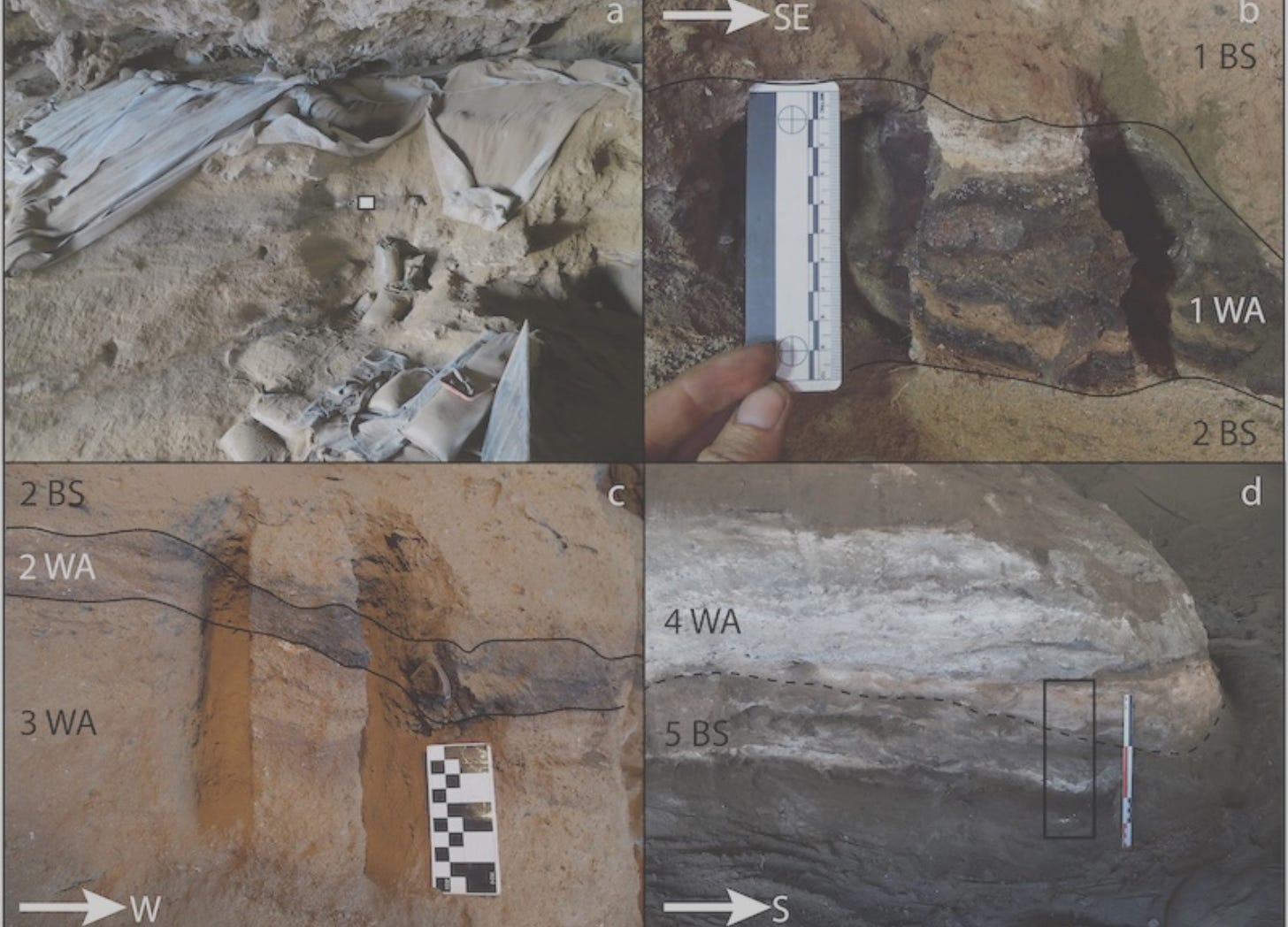
Long before houses, mattresses, or woven textiles became part of human life, people were already thinking carefully about where they slept. A new study from Border Cave in South Africa suggests that Middle Stone Age hunter-gatherers did not simply lie down on bare cave floors. Instead, they created plant-based sleeping surfaces, renewed them, burned old layers, and repeatedly built fresh beds over ash.
The evidence comes from Border Cave, a famous rock shelter in the Lebombo Mountains near the modern border between South Africa and Eswatini. This site is one of the most important places in the world for studying early Homo sapiens behavior. Its archaeological deposits preserve a long sequence of human activity, stretching across hundreds of thousands of years, and have already provided important clues about early technology, symbolic behavior, plant use, fire use, and daily life.
The new research, published in the Journal of Archaeological Science by Peter Morrissey and Dominic Stratford, focuses on microscopic evidence from ancient bedding deposits. The authors examined plant-based bed structures dating between roughly 161,000 and 43,000 years ago. Other bedding evidence from Border Cave reaches even further back, to around 200,000 years ago, making this site central to understanding how ancient humans organized their living spaces.
What makes the discovery so important is not just the age of the bedding. It is the level of routine behind it. The people who occupied Border Cave appear to have built sleeping or resting areas using grasses and other plant materials, often placing them over layers of ash. In many cases, older bedding was burned, trampled, covered, or replaced with new plant material. This points to a repeated maintenance practice, not a random or isolated event.
Most of the bedding material identified at Border Cave belonged to grasses from the Panicoideae subfamily. This plant group includes relatives of modern grasses associated with crops such as millet, maize, and sugarcane. In some bedding deposits, researchers also found evidence of sedges or reed-like plants. These choices may reflect what was locally available near the cave, but they may also suggest that people selected plants with particular textures or practical qualities.
The beds were not preserved as soft, complete mats in the modern sense. Instead, archaeologists identified them through thin sections, phytoliths, microscopic plant traces, sediment structure, ash deposits, and carbonized material. These small-scale clues allow researchers to reconstruct how the beds were made, used, altered, and replaced over time.
One of the most striking patterns is the repeated association between bedding and ash. Across the analyzed samples, the ancient beds were commonly placed on ash-rich surfaces. Some ash layers may have already been present from earlier fires or burned bedding. In other cases, the ash may have been deliberately moved, piled, or prepared as a base before fresh plant material was added.
Why would people sleep on ash?
One possibility is pest control. Ash can make it difficult for crawling insects to move through a surface. It may have helped deter ticks, fleas, bedbugs, and other biting insects. Earlier research at Border Cave also suggested that ash beneath grass bedding may have acted as a natural insect barrier. This would make the bedding system more than a comfort feature. It may have been part of a practical strategy for hygiene, protection, and domestic maintenance.
Ash may also have helped create a drier and warmer surface. Cave floors can be cold, damp, uneven, or dirty. A layer of ash beneath grass could have insulated the body from the ground and made the sleeping area more usable. Even if the original purpose was not always the same, the repeated use of ash shows that these early humans were actively managing their living environment.
The researchers identified several different forms of bedding microstructure. Some samples contained dense, layered plant material. Others showed plant remains mixed with ash, clay, and other sediments. Some beds had been heavily burned, while others were only partly carbonized or better preserved. This variation shows that not all beds were used in the same way or for the same length of time.
The older layers often show signs of more intensive occupation. In these deposits, bedding material appears more fragmented, burned, trampled, and mixed with surrounding sediments. This suggests that people may have returned to the same living areas repeatedly, renewing or burning bedding as part of a maintenance routine. By contrast, some later deposits between about 60,000 and 43,000 years ago appear less disturbed, possibly reflecting shorter stays, smaller groups, or different patterns of cave use.
This is important because archaeologists often try to understand ancient occupation intensity through visible layers, artifacts, hearths, bones, and sediment color. Border Cave complicates that picture. Some beds with evidence of intensive use were found in deposits previously interpreted as lower-intensity occupation phases. The new microscopic work shows that ancient cave deposits can preserve hidden activity patterns that are not always obvious during excavation.
In other words, a layer that looks quiet at first may still contain traces of repeated human behavior when studied at the microscale.
The study also compares Border Cave with other South African sites where ancient bedding has been identified, especially Sibudu Cave and Diepkloof Rock Shelter. These sites show that plant bedding was not unique to one community. However, each site also had its own pattern. At Sibudu, bedding was often made from sedges, while at Border Cave, grasses from the Panicoideae group seem to have been more common. This could reflect environmental differences, local plant availability, or cultural choices.
The Border Cave evidence adds to a growing picture of Middle Stone Age humans as careful organizers of space. They were not simply surviving in caves. They were creating domestic zones, preparing surfaces, managing fire, using plants in structured ways, and maintaining areas for rest or work.
This behavior matters because bedding is part of daily life, but daily life rarely survives in the archaeological record. Stone tools, bones, and fireplaces are usually easier to find than soft plant materials. Grass, leaves, reeds, mats, baskets, and bedding normally decay. When they do survive, they can reveal behaviors that are otherwise invisible.
The Border Cave bedding therefore gives archaeologists a rare view into the domestic side of early human life. It shows how people shaped the small spaces around their bodies: where they slept, where they sat, how they kept surfaces clean, and how they may have protected themselves from insects.
The research also connects to broader debates about the emergence of “modern” human behavior. Many discussions of behavioral modernity focus on symbolic objects, ornaments, pigments, long-distance exchange, complex tools, or art. But the Border Cave beds remind us that modernity was not only about symbols. It was also about routine, planning, comfort, hygiene, and the repeated organization of everyday space.
The act of building a bed may seem ordinary, but in deep prehistory it reveals several important capacities. People had to recognize useful plants, collect them, bring them into the cave, arrange them in a suitable area, understand the value of ash, manage old bedding, and renew the surface over time. These are practical decisions, but they also show memory, planning, environmental knowledge, and shared habits.
The continuity is especially remarkable. The evidence suggests that bedding construction and maintenance at Border Cave continued across a very long period. While the details changed through time, the general idea of building plant beds over ash remained part of life at the site for tens of thousands of years.
That does not mean the same group of people followed an unchanged tradition for 200,000 years. Populations shifted, climates changed, and occupation intensity varied. But the repeated appearance of similar bedding practices shows that this solution remained useful across deep time.
The study is also careful about its limits. Morrissey and Stratford note that the current sampling is not yet complete across the entire stratigraphic sequence. More systematic micromorphological work is needed to understand how bedding practices changed through time, how often the cave was occupied, and what factors drove differences in maintenance behavior.
Even so, the evidence already changes how we imagine Stone Age life. The people of Border Cave were not sleeping randomly on stone. They were preparing surfaces, using fire byproducts, selecting plant materials, and maintaining their living areas.
Around 200,000 years ago, a bed was not a piece of furniture. It was a constructed place: grass laid over ash, renewed when necessary, sometimes burned, sometimes preserved, and always tied to the daily rhythm of human occupation.
Border Cave shows that the story of human intelligence is not only written in tools, art, or monuments. Sometimes it is preserved in the faint remains of a sleeping place, where grass, ash, and fire reveal how early humans turned a cave floor into something closer to home.
Sources: Morrissey, P. & Stratford, D. 2026. New microscale insights into plant-based bedding construction and maintenance between 200,000 and 43,000 years ago at Border Cave, South Africa. Journal of Archaeological Science, Vol. 191, DOI: 10.1016/j.jas.2026.106592.


