


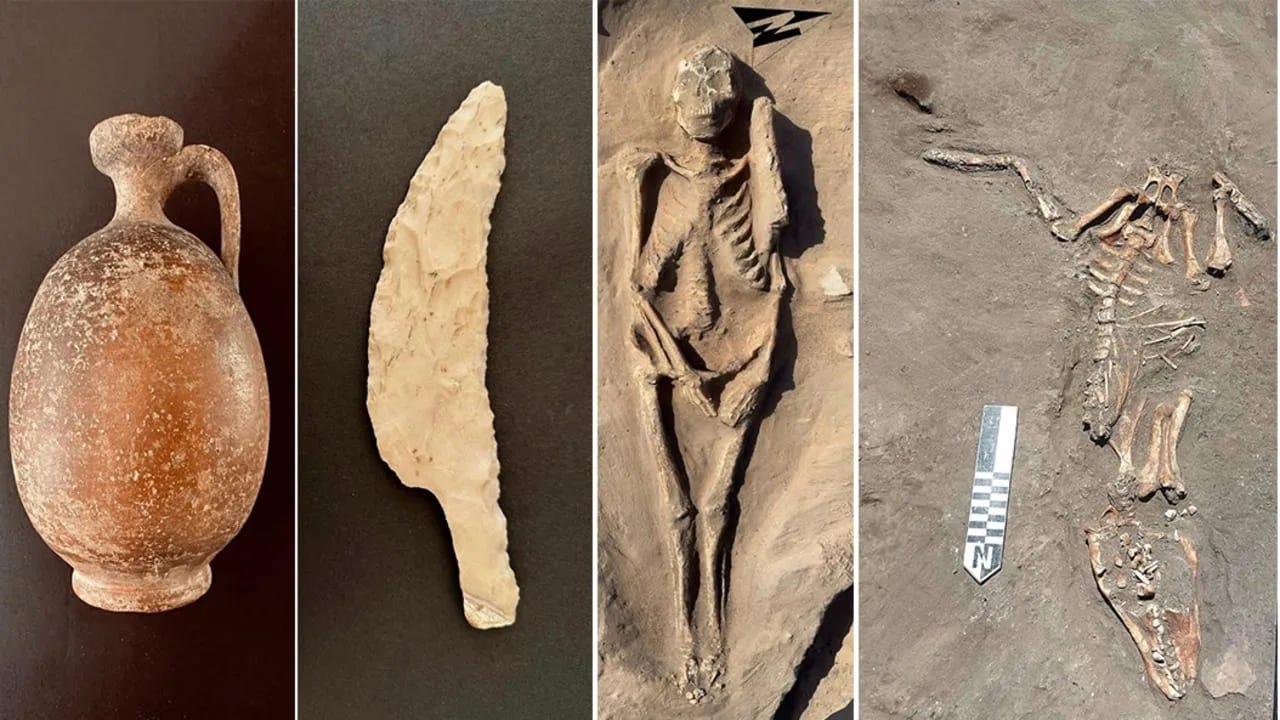
Ancient human remains and artifacts uncovered at a Greco-Roman cemetery in northern Egypt. Photo credit: Egyptian Ministry of Tourism and Antiquities
The excavation was carried out by an Egyptian archaeological mission working under the Supreme Council of Antiquities. According to the ministry, the cemetery belongs to the Greco-Roman period, but the deeper archaeological layers show that Tell Kom Aziza had been active across a far longer span of Egyptian history.
The burial area contained several different forms of interment. Some individuals were placed directly in simple pits cut into the soil. Other graves were framed with mudbrick, creating more formal burial spaces. Archaeologists also found painted plaster coffins and barrel-shaped pottery coffins, a burial type especially associated with the Ptolemaic period.
Preliminary examination of the human remains shows a wide range of funerary practices. Burials were arranged on different axes, including north-south and east-west orientations. The position of the hands also varied. Some individuals had their hands crossed over the pelvis, while others had them placed near the neck. Some were arranged in the Osirian position, with the arms crossed over the chest, and others had the arms extended alongside the thighs.
This variation matters because it points to a cemetery used by communities with different burial habits, social traditions, or chronological phases. Rather than presenting one uniform funerary system, Tell Kom Aziza shows a more complex picture of how local communities treated the dead during the later periods of ancient Egyptian history.
One of the most unusual discoveries at the site was the presence of complete wild boar burials. Such finds are rare in ancient Egyptian funerary contexts. The animal carried difficult religious associations in Egyptian belief, especially because of its connection with the god Set. For that reason, the discovery raises questions about whether the boars were connected to domestic activity, economic life, local ritual behavior, or another practice that still requires further study.
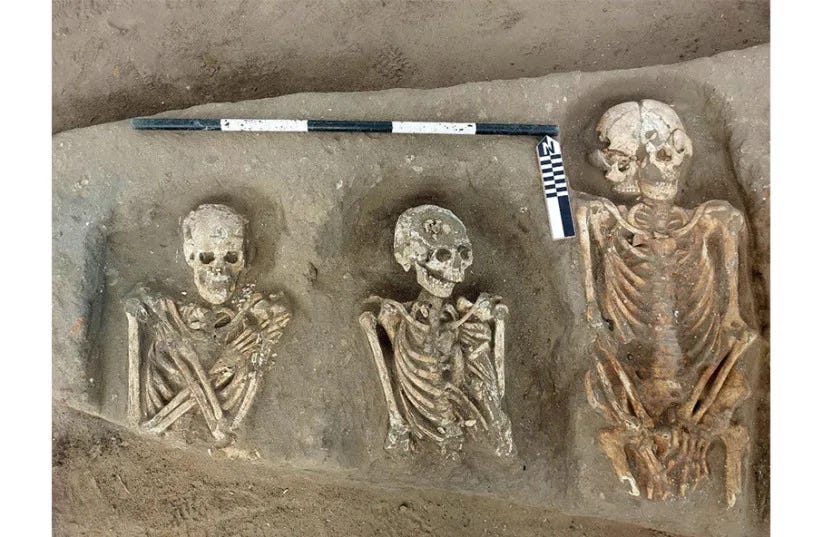
Human remains uncovered at a Greco-Roman cemetery in northern Egypt. Credit: Egyptian Ministry of Tourism and Antiquities
The cemetery was built above older occupation layers. These earlier levels produced material connected with the Old Kingdom, New Kingdom, Late Period, Greek period, and Roman period. This means the Greco-Roman cemetery represents only one stage in a much longer history of activity at Tell Kom Aziza.
The finds from the older layers include pottery vessels, stone vessels, bread molds, multi-purpose stone tools, ovens, storage containers, and large quantities of fish, bird, and animal bones. These objects shift the importance of the site beyond burial alone. They show food preparation, storage, craft activity, and interaction with the Delta environment over many centuries.
Mohamed Abdel-Badie, head of the Ancient Egyptian Antiquities Sector at the Supreme Council of Antiquities, described the site as a multi-period archaeological record. The evidence suggests that Tell Kom Aziza first functioned as a place of habitation and daily work before later becoming an area of intensive funerary use.
Tourism and Antiquities Minister Sherif Fathy also emphasized the importance of the discovery for understanding the Nile Delta. The value of the site comes from the combination of burial remains, settlement layers, tools, food remains, and architectural traces. Together, they provide evidence for how communities lived, worked, adapted, and buried their dead across thousands of years.
The discovery is especially important because Delta archaeology often preserves a complicated sequence of occupation. River activity, agriculture, later building, and modern development can all disturb ancient sites. A stratified site such as Tell Kom Aziza can therefore help archaeologists reconstruct long-term patterns of settlement in a region that played a major role in Egyptian history.
Earlier research has already pointed to the wider importance of Beheira Governorate during the Late Dynastic, Ptolemaic, and Roman periods. Kom Aziza had previously produced Dynastic, Ptolemaic, and Roman material, showing that the site was occupied earlier than expected for a settlement usually discussed in relation to the Ptolemaic and Roman periods.
The new cemetery discovery adds another layer to that picture. It connects the site’s domestic and settlement evidence with funerary behavior, allowing researchers to examine how the same landscape changed function over time. A place used for daily life in one period could later become a cemetery, while older materials beneath the graves preserved traces of earlier communities.
The complete wild boar burials may become one of the most discussed elements of the discovery. Their meaning remains open to interpretation, but their presence inside an archaeological layer at Tell Kom Aziza adds a rare animal-related component to a site already rich in human burial evidence and domestic remains.
Further excavation seasons are expected to clarify the chronology of the cemetery, the relationship between the different burial types, and the role of the animal burials. Future analysis of the bones, pottery, coffins, and settlement debris may also help identify changes in diet, economy, burial customs, and religious practice across the long life of the site.
Additional Context: Newly Unearthed Coffins at Dra Abu el-Naga in Luxor
The Tell Kom Aziza discovery follows another major announcement from Egypt’s archaeological sector concerning finds at Dra Abu el-Naga on Luxor’s West Bank. Excavations there began in November 2025 and focused on the southeastern area of the tomb of Roy, an 18th Dynasty royal scribe, and the area between Roy’s tomb and the nearby tomb of Baki.
Archaeologists uncovered a burial shaft containing ten wooden coffins. The coffins were reported in good condition and carried painted scenes and inscriptions. Preliminary study dated four of them to the 18th Dynasty, including one inscribed with the name Merit, identified as a chantress of Amun.
Another coffin dated to the Ramesside period and carried the name Padi-Amun, identified as a priest in the Temple of Amun. The remaining coffins were assigned to Egypt’s Late Period, approximately 664–332 BCE.
The Luxor discoveries also included evidence for previously unrecorded individuals and titles, showing how continued excavation in known necropoleis can still expand the historical record. Together, the finds at Tell Kom Aziza and Dra Abu el-Naga show two different sides of Egyptian archaeology: one in the Delta, where settlement and funerary layers overlap across millennia, and one in Thebes, where elite tomb landscapes continue to produce new information about named individuals, religious offices, and burial practices.