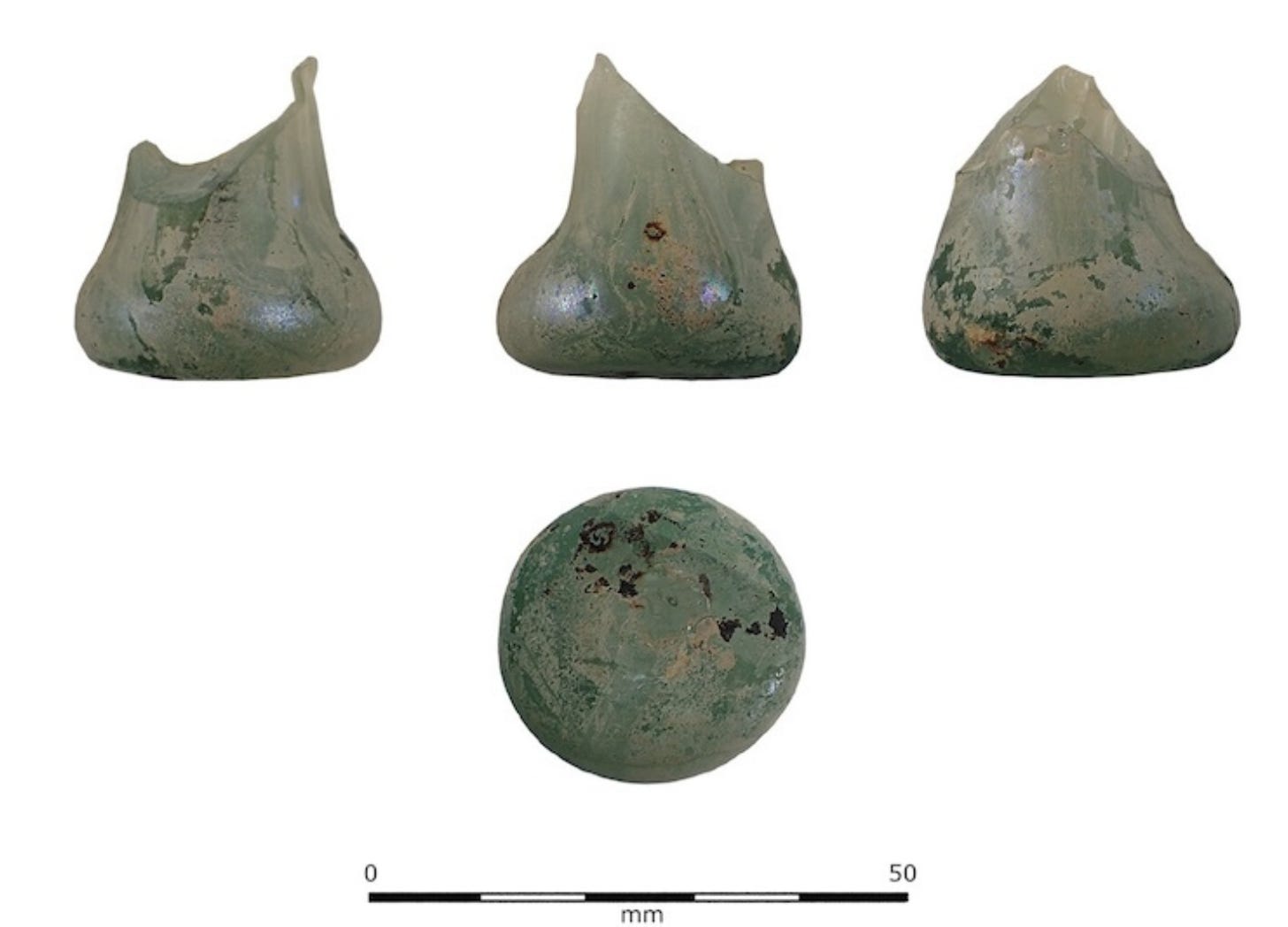
Kohl bottle found in York. Credit: Cool, 2026.
A small glass vessel discovered in York more than four decades ago has turned out to be far more important than it first appeared. The object, excavated in 1983–1984 at 24–30 Tanner Row, was recovered from a late 2nd-century Roman context. For years, it seemed like an unusual but modest glass bottle. A new study now identifies it as something extremely rare in Britain: an Egyptian-style kohl bottle.
The study, published in Britannia by archaeologist Hilary Cool, suggests that the vessel was probably used to hold kohl, the dark eye cosmetic strongly associated with ancient Egypt and Sudan. Kohl was commonly stored in small containers and applied around the eyes with a narrow stick. Although these containers are well known from Egypt and Nubia, they are almost never found beyond that cultural zone. That makes the York example exceptional.
The bottle was found during excavations by the York Archaeological Trust in an area that, during the late 2nd century AD, appears to have functioned partly as a dumping ground. At that time, the settlement across the River Ouse from the legionary fortress was developing into an important civilian center. The discarded material from this zone may have included waste connected with the nearby Roman military presence.
At first glance, the object did not fit neatly into the normal pattern of Roman-British glassware. It was blue-green in color, with thick walls, a silvery surface sheen, and dark weathered patches. Its appearance was not easily explained by burial conditions, since most of the other glass from the same assemblage did not show the same unusual features. Nor did it seem likely that the vessel was simply a badly made Roman bottle. Its form, proportions, and internal structure were too distinctive.
The crucial detail was the shape of the hollow inside the vessel. Many Roman bottles have an interior cavity that follows the outer shape of the object. The York bottle, however, had a more cylindrical internal space. This feature closely matches certain Egyptian glass bottles of the 1st and 2nd centuries AD, especially those designed to store kohl. A narrow cylindrical space would have made practical sense, allowing the cosmetic to be kept securely and removed with an applicator.
Comparable kohl bottles have been found at several Egyptian sites, including military locations such as Umm Balad and Didymoi. They are also known from rubbish deposits at Fort Wadi Abu Ma’amel, where dozens of 2nd-century kohl containers were recovered. In Egypt, such objects were part of a familiar daily habit. In Roman Britain, however, they are almost unknown.
This rarity is important. If kohl bottles had been widely traded across the empire as ordinary goods, archaeologists would expect to find them more often in Britain, Gaul, Italy, or other Roman provinces. Their absence suggests that kohl was not a common export product or fashionable empire-wide cosmetic in this specific container form. It appears instead to have remained strongly tied to Egypt and Sudan.
That makes the York bottle more personal than commercial. It was probably not a perfume container, because its size and structure were not well suited to that purpose. It is also unlikely to have been a casual tourist souvenir, since Egyptian kohl containers would appear more frequently in the archaeological record if visitors commonly brought them home. The object therefore may represent the possessions of someone who used kohl as part of a familiar cultural practice.
Cool’s interpretation is careful rather than sensational. The bottle does not prove, by itself, that an Egyptian lived in York. There is no inscription naming the owner, no skeleton identified as Egyptian, and no direct written record attached to the find. But the object does open a plausible historical possibility: it may have belonged to a person from Egypt, or to someone who had lived in Egypt long enough to adopt local habits, before ending up in Roman Britain.
This possibility fits the wider picture of Roman York, known as Eboracum. The city was one of the most important military centers in Roman Britain, home to the Sixth Legion Victrix and connected to people, goods, and religious ideas moving across the empire. Soldiers and officers did not always remain in one region. They could be posted from one frontier to another, carrying personal objects, habits, beliefs, and identities with them.
There are other hints of Egyptian connections in Roman York and nearby regions. A famous inscription from York records that Claudius Hieronymianus, legate of the Sixth Legion Victrix, built a temple to Serapis, a Greco-Egyptian deity. This does not prove that Egyptians lived in York, but it does show that Egyptian religious imagery and cult practice had a place in the city’s Roman military world.
Further south, in Leicester, archaeologists have also found objects with Egyptian associations, including an ivory box decorated with Anubis, the jackal-headed god connected with death and protection. Military seals from the same broader context included links to Egypt as well. Taken together, these finds suggest that Egyptian cultural references were not entirely alien to Roman Britain, especially in settings connected with soldiers and imperial mobility.
The York kohl bottle is therefore small in size but large in significance. It reminds us that Roman Britain was not isolated at the edge of the world. It was part of a vast imperial network stretching from northern Britain to Egypt, Syria, North Africa, the Danube, and beyond. People moved through that network, and they carried more than weapons or trade goods. They carried customs, cosmetics, gods, memories, and personal routines.
The find also challenges modern expectations about Roman soldiers. Popular imagination often pictures them in armor, carrying shields, and marching in disciplined formation. Yet archaeology can reveal a more intimate world: a soldier or traveler applying eye makeup, keeping a familiar cosmetic in a small bottle, and maintaining a habit learned far from Britain’s cold northern frontier.
No further scientific study is currently planned for this particular vessel, but similar research into Roman glass containers and their contents may continue to reveal hidden details about daily life in the empire. Residues, vessel forms, and forgotten museum finds can all preserve traces of personal behavior that written history rarely records.
In the end, the York bottle does not give us a name. It does not tell us whether its owner was born in Egypt, stationed there, or simply shaped by time spent in the eastern empire. But it does offer a rare and intimate clue. In a late 2nd-century rubbish deposit in Roman York, archaeologists found not just a glass container, but a possible trace of Egyptian identity at the far edge of Roman Britain.


