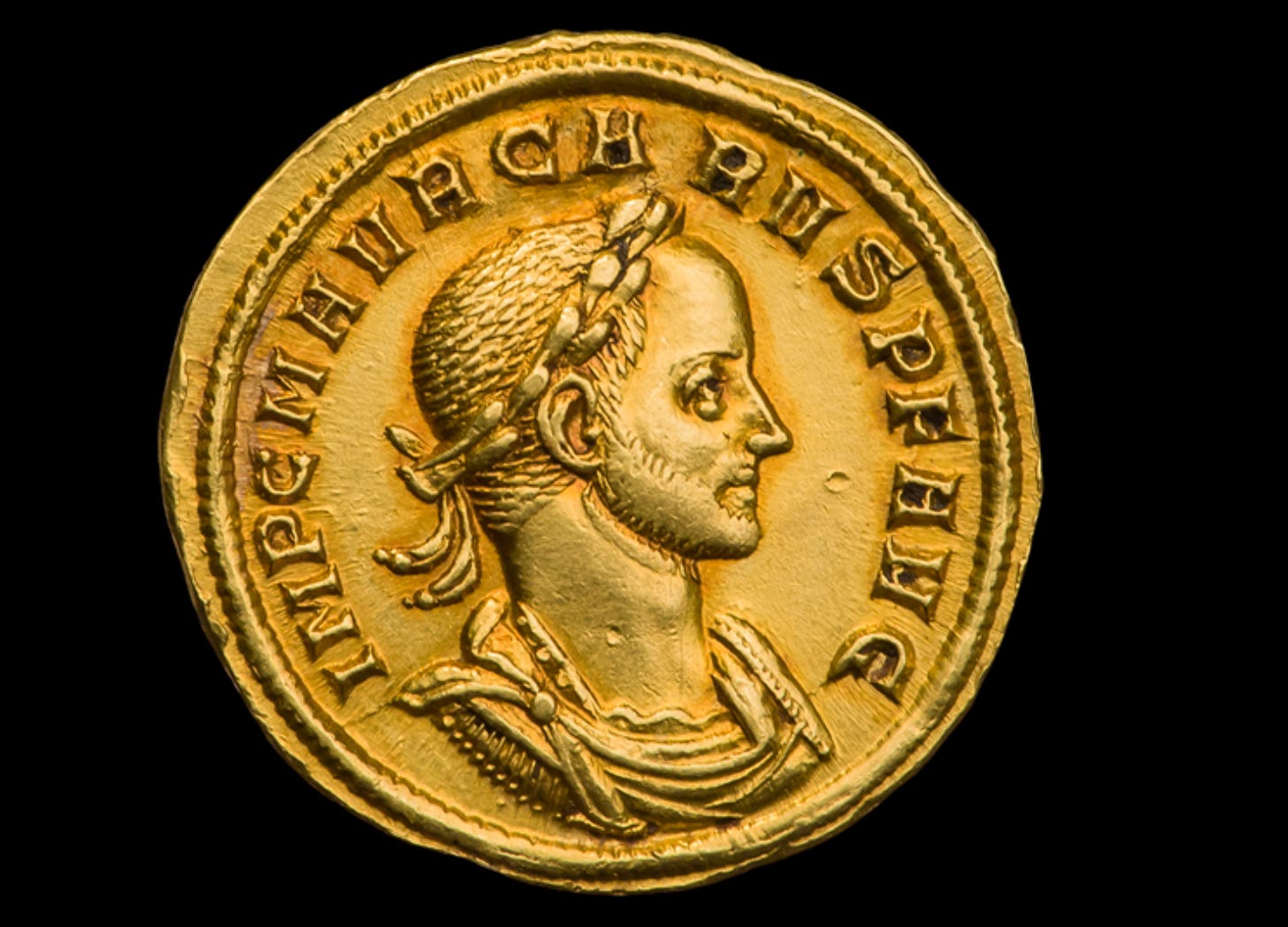
Aureus. Carus. c. AD 282–283, obverse. Bust of Carus in armor and cloak, facing right. Credit: By АНО “Международный нумизматический клуб” - АНО “Международный нумизматический клуб”, CC BY-SA 4.0, https://commons.wikimedia.org/w/index.php?curid=93340292
Roman imperial history is filled with sudden deaths, battlefield disasters, palace plots, poisoned banquets, and suspicious “natural causes.” Yet even by Roman standards, the death of Emper
or Carus stands out as one of the strangest stories attached to any ruler of the empire.
Carus ruled for only a short time, from 282 to 283 CE, but his final campaign placed him at the center of one of Rome’s oldest ambitions: victory in the East. After taking power following the death of Emperor Probus, Carus turned his attention toward Persia, Rome’s great imperial rival. His advance into Sasanian territory was bold, successful, and politically valuable. But at the very moment when his reputation should have reached its height, he died suddenly near the Tigris.
Ancient writers later claimed that the emperor was struck by lightning.
The question is whether that dramatic version should be believed.
Carus, whose full imperial name was Marcus Aurelius Carus, probably came from the western provinces of the empire, though ancient sources disagree over his exact birthplace. Some traditions place his origins in Gaul, while others connect him with Illyricum. Before becoming emperor, he served under Probus and rose to the powerful position of praetorian prefect, a post that placed him close to the military heart of imperial power.
When Probus was murdered by his own troops in 282 CE, Carus was elevated to the purple. His accession was not entirely free from suspicion. Some ancient accounts implied that he may have benefited from, or even encouraged, Probus’ removal. Other accounts are more favorable and present him as a capable soldier chosen by the army in a moment of crisis.
What is clear is that Carus inherited an empire still recovering from the turmoil of the third century. For decades, Rome had faced civil wars, usurpers, border invasions, economic instability, and repeated imperial assassinations. Any emperor who wanted to be taken seriously needed military success quickly.
Carus found that opportunity in the East.
After securing the Danube frontier, he launched a campaign against the Sasanian Persians. The timing favored Rome. The Sasanian king Bahram II was dealing with internal problems and could not respond with full strength. Carus pushed deep into Mesopotamia and reached the region of Ctesiphon, the great Persian capital on the Tigris. Roman emperors had long dreamed of eastern glory, and Ctesiphon carried enormous symbolic weight.
The campaign was impressive enough for Carus to take the title Persicus Maximus, meaning “great victor over the Persians.” For a Roman emperor, this was not just a military honor. It was propaganda, memory, and legitimacy compressed into one title.
Then, at the height of success, everything stopped.
Carus died suddenly in 283 CE while still in Persian territory. The exact circumstances remain unclear because no surviving eyewitness account can be treated as fully secure. Later authors wrote from a distance, and their versions reflect rumor, political interpretation, and literary drama as much as reliable reporting.
The most famous account appears in the Historia Augusta, a late Roman collection of imperial biographies. This source says there were already different explanations for Carus’ death. Some claimed he died from disease. Others said he was killed by a lightning strike. The same narrative describes the emperor as lying ill in his tent when a violent storm broke out. Thunder and lightning terrified the camp, and in the confusion, word spread that the emperor had died.
The detail that makes the story especially interesting is the burning of the imperial tent. According to the account, Carus’ attendants set fire to the tent after his death, and this may have helped create or strengthen the rumor that lightning had struck him. In other words, even the ancient source preserves a rational explanation for how the lightning legend may have formed.
The story did not remain only a medical report or battlefield rumor. It also became a moral and supernatural tale. Some versions suggested that Fate did not allow Roman emperors to pass beyond Ctesiphon. In that reading, Carus was not merely unlucky. He had crossed a boundary set by divine power, and lightning became the visible sign of punishment.
That kind of explanation fit Roman habits of thinking. Storms, omens, dreams, prodigies, and sudden deaths were often interpreted through religion and fate. A victorious emperor dying in enemy territory was already shocking. Turning the event into a heavenly warning gave it meaning.
But modern historians are cautious.
The lightning story is possible in the basic physical sense. People can and do die from lightning strikes. Yet the problem is not whether lightning can kill someone. The problem is whether the surviving evidence gives us enough reason to believe that it killed Carus.
There are several reasons for doubt.
First, the sources are late and not eyewitness accounts. Writers such as Eutropius and Aurelius Victor also mention the lightning version, but they wrote after the event and were repeating a tradition already shaped by rumor.
Second, the Historia Augusta is a difficult source. It preserves valuable material, but it is also famous for unreliable details, invented documents, contradictions, and literary invention. When a source like this gives us both illness and lightning, it should not be read too confidently.
Third, illness fits the evidence very well. The account itself places Carus in his tent already unwell. A sudden death during a military campaign in Mesopotamia would not be surprising. Disease, exhaustion, heat, age, and the stresses of command all provide ordinary explanations.
Fourth, assassination cannot be dismissed. The third-century Roman Empire was brutally unstable, and emperors often died by violence. Carus’ death was followed by the deaths of both of his sons, Numerian and Carinus. Diocletian eventually emerged as the new ruler of the Roman world. This sequence naturally raises suspicion, even if it does not prove that Diocletian or his supporters murdered Carus.
Because of this, three main explanations remain: lightning, illness, and assassination.
The lightning version is the most dramatic.
The illness version is the most restrained.
The assassination version is the most politically tempting.
The truth may be beyond recovery. Carus died in a military camp far from Rome, at the edge of a campaign that had just humiliated Persia. In that environment, news could be controlled, distorted, or mythologized almost immediately. Soldiers needed an explanation. Officials needed a story. Later writers needed a memorable ending.
A lightning strike gave Carus exactly that: a death worthy of legend.
So did Emperor Carus really die from lightning?
The safest answer is this: he died suddenly during his Persian campaign in 283 CE, and ancient tradition soon linked his death to a violent storm. A literal lightning strike cannot be completely ruled out, but illness or assassination is more historically plausible. What survived most powerfully was not certainty, but symbolism.
Carus had reached the old frontier of Roman ambition. Then the sky itself seemed to close over him.