


A small fragment of ceramic from Guatemala may carry one of the earliest known examples of written numeration in Mesoamerica. The object is a Middle Preclassic figurine from La Blanca, an ancient urban center in San Marcos, Guatemala, near the Pacific coast. It dates to roughly 750–650 BC and belongs to a distinctive class of clay objects known as “tab” figurines.
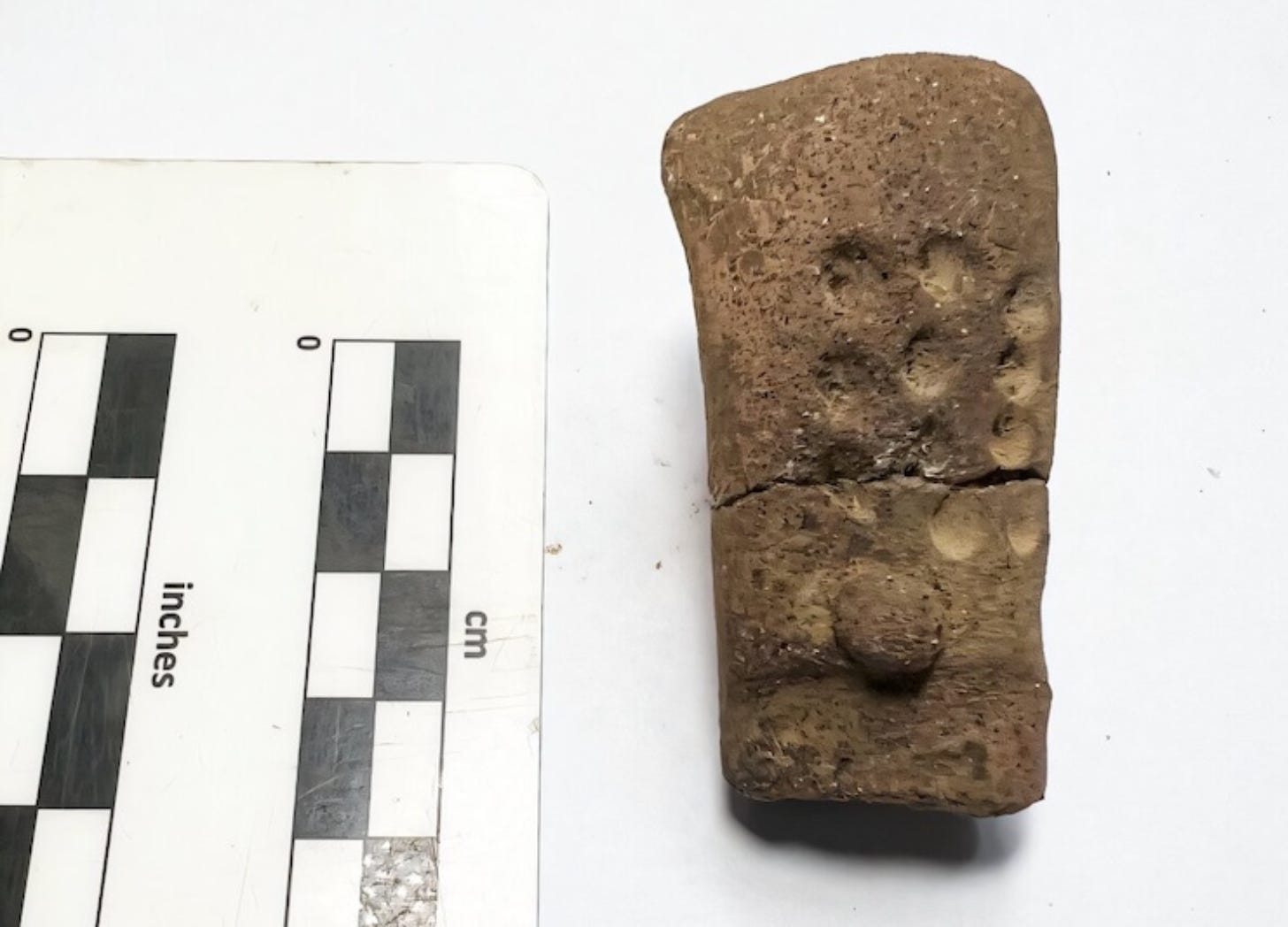
“Tab” figurine with a preserved head-like projection bearing 11 impressed dots. Credit: J. Guernsey.
At first glance, the surviving piece looks simple: a broken figurine with a projecting, head-like form rather than a naturalistic face. Yet on that head-like projection, someone pressed 11 small dots into the clay before firing. The dots are arranged in three vertical columns: one column of three and two columns of four. According to researchers Julia Guernsey, Stephanie M. Strauss, and Michael Love, this arrangement may represent an early form of dot numeration, possibly the number 11.
If this interpretation is correct, the La Blanca figurine becomes an important piece of evidence in the long history of writing and numerical notation in ancient Mesoamerica. It also raises a broader question: were numbers in this early period already connected to identity, the human body, names, destiny, and calendrical systems?
A small object from an early urban center
La Blanca was a major Middle Preclassic settlement in Pacific Guatemala. Archaeological work at the site has revealed thousands of hand-modeled figurines, most of them fragmentary. These objects appear across households of different social ranks, suggesting that figurines were part of shared domestic rituals or community practices rather than objects restricted to a single elite group.
The dotted figurine came from the Joyas Group area of La Blanca, about one kilometer northwest of the ceremonial center. It was recovered near a household floor, in association with architectural remains and other domestic debris, including figurine fragments, obsidian, pottery, and stone pieces. This context matters because early writing and numerical signs in Mesoamerica are often difficult to evaluate when their archaeological setting is uncertain. In this case, the object comes from a controlled excavation context.
The figurine itself is broken. Only the upper portion survives. It belongs to the “tab” figurine type, a category known from La Blanca and nearby sites. More than 300 examples of tab figurines have been identified at La Blanca. Their most unusual feature is the treatment of the head: instead of a fully modeled face, they have a projecting tab-like element. Some examples include headbands or ear ornaments, which indicates that the tab was still meant to be read as a head or head region.
This is where the 11-dot example stands apart. Among the known La Blanca figurines, this one is the only tab figurine currently identified with possible numerical notation.
The significance of the 11 dots
The dots are more than casual decoration. They were pressed into the clay in an organized format before the object was fired. Their layout suggests planning: three vertical columns, arranged above a horizontal band that works visually like a headband or headdress base.
The number is also significant. Eleven is an uneven total. If the dots were only decorative, a more symmetrical design might be expected, especially in a visual tradition where balance and axial organization often mattered. The arrangement of three, four, and four may have helped viewers recognize the total quickly.
In later Mesoamerican writing systems, dots commonly represented units of one. The best-known system is the bar-and-dot system, where a dot equals one and a bar equals five. This system became central to Maya, Zapotec, and Epi-Olmec/Isthmian writing, especially in calendrical records. Yet Mesoamerican numerical systems were never limited to a single format. Later Mixtec and Aztec manuscripts, for example, could use dots alone for numbers up to 13.
That wider background makes the La Blanca figurine especially interesting. The 11 dots could represent a stringed-dot numeral, where each dot carries the value of one. In that reading, the object may preserve an early written “11.”
Early numbers before fully developed writing
The La Blanca figurine belongs to a period when Mesoamerican communities were experimenting with graphic systems, symbols, and early forms of notation. The authors of the Cambridge study place the object within a broader group of possible early numerical signs.
One comparison comes from Oxtotitlan Cave in Guerrero, Mexico, where a Middle Preclassic painting includes a zoomorphic head associated with rows of dots. Scholars have debated whether the dots refer to a calendrical date, possibly connected to the 260-day ritual calendar.
Another important comparison comes from San Andrés in Tabasco, Mexico, where a cylinder stamp dated to around 650 BC has been interpreted by some researchers as evidence for early logographic writing. Its design includes bird imagery, speech scrolls, glyph-like elements, and possible numerical signs. The interpretation remains debated, but the object shows how portable artifacts could carry early graphic communication.
Chiapa de Corzo also provides relevant evidence. Several stamps from Preclassic contexts show circles or dot-like forms that may have functioned as numbers, although distinguishing numerical dots from decorative circles can be difficult. This problem is central to the La Blanca figurine as well: circular marks can be numerical, decorative, iconographic, or mnemonic depending on context.
The La Blanca object gains importance because of its archaeological context, its clear organization, and the placement of the dots on the head or headdress area of a figurine.
Numbers, bodies, and identity
The study’s most important argument concerns the relationship between numbers and the body. In ancient Mesoamerica, numbers were deeply connected to embodied ways of thinking. The vigesimal, or base-20, system reflects the human body: ten fingers and ten toes. In several Mayan languages, words connected to personhood and the number 20 are closely related.
The K’iche’ Maya term “winik” can mean both “person” and “20.” This connection reflects a broader Mesoamerican habit of linking counting, personhood, and the body. In Kaqchikel, the word for destiny is associated with “face,” again connecting identity to the body’s most expressive and socially meaningful part.
This matters for the La Blanca figurine because the possible numeral appears exactly where identity was often displayed: the head or headdress. Across Mesoamerica, heads, faces, helmets, and headdresses frequently carried signs of rank, name, supernatural status, lineage, or identity. The famous colossal heads of San Lorenzo each have distinctive headgear. Smaller figurines from sites such as Cantón Corralito also carry symbols on or around the head.
The La Blanca figurine appears to fit this wider convention. Its 11 dots may have identified the being represented by the figurine. That identity could have been human, supernatural, ancestral, calendrical, or a combination of categories that were more fluid in Preclassic Mesoamerican thought.
The 260-day calendar connection
The 260-day calendar was one of the most important intellectual systems in Mesoamerica. It combined 20 day signs with 13 numerical coefficients, creating a cycle of 260 named days. In later Mesoamerican societies, a person’s birth date in this calendar could be tied to identity, name, destiny, character, and ritual role.
The 11 dots on the La Blanca figurine are not accompanied by a clear day sign, so they cannot be confidently read as a full calendar date. Still, their placement and format make a calendrical or identity-related meaning plausible. The number may have referred to a day coefficient, a name, a supernatural being, or another category of information understood by people familiar with the visual system.
The authors are careful with this interpretation. They do not claim that the meaning is solved. Instead, they argue that the figurine opens a serious possibility: early numeration at La Blanca may have participated in a wider system where numbers helped communicate identity.
La Blanca and proto-glyphs
The dotted figurine is not the only evidence that La Blanca participated in early experiments with graphic communication. Other objects from the site carry motifs that resemble later Mesoamerican calendrical signs, including forms associated with Ajaw, K’in, and Lamat/Venus signs. These appear on ceramics from an elite household in the ceremonial center.
That pattern suggests that some La Blanca residents were already using controlled visual forms that later became part of formal writing and calendar systems. The dotted figurine expands this discussion because it was portable, small, and made for close viewing. It fits a broader pattern in Mesoamerica, where early writing and proto-writing often appeared on objects that could be handled, moved, and inspected at close range.
The figurine’s small scale is therefore part of its importance. Early writing in Mesoamerica did not begin only on grand monuments. It also developed through intimate objects: stamps, ceramic vessels, figurines, sherds, mural fragments, and portable surfaces.
Why the interpretation remains cautious
The meaning of the dots remains uncertain. Archaeologists must be careful when interpreting early marks, especially when only one example of a type is known. Circular marks may be decorative. They may imitate beads, breath, speech, water, celestial features, or other visual ideas. Some Preclassic objects show dots or circles that look numerical but may have had other meanings.
The La Blanca figurine, however, has several features that support a numerical reading. The dots are intentional, pre-fired, organized into columns, placed on a head/headdress zone, and total 11. Their format resembles later and earlier examples of dot-based notation across Mesoamerica. The object also comes from a site where other proto-glyphic signs were already present.
For these reasons, the figurine deserves attention even without a final decipherment. It may represent the earliest securely dated example of possible dot-system numeration in Mesoamerica.
A fragment with a large historical meaning
The La Blanca figurine shows how much information can be contained in a small object. It is a broken piece of clay, but it sits at the intersection of several major developments: early urbanism, household ritual, figurine traditions, proto-writing, numerical notation, calendrical thought, and identity.
The 11 dots may record a number. They may label a being. They may refer to a calendrical identity or a name. They may preserve a visual system that was understood locally and later disappeared or transformed. The exact reading is still open, but the object shows that early Mesoamerican communities were already experimenting with ways to make numbers visible and meaningful.
This possibility carries broader implications for understanding the origins of writing in the Americas. The La Blanca figurine suggests that numbers were part of early graphic communication and that they may have been tied to how people understood bodies, names, destiny, and personhood.
A small figurine from Guatemala may therefore preserve more than an early number. It may preserve a moment when number, body, and identity were being shaped into written form.
Sources
Julia Guernsey, Stephanie M. Strauss, and Michael Love. “Numbers and Bodies: Potential Early Numeration on a Middle Preclassic Figurine from La Blanca, Guatemala.” Latin American Antiquity, First View, Cambridge University Press, 2026. DOI: 10.1017/laq.2025.10146.
Cambridge Core article page, Latin American Antiquity, Cambridge University Press.
Additional references discussed within the Cambridge paper include work on La Blanca figurines, early Mesoamerican writing, the 260-day calendar, San Andrés, Oxtotitlan Cave, Chiapa de Corzo, San Bartolo, La Mojarra, Los Mangales, and Mesoamerican numeration systems.