


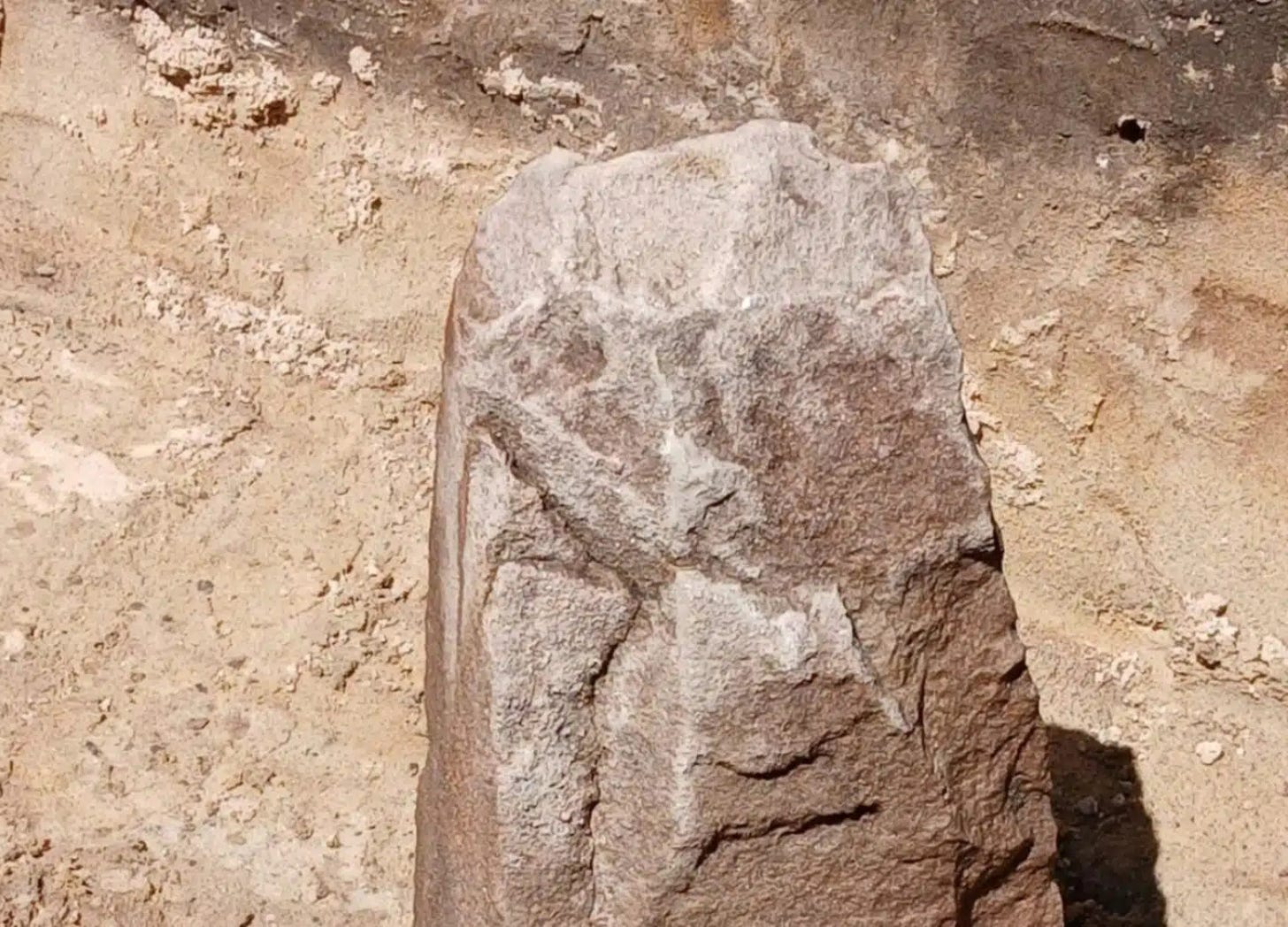
Archaeologists working on Alderney, one of the Channel Islands, have uncovered a prehistoric standing stone that appears to show the outline of a human face. The stone was found at Longis Common during excavations led by Dig Alderney, a local archaeological group investigating the island’s long and layered past. Researchers believe the object may belong to the European Middle Bronze Age, although further examination is still needed before a secure interpretation can be made.
The stone is described as a menhir, a type of upright prehistoric stone often associated with ancient landscapes across Britain and mainland Europe. Menhirs could serve several purposes, from territorial markers to ritual monuments, and many were deliberately placed in visible or meaningful positions. In this case, the Alderney stone was discovered standing upright in the ground, suggesting it had not simply been discarded or randomly deposited.
One of the most striking details is the upper part of the stone. From certain angles, it seems to carry face-like features, although archaeologists are being careful not to overstate the evidence. Dr Jason Monaghan, secretary of Dig Alderney, has said the stone may look like a figure under particular light conditions, but researchers have not yet confirmed whether the facial appearance was intentionally carved or partly created by natural weathering.
The surface is rough, pitted, and heavily weathered, which makes interpretation difficult. Small cracks and natural irregularities can sometimes create shapes that resemble eyes, a nose, or a mouth. At the same time, prehistoric communities are known to have selected stones for their natural forms, especially when a rock already suggested a human, animal, or symbolic shape. That possibility makes the Alderney discovery especially interesting: the stone may not need to be fully carved to have held meaning.
Archaeologists also noted that the lower part of the stone may have been shaped into a more rectangular base. This could have helped it stand securely when set into the earth. If confirmed, that detail would support the idea that the object was intentionally positioned rather than naturally placed. The question now is whether the upper “face” was worked by human hands, enhanced from a natural shape, or simply perceived because of erosion.
The find comes from Longis Common, an area that has already produced evidence from several periods of Alderney’s history. Previous work at the site uncovered Iron Age pottery, along with remains connected to the German occupation of the island during World War Two. That combination shows how the same landscape was reused across thousands of years, from prehistoric communities to modern military activity.
For Alderney, the discovery is important because it adds another prehistoric layer to the island’s archaeological map. The Channel Islands sit between Britain and the coast of northern France, making them part of a wider cultural zone where seafaring, trade, movement, and ritual practices may have connected communities across the Channel. Similar standing stones are known in regions such as Brittany and northern France, which makes the Alderney menhir part of a broader Atlantic and northwest European tradition.
The next stage will involve closer study of the stone itself. Researchers are expected to look for tool marks, examine the surface under different lighting, and attempt to place the monument more securely within its archaeological context. Dating standing stones can be difficult, especially when the stone itself cannot be directly dated, so surrounding deposits and associated finds may become essential.
Whether it proves to be a deliberately carved face, a naturally suggestive stone, or something in between, the Alderney menhir raises a powerful question about prehistoric perception. Ancient people did not always separate natural form from human-made symbol in the way modern observers do. A stone that already looked alive may have been exactly the kind of object worth raising, marking, and remembering.
For now, the Longis Common stone remains a rare and intriguing glimpse into Alderney’s deep past: a weathered prehistoric monument standing between landscape, memory, and the human imagination.