Bronze Age Brain Surgery
Archaeologists in southern Uzbekistan found a 4,000-year-old child’s skull showing evidence of cranial surgery.
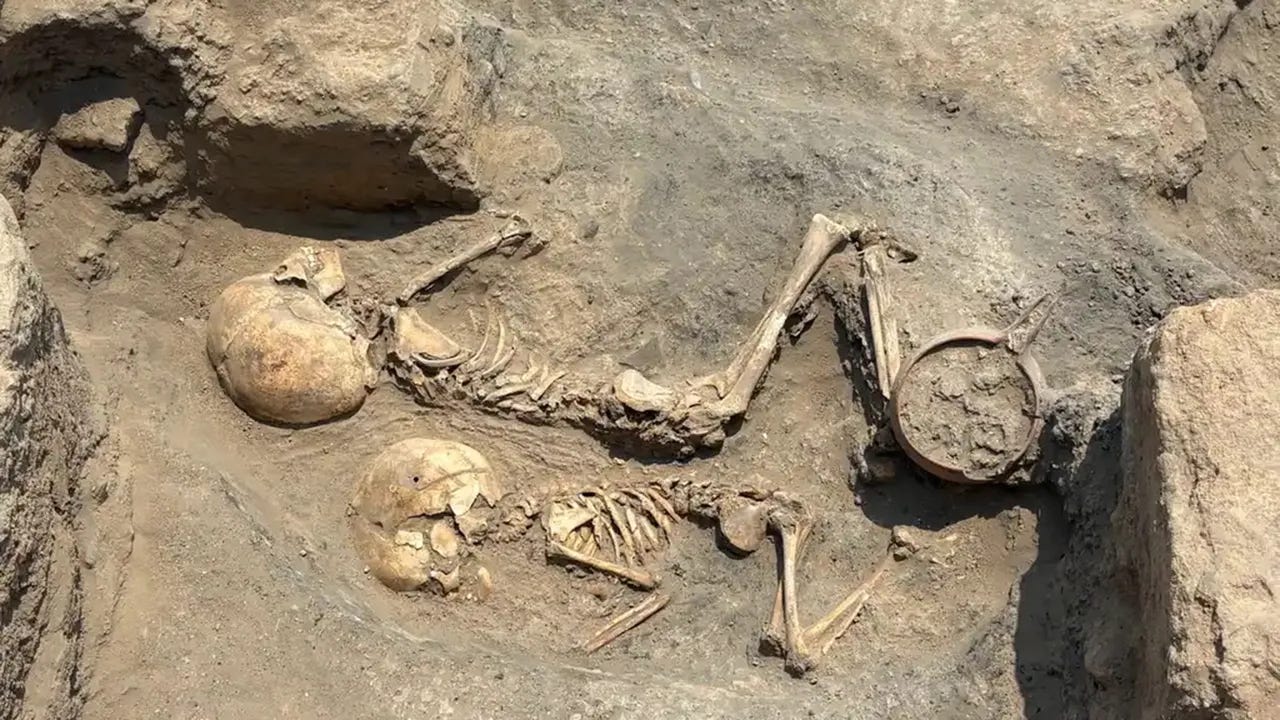
The 5-year-old child was buried in a single grave beside a younger child. Image credit: Italian Archaeological Mission in Uzbekistan
The discovery was made at Djarkutan, one of the most important ancient settlements of Northern Bactria. The site lies in the Surkhan Darya region, near the modern border with Afghanistan, in an area once connected to the wider world of the Oxus Civilization. This Bronze Age culture, also known as the Bactria-Margiana Archaeological Complex, flourished across parts of Central Asia and linked oasis settlements, river valleys, trade networks, craft traditions, and early urban life.
Inside one grave, researchers found the remains of two children placed side by side. One child was about three years old at death. The other was about five. It was the older child whose skull drew immediate attention.
According to the archaeological team, the skull shows clear signs of trepanation, an ancient procedure in which an opening is deliberately made in the cranium. The operation appears to have been carried out with tools made from stone or bone. In modern terms, it belongs to the deep history of neurosurgery, although in the Bronze Age the meaning of such a procedure may have combined medical, ritual, and spiritual ideas.
That is what makes the find so important. The child from Djarkutan is now considered the earliest documented evidence of surgery in Central Asia and one of the earliest known examples from the wider Asian continent. It pushes the medical history of the region deeper into the Bronze Age and raises new questions about how much ancient specialists understood about the human body.
Trepanation is one of the oldest surgical practices known in archaeology. It has been identified in prehistoric skulls from many parts of the world, including Europe, Asia, Africa, and the Americas. In some cases, signs of bone healing around the opening show that patients survived for weeks, months, or even years after the operation. In other cases, little or no healing suggests the person died soon after the procedure or that the opening was made after death.
The Djarkutan child is especially striking because of the patient’s age. Trepanation is already a difficult procedure to interpret in adults. On a five-year-old child, it becomes even more mysterious. Why was such an operation attempted? Was the child suffering from trauma, seizures, severe headaches, infection, behavioral changes, or another condition that ancient healers believed could be treated by opening the skull? Or did the act belong partly to a ritual world where illness, the body, and unseen forces were understood together?
The grave was uncovered at Djarkutan, an archaeological site in southern Uzbekistan near the Afghan border. Image credit: Italian Archaeological Mission in Uzbekistan
Researchers have suggested several possible explanations. The operation may have been an attempt to treat a neurological problem, such as epilepsy, migraines, head injury, or abnormal behavior. But they also warn against separating medicine and ritual too sharply. In a Bronze Age society, healing may not have been purely clinical in the modern sense. The person performing the procedure may have been both a medical specialist and a ritual authority.
This is one of the most fascinating parts of the discovery. A trepanation requires practical knowledge. The person carrying it out had to understand where to open the skull, how deeply to cut, and how to avoid immediately fatal damage. Even with simple tools, the procedure demanded control, experience, and a steady hand. Whether it was done for healing, ritual, or both, it suggests the presence of trained specialists within the community.
Djarkutan itself gives the discovery a wider historical meaning. It was not an isolated village but a major Bronze Age settlement with organized quarters, monumental architecture, skilled craftsmanship, and links to broader cultural networks. The Oxus world connected regions that now include Uzbekistan, Turkmenistan, northern Afghanistan, eastern Iran, and surrounding zones. These communities were part of a dynamic Bronze Age landscape where agriculture, metallurgy, ceramics, long-distance contacts, and urban planning developed in complex ways.
The discovery also adds a human dimension to this civilization. Archaeology often presents the Oxus world through seals, ceramics, architecture, and trade. This grave tells a more intimate story. Two children were buried together. One of them carried on the skull the mark of an extraordinary intervention. Behind that mark is a moment of fear, hope, and decision: someone tried to save or transform the life of a child.
The excavation is part of a joint Italian-Uzbek research project involving the University of Salento, Termez State University, and the Samarkand Archaeological Institute. The project began in 2024 and uses a multidisciplinary approach, bringing together archaeology, physical anthropology, paleogenetics, archaeobotany, archaeozoology, topography, and archaeometry. These methods are designed to reconstruct not only the objects found at Djarkutan, but also the lives, deaths, diets, environments, and biological histories of the people who lived there.
Further study will be crucial. Researchers still need to examine the skull in greater detail to understand the surgical marks, the technique used, the possible cause of the operation, and whether the child survived for any period after the procedure. Paleogenetic and anthropological analyses may also reveal more about the child’s health, ancestry, and relationship to the younger child buried in the same grave.
For now, the find stands as a powerful reminder that ancient medicine was not primitive in the simple sense often imagined. Bronze Age people did not have modern hospitals, anesthesia, antibiotics, or metal surgical instruments in every context. Yet some communities clearly developed complex ways of responding to illness and injury. They observed the body, created tools, performed difficult interventions, and built systems of knowledge that blended practical experience with belief.
The skull from Djarkutan does not answer every question. Instead, it opens many new ones.
Who performed this operation? Was that person a healer, priest, surgeon, elder, or specialist whose role no longer fits modern categories? What symptoms led the community to attempt such a risky intervention on a child? Did the child survive the procedure? And how widespread was this kind of medical knowledge in Bronze Age Central Asia?
A small skull from a 4,000-year-old grave has now become one of the most important pieces of evidence for early surgery in the region. It shows that the history of medicine in Central Asia is older, more complex, and more human than previously known.
At Djarkutan, the Bronze Age does not speak only through walls and artifacts. It speaks through the fragile remains of a child, and through the mark left by someone who tried, thousands of years ago, to heal.


