Britain’s Oldest Known Cave Art Rediscovered in Wales
A set of red markings inside a coastal cave in South Wales may have changed the story of prehistoric art in Britain.
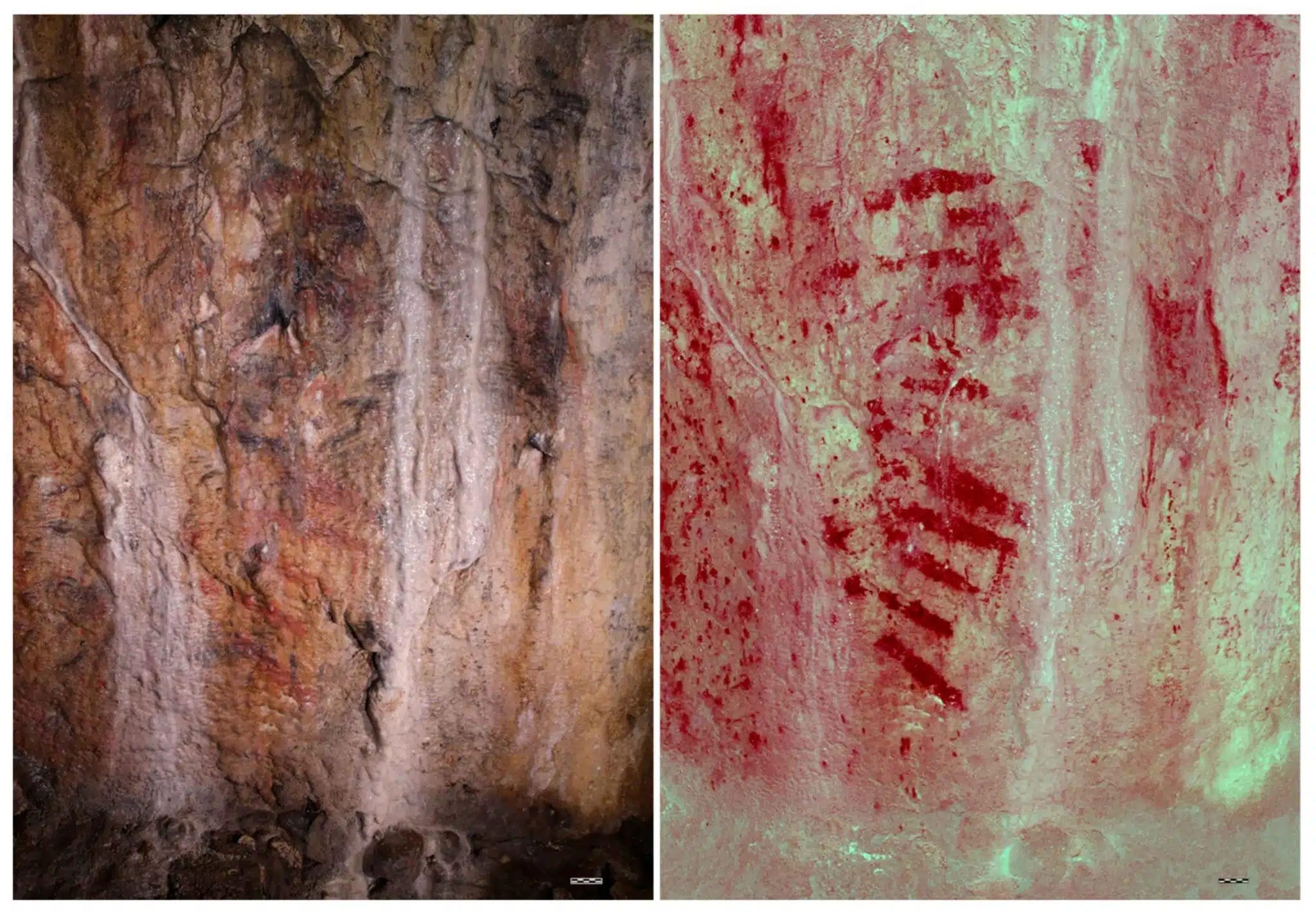
Red pigment markings at Bacon Hole Cave in Wales. Credit: George H. Nash / CC BY 4.0
Archaeologists have confirmed that painted stripes found in Bacon Hole Cave, on the Gower Peninsula near Swansea, were made by human hands around 17,100 years ago. If the dating is upheld by future study, the discovery makes the markings the oldest known rock art in Britain and one of the earliest known examples in north-western Europe.
The artwork is not a dramatic image of an animal, a hunting scene, or a human figure. It is far simpler: a series of red horizontal lines painted on a cave wall. Yet that simplicity is exactly what makes the find so important. These marks suggest that people living near the end of the Ice Age were using caves in Britain not only for shelter or survival, but also for symbolic expression.
The story of Bacon Hole Cave is unusual because the discovery is not entirely new. The markings were first noticed in 1912 by two major figures in early prehistoric research, Professor William Sollas and the French prehistorian Henri Breuil. At the time, they believed the red bands were Palaeolithic cave art, a claim that would have placed Britain directly within the wider Ice Age artistic tradition known from caves in France and Spain.
But the excitement did not last. By the late 1920s, the markings were dismissed as natural mineral staining. Researchers argued that the red lines were probably caused by iron-rich minerals seeping through the limestone rather than by prehistoric people. Without the scientific dating tools available today, the original interpretation faded from serious discussion.
More than a century later, archaeologists returned to the cave with modern technology. An international research team led by Dr George Nash re-examined the painted surface and surrounding areas inside Bacon Hole. Their work included detailed photography, digital enhancement, pigment analysis and uranium-series dating of calcite deposits associated with the markings.
The results brought the old claim back to life. The red pigment was identified as haematite, an iron-rich mineral widely used in prehistoric art. The team concluded that the markings were not random stains but deliberately applied pigment. The lines appear arranged in a structured pattern, with a consistency that points toward intentional human activity.
Eastern view of the cave entrance and the Bristol Channel. Credit: George H. Nash / CC BY 4.0
Researchers also noted other traces of red pigment in the cave, including dots, splashes and possible finger-applied marks. This suggests that the painted panel may not have been an isolated accident or casual stain, but part of a broader act of mark-making within the cave.
Dating cave art is never simple. The paint itself is difficult to date directly, so scientists often examine mineral layers that formed over or around it. At Bacon Hole, uranium-series dating of calcite associated with the markings produced an age of about 17,100 years. Since the calcite formed after the pigment was placed on the wall, the painting must be at least as old as the mineral layer covering it.
That places the artwork in the Late Upper Palaeolithic, a period when Britain and Wales were emerging from the harsh conditions of the last Ice Age. The landscape around what is now the Bristol Channel would have looked very different. Sea levels were lower, the coastline was not the same, and large animals moved through open, cold environments. Reindeer, wild horses, bison and other Ice Age fauna would have been part of the world known to hunter-gatherer groups.
The people who made the marks were likely mobile hunter-fisher-gatherers. They lived in a challenging but changing landscape, following animal movements and seasonal resources. Caves along the Gower coastline may have offered shelter, vantage points and places of repeated return. But Bacon Hole now appears to have held something more than practical value.
The location of the markings is especially significant. They were found in a side chamber, away from ordinary daylight. Deep cave spaces often create a powerful sensory experience. Darkness, echo, narrow passages and separation from the outside world can all transform how a place feels. For prehistoric communities, entering such spaces may have carried symbolic or ritual meaning.
This does not mean we can claim with certainty what the marks meant. Archaeologists cannot read them as a written message. They may have been ritual symbols, memory marks, signs of presence, or part of a practice whose meaning is now lost. What can be said more safely is that the markings show deliberate human engagement with the cave wall at a very early date.
Bacon Hole also has a longer archaeological story. The cave and the wider Gower Peninsula are already known for important prehistoric remains. Gower contains some of Britain’s richest Palaeolithic evidence, including the famous Paviland burial, long known as the “Red Lady of Paviland,” although later study showed the remains belonged to a young man. The region has repeatedly shown that Wales played an important role in the deep human history of Britain.
The new Bacon Hole research strengthens that picture. It suggests that artistic or symbolic activity in the British Isles was older and more complex than previously confirmed. Before this discovery, some of Britain’s best-known Ice Age art came from sites such as Creswell Crags and Cathole Cave. Bacon Hole now pushes the timeline further back.
The discovery also shows how archaeology can change when old evidence is revisited. The red lines were not newly painted, newly exposed, or newly invented. They were seen in 1912, rejected decades later, then recovered through modern scientific methods. In that sense, the find is both a discovery and a correction.
It is a reminder that early archaeologists sometimes noticed important things but lacked the tools to prove them. It is also a reminder that scientific interpretation is never fixed forever. A mark once dismissed as natural can become, under closer analysis, one of the most significant pieces of prehistoric art in a region.
Conservation now becomes a major issue. Bacon Hole Cave is located in a fragile coastal environment, and public access is unsafe. The National Trust, which cares for the site, has taken protective measures to safeguard the archaeology, the painted surfaces and the bats that use the cave. Such protection is essential because prehistoric pigment can be easily damaged by touch, moisture, pollution or uncontrolled visits.
The importance of the Bacon Hole markings lies not in visual complexity, but in survival. These red lines remained on a limestone wall for more than 17,000 years. They passed through climate change, sea-level change, erosion, human visits, later graffiti and scholarly doubt.
Now, after a century of uncertainty, they are being recognized again as the work of Ice Age people.
In a quiet side chamber on the Gower coast, a few red lines have reopened a deep chapter of human expression in Britain. They show that even in a cold, shifting world at the edge of the Ice Age, people were not only surviving. They were marking places, shaping meaning, and leaving traces of thought on stone.
Help support ancientcontent.com. Every coffee helps fund more research, articles, visuals, and stories from archaeology, artifacts, and lost civilizations.


