


In a busy ceramic workshop on the edge of ancient Yavne, sometime in the seventh century BC, someone lost or set aside a small limestone seal carved with a scene of worship, a bearded man raising his hand toward the moon and a star.
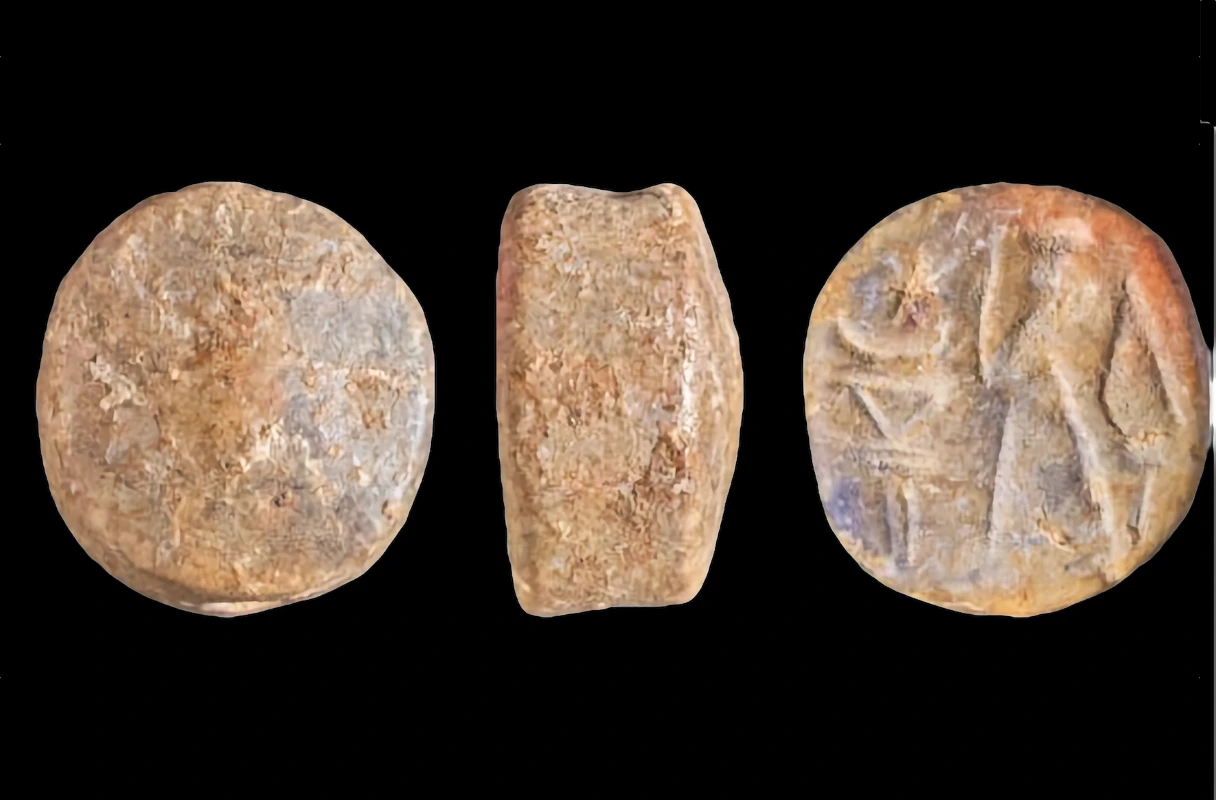
‘Assyro-Levantine’ stamp seal discovered at Yavne. Credit: Assaf Peretz, Yaakov Shmidov, and Ulrike Zurkinden.
Rediscovered by Israel Antiquities Authority archaeologists nearly 2,700 years later, the object offers a rare, intimate link between an industrial corner of a Levantine town and the astral cults the Bible’s own writers condemned by name.
The seal is described in a study by Christoph Uehlinger of the University of Zurich, together with Israel Antiquities Authority archaeologists Pablo Betzer, Revital Golding-Meir, and Daniel Varga, and Gunnar Lehmann of Ben-Gurion University of the Negev.
Found beside the kilns
The seal turned up in Area U of the Yavne East excavations, part of an extensive Iron Age IIC ceramic production complex on the city’s outskirts. The industrial zone held nine kilns, several potter’s wheels, and multiple work surfaces equipped with grinding tools, storage jars, and other tools of the trade. The seal itself was found on one such surface, alongside storage jars, a mortar, and loom weights, about three meters from a potter’s wheel and some twenty meters from the kilns, a working corner of a working site rather than a temple or shrine.
Intact and small enough to fit easily in a palm, the seal measures 14.6 millimeters long, 13.2 millimeters wide, and 8 millimeters high. It is carved from reddish crystalline limestone and pierced lengthwise, meaning it was almost certainly worn as a pendant or personal ornament rather than kept purely for administrative sealing.
Its presence stands out precisely because it does not belong. Researchers describe it as the only clearly foreign element in the immediate environment of the workshop. Yet it is not entirely alone at the site. About 160 meters north, in Area H, excavators had already uncovered several tombs carrying features distinctive of Assyrian funerary tradition, including two burials covered by large inverted ceramic vessels and a crypt built of mud brick, a tomb type previously unknown in the region for this period. Taken together, the seal and the tombs point to a non-local population with a real presence at Yavne, not just passing imperial influence.
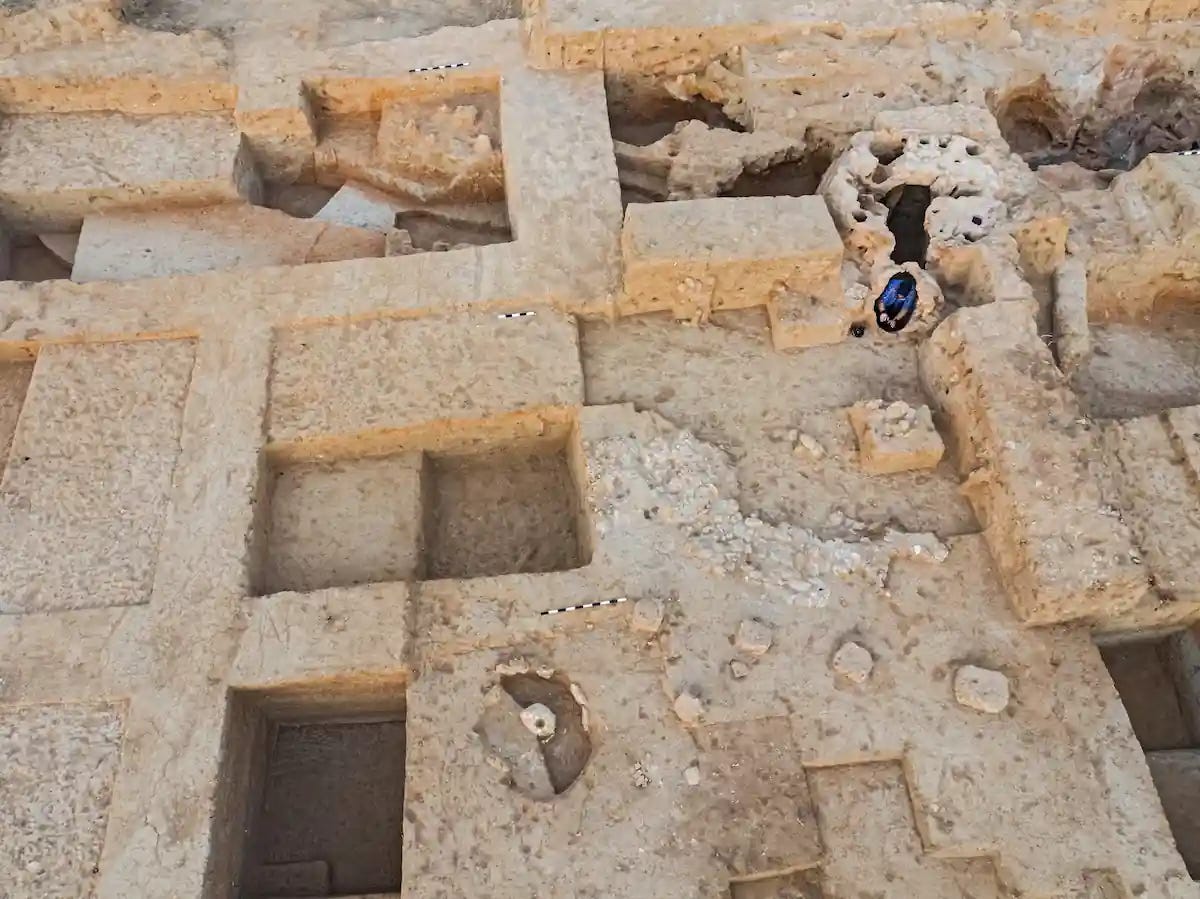
Iron Age potters’ workshop in Area U, viewed eastward, showing the kiln (upper right), working surfaces with stone- and pebble-paved floors (centre right), flat kurkar stones, and a potter’s wheel. Credit: Assaf Peretz, Israel Antiquities Authority.
A man, a moon, and a star
The seal’s engraved base carries a compact but legible scene. A bearded male figure, dressed in a long, ankle-length two-piece garment, stands facing left toward three symbolic elements, one arm extended forward with the palm open, in a gesture the researchers read clearly as worship or ritual greeting.
Arranged vertically before him are an offering stand or pedestal at the base, a crescent moon above it, and higher still an eight-pointed star. The researchers identify the crescent and the star with the Mesopotamian moon god Sin and the goddess associated with the planet Venus, two of the central figures of the Assyro-Babylonian pantheon. To the worshiper’s right stands a cypress-like tree, a detail the study takes as a sign that the scene depicts an outdoor ritual, performed in the open rather than inside a temple building.
The composition is not unique to Yavne. Researchers have identified closely comparable seals from Akko, Tell Jemmeh, Jerusalem, Megiddo, and Shiqmona, each combining the same basic repertoire, worshiper, offering stand, crescent moon, star, and tree, in varying arrangements.
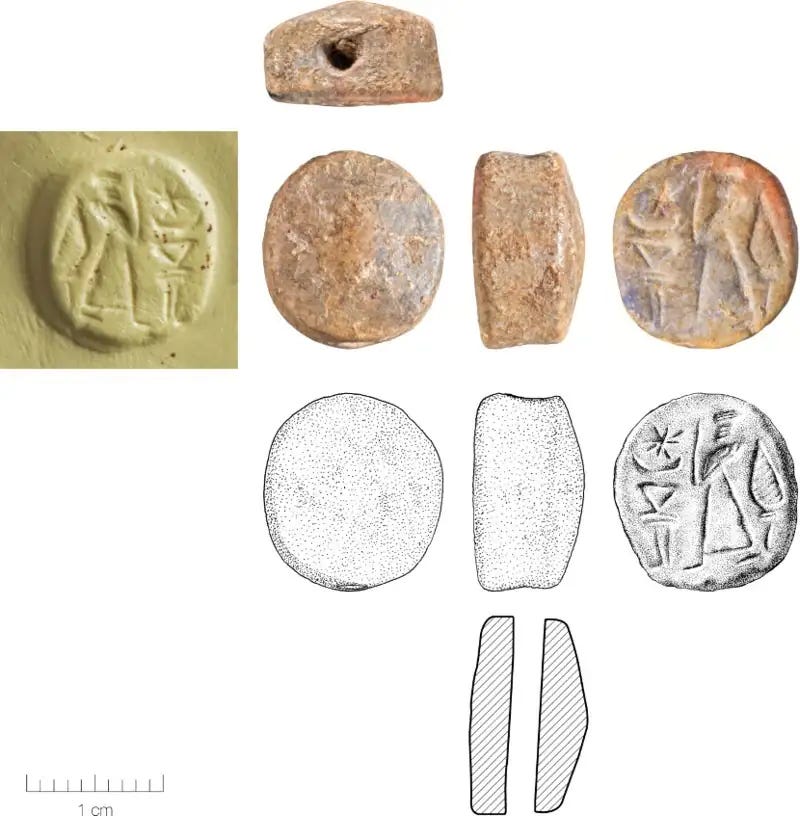
‘Assyro-Levantine’ stamp seal from Yavne. Credit: Assaf Peretz, Yaakov Shmidov, and Ulrike Zurkinden.
The moon rises over the sun
The Yavne find fits a broader shift the study’s authors trace across the region’s glyptic art. During the eighth century BC, seal iconography in the southern Levant was dominated by solar imagery. Across the seventh century, that balance tipped decisively toward the moon, the planets, and the stars.
The authors connect that shift directly to the westward expansion of the Assyrian Empire and to changes in imperial religious policy spanning the reigns of Tiglath-Pileser III through Ashurbanipal, the period they call the Assyrian century, running roughly from 730 to 630 BC. They are careful, however, not to overstate the case for a simple imperial imposition. The Yavne seal belongs to a fairly homogeneous group of seals, made of brown or reddish limestone, roughly circular in shape, and carved using a technique that combines incised lines with flat relief and interior shading. Although these objects clearly arrived in the southern Levant as a consequence of Assyrian expansion, the researchers stress they should not simply be labeled Assyrian, since no comparable examples have turned up at the empire’s own core, in Nineveh, Arbela, or Assur.
Rather than a phenomenon imposed top-down from the Assyrian center, the study frames the rise of astral cult imagery and its associated seal production as something closer to a regional response, a way local populations across the southern Levant adapted to the new realities of Assyrian hegemony on their own terms.
The priests Josiah swept away
Perhaps the study’s boldest proposal is who these seals actually belonged to. The researchers connect the worshiping figures depicted on them to a specific class of ritual specialists, known in Aramaic inscriptions as kmr and in the Hebrew Bible as kemarim. The term appears in the Book of Hosea and in the Second Book of Kings, where these priests are described as practitioners of astral cults and divination, a class of ritualists the biblical narrative says King Josiah suppressed as part of his religious reforms.
The relevant passage, 2 Kings 23:5, names the kemarim as those who burned incense to Baal, to the sun, to the moon, to the planets, and to all the host of heaven. For Uehlinger and his co-authors, this priesthood was not a phenomenon confined to Judah alone, but part of a wider network of ritual specialists active across the southern Levant during the Assyrian period, of which the Yavne seal’s owner may well have been one small, otherwise anonymous member.
Yavne under Assyrian rule
Yavne sits roughly 15 kilometers from Ashdod and 40 kilometers from Ashkelon, a strategic position on the southern coastal plain. The researchers place the seal’s context within the broader arc of Assyrian domination over the region, which took effective hold following Tiglath-Pileser III’s campaigns of 734 and 732 BC. In 711 BC, Sargon II conquered Ashdod and converted the territory into a province under an Assyrian governor, a presence attested by fragments of three Assyrian royal stelae found at Ashdod and by a monumental administrative building at Ashdod Ad Halom, roughly 15 kilometers southwest of Yavne, likely the governor’s residence. Local kingship persisted alongside that imperial administration, the researchers note, citing inscriptions of Esarhaddon from 677 BC and Ashurbanipal from 667 BC that name a king of Ashdod called Ahimilki, alongside an Assyrian governor, Samas-kasid-ayabi, recorded as eponym of the year 669 BC. Assyrian control over the Yavne and Ashdod area lasted until roughly 637 to 635 BC, when the Egyptian pharaoh Psammetichus I’s campaign against Ashdod brought it to an end.
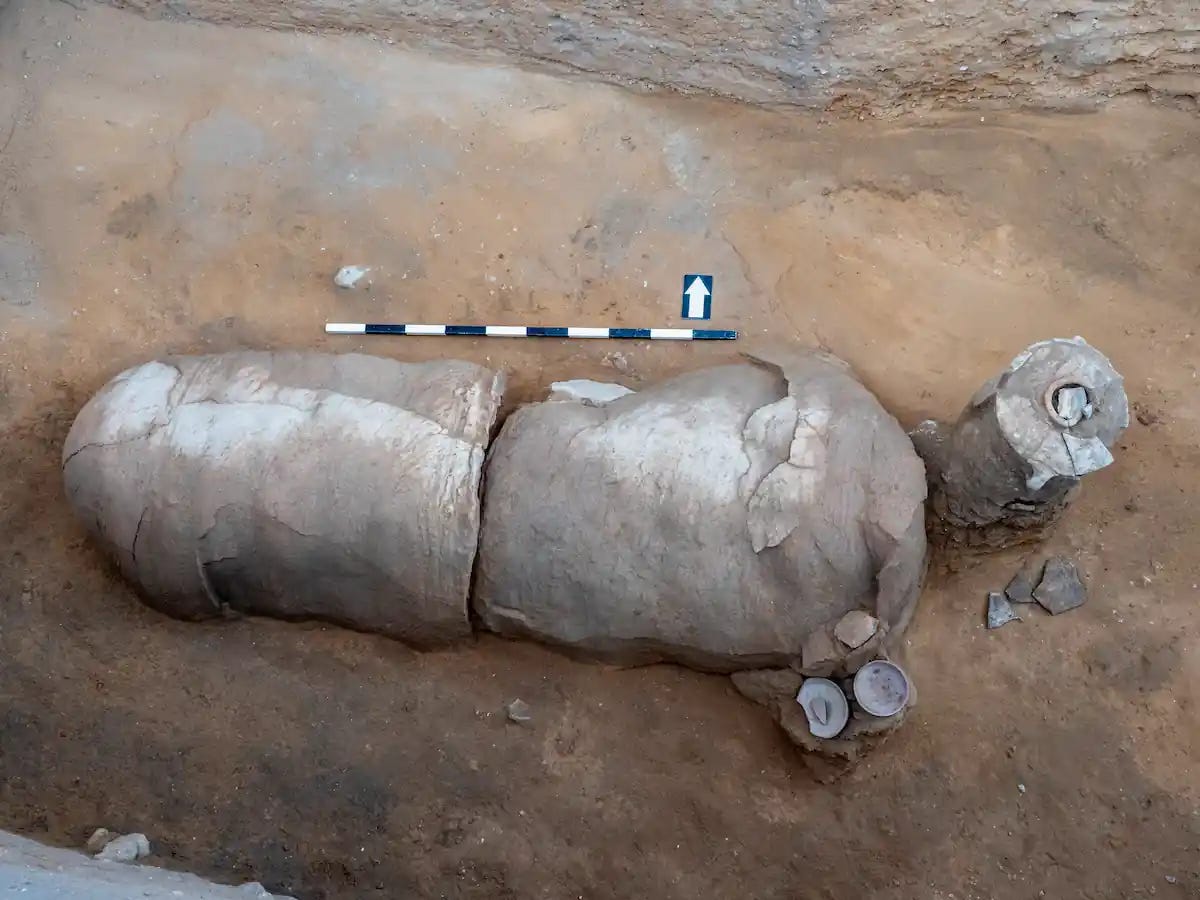
‘Double-pot’ burial unearthed in Area H. Credit: Assaf Peretz, Israel Antiquities Authority.
An industrial hub in an imperial economy
The pottery complex where the seal was found carries its own economic significance. About 20 kilometers south of Yavne, the city of Ekron hosted a major olive oil production center under Assyrian rule, an industry that would have consumed vast quantities of ceramic storage containers, yet no pottery workshops have been identified at Ekron itself. Yavne, by contrast, held a substantial ceramic production facility clearly capable of manufacturing containers at scale. Although no direct evidence of oil or wine production has turned up at Yavne itself, the researchers consider it plausible that the site supplied ceramics to Ekron or to other centers within the wider Assyrian economic network.
The Assyrian-style tombs uncovered nearby, with their inverted double-vessel burials and mud-brick crypt, may belong to deportees resettled from Mesopotamia, a practice documented in the territory of Ashdod and at Tel Hadid, or to individuals otherwise connected to the Assyrian administration. Together with the seal, the researchers conclude, these finds offer a privileged window into the complex interactions between Yavne’s local population and Assyrian imperial power during the seventh century BC, evidence not simply of military and administrative control, but of a local population that adopted, reinterpreted, and adapted elements of imperial culture on its own terms, as a small stone seal, lost on a potter’s work surface, quietly attests.
Support Independent Ancient Content. Your support helps me create more archaeology posts, articles, and mini history videos:
Source. Uehlinger, C., Betzer, P., Golding-Meir, R., Varga, D., and Lehmann, G. (2026). “An ‘Assyro-Levantine’ Stamp Seal with a Worship Scene Found near Tel Yavne.” Tel Aviv, 1 to 26. doi.org/10.1080/03344355.2026.2637186
In the Land of Canaan, on Mount Zion—if I am not mistaken—to the west of Jerusalem, they worshipped the twins ‘Shachar and Shalem’.
Shachar – black; the black moon.
Shalem – the full moon.
There may be a connection.