For the first time, underwater archaeologists have identified shipwrecks in the Bahamas that can be linked to the real pirates of the Caribbean.
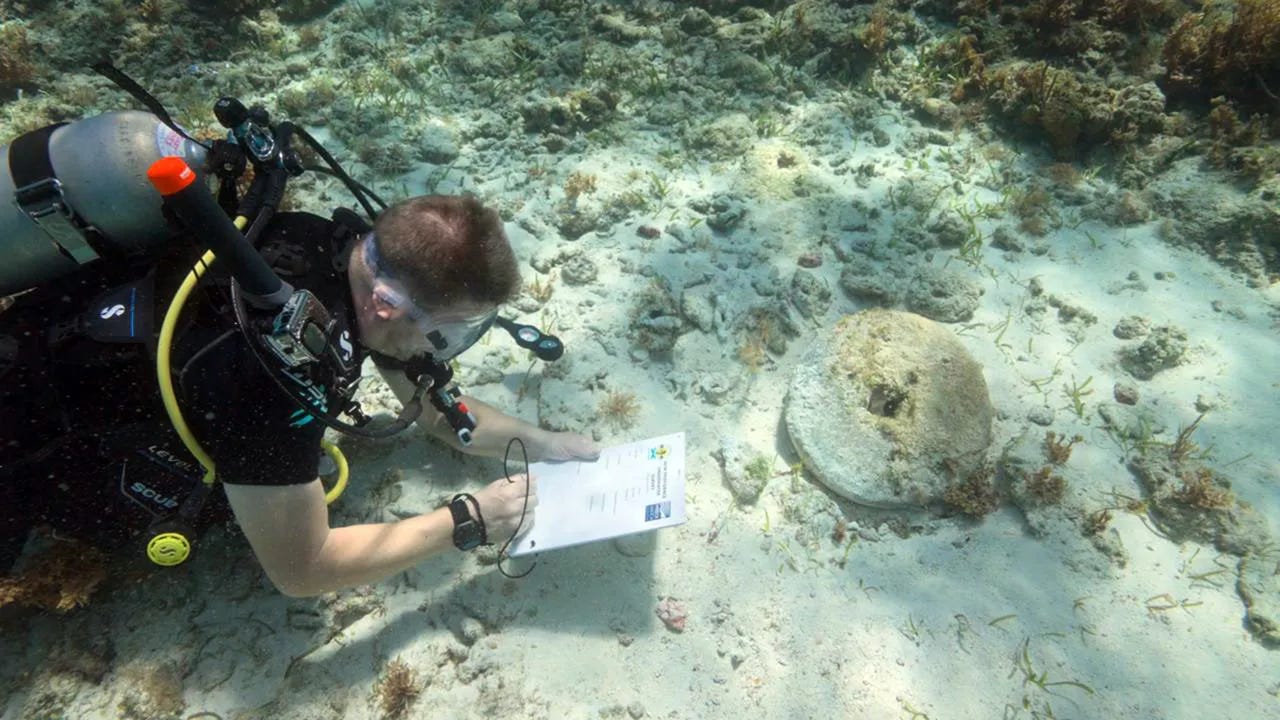
Divers discovered a grinding stone used for sharpening swords, a find recorded by marine archaeologist Sean Kingsley. Image credit: Chris Atkins, © Wreckwatch TV
The discovery was made in and around Nassau, on New Providence Island, a place that became one of the most important pirate bases in the Atlantic during the late 17th and early 18th centuries. For decades, Nassau was associated with figures such as Blackbeard, Calico Jack Rackham, Henry Avery, Benjamin Hornigold, and Anne Bonny. Until now, however, the physical remains of pirate-era ships in Nassau’s own waters had never been properly documented through an official archaeological survey.
An international team of archaeologists and filmmakers discovered six shipwrecks during work in Nassau Harbour and nearby waters. Three of those wrecks have been connected to the Golden Age of Piracy, the period usually dated from the 1680s to the 1720s, when Atlantic trade routes, colonial rivalries, privateering, and maritime crime helped create a short but intense age of pirate activity.
One of the most important discoveries was a burned wooden hull lying beneath a pile of ballast stones. Ballast stones were carried in ships to help stabilize them, especially when they were lightly loaded. In this case, the stones were found resting over the remains of the vessel’s burned structure, including planks, frames, and wooden treenails. Treenails were wooden pegs used to fasten parts of a ship together, and their presence suggests an early 18th-century date.
The burned condition of the hull is one of the strongest clues connecting the wreck to pirate activity. Pirates did not simply seize ships and sail away with treasure. After taking cargo, guns, fittings, and anything else of value, they often destroyed the captured vessel. Burning a ship down to the waterline helped remove evidence and made it harder for authorities to reconstruct what had happened.
That makes this Nassau wreck especially important. It is not just another old ship on the seabed. It may preserve the physical remains of a known pirate tactic: capture, strip, burn, and abandon.
The team also found evidence of armed vessels from the same era. East of Nassau Harbour, another wreck contained a swivel gun, an iron cannon, and ballast. A second armed wreck, located about 22 miles east of Nassau, appears to have been an early 18th-century sloop. It included a ballast pile, a large deck cannon, an iron swivel gun, a grinding stone used for sharpening blades, lead musket balls, and three cannonballs.
These finds do not automatically prove that every wreck belonged to pirates. Some merchant ships also carried weapons for protection, especially in waters threatened by piracy. Still, the combination of heavy armament, missing cargo, burning, and location makes the pirate connection strong. In particular, the absence of ordinary cargo on some wrecks may support the idea that the vessels were stripped before they sank or were deliberately destroyed.
Nassau was the right place for such evidence to appear.
During the Golden Age of Piracy, New Providence became a natural hideout. Its harbour offered shelter, shallow approaches, and escape routes that were useful for smaller vessels. Large naval ships had difficulty operating in parts of the harbour, while pirate sloops could move quickly through narrow channels. This geography helped Nassau become a base where pirates planned raids, divided plunder, repaired vessels, and sold or traded stolen goods.
By 1718, the situation had become serious enough for Britain to send Woodes Rogers as royal governor. His mission was to restore order and break pirate control of New Providence. Historical records from that period describe dozens of seized ships around Nassau that had been burned or sunk. Those accounts have long suggested that pirate wrecks should exist in the area, but Nassau Harbour had never produced confirmed archaeological examples until this project.
The new expedition was possible because the team received official permission from the Antiquities, Monuments and Museum Corporation of the Bahamas to dive in a restricted zone of Nassau Harbour. The fieldwork took place in September and October 2025, with help from local divers who knew the waters.
The conditions were difficult. Nassau Harbour is large, active, and affected by strong currents. The seabed has also been disturbed by dredging, pipelines, and coastal development. Sharks are common in the area as well. For archaeologists, that meant the chances of finding intact remains were low. The survival of any wooden hull from the early 18th century was therefore unexpected.
One site under Nassau’s old bridge contained two badly damaged hulls. One had been pierced by a modern pipeline, showing how recent harbour development has affected older wrecks. Even so, the team identified rigging, glass bottles, hull planks, and bricks from a ship’s cooking area. This vessel may have struck a sandbank during a storm rather than being destroyed in a pirate attack, but it still helps reconstruct the maritime landscape of Nassau during and after the pirate period.
Another group of finds points to Nassau’s later transformation from pirate base to trading port. Archaeologists discovered remains of shipping containers and dozens of clay tobacco pipes. Some were decorated with royal British symbols, including a crown and coat of arms. These pipes were probably made in London in the 1740s or 1750s, after Nassau’s most notorious pirate period had already ended.
That later wreck may have belonged to an English trading ship traveling to New Providence after pirate control had been suppressed. The cargo, including wine bottles and decorated smoking pipes, shows a different Nassau: not the chaotic pirate harbor of the early 1700s, but a port trying to return to regular commerce.
The discovery also raises the question of Henry Avery’s famous ship, the Fancy.
Avery was one of the most successful pirates of the period. In 1695, he and his crew attacked a Mughal treasure ship in the Indian Ocean, taking an enormous fortune in gold, silver, jewels, and other valuables. Afterward, Avery sailed to Nassau, where historical accounts say the Fancy was stripped and abandoned or scuttled in 1696.
One of the newly recorded wrecks has been considered as a possible candidate for the Fancy because of its size, age, and construction. The absence of artifacts could fit the historical account of a ship that had been stripped before abandonment. But the identification remains uncertain. There is no single object naming the vessel, and hundreds of wrecks from different periods lie in and around Nassau Harbour. For now, the Fancy connection is a possibility rather than a proven conclusion.
That caution is important. Pirate archaeology is difficult because pirates rarely left clean archaeological signatures. Their ships were often stolen vessels, not specially built pirate craft. They carried mixed cargo, reused weapons, and moved quickly between regions. A pirate wreck might contain English, French, Dutch, Spanish, African, or Asian material in the same deposit. In many cases, the strongest evidence comes from the total pattern: weapons, burning, missing cargo, historical location, date, and ship type.
The Nassau finds matter because they add physical evidence to a history often dominated by legend. Popular culture has turned Caribbean piracy into a world of treasure maps, buried gold, dramatic captains, and theatrical violence. The archaeology is more practical and more revealing. It shows how ships were used, attacked, stripped, burned, repaired, or abandoned. It also shows how Nassau changed from a pirate refuge into a controlled colonial port.
The expedition team did not only search underwater. On land, they studied old maps and 300-year-old documents, explored caves associated with pirate stories, examined plantation landscapes connected to enslaved people, and investigated places linked by tradition to Blackbeard and other pirates. Their aim was to reconstruct Nassau as a working pirate landscape, not just as a romantic myth.
The first results suggest that more wrecks may still survive in the harbour and surrounding waters. If Woodes Rogers’s 1718 account of burned and sunken ships is accurate, the six wrecks found so far may represent only a small part of a much larger archaeological record.
For historians, the discovery is significant because Nassau was not a minor pirate stop. It was one of the central bases of the Golden Age of Piracy. Finding pirate-era wrecks there helps connect written records with material evidence on the seabed.
The finds do not give us a Hollywood version of piracy. They show something more useful: burned timber, ballast stones, cannon, musket balls, tobacco pipes, galley bricks, and stripped hulls. These are the remains of a violent maritime economy, where stolen ships were tools, evidence, and sometimes disposable objects.
For the first time, Nassau’s underwater archaeology is beginning to show what happened after the pirates sailed into the harbour.
Sources: National Geographic History
Background on Nassau’s pirate-era shipwrecks and the possible, unconfirmed link to Henry Avery’s Fancy.
Wreckwatch Magazine / Wreckwatch TV
New Providence Pirates Expedition, Fall 2025 fieldwork, six wrecks, three tied to the Golden Age of Piracy.
Your donation helps support the research, writing, visuals, and independent archaeology content published on ancientcontent.com.


