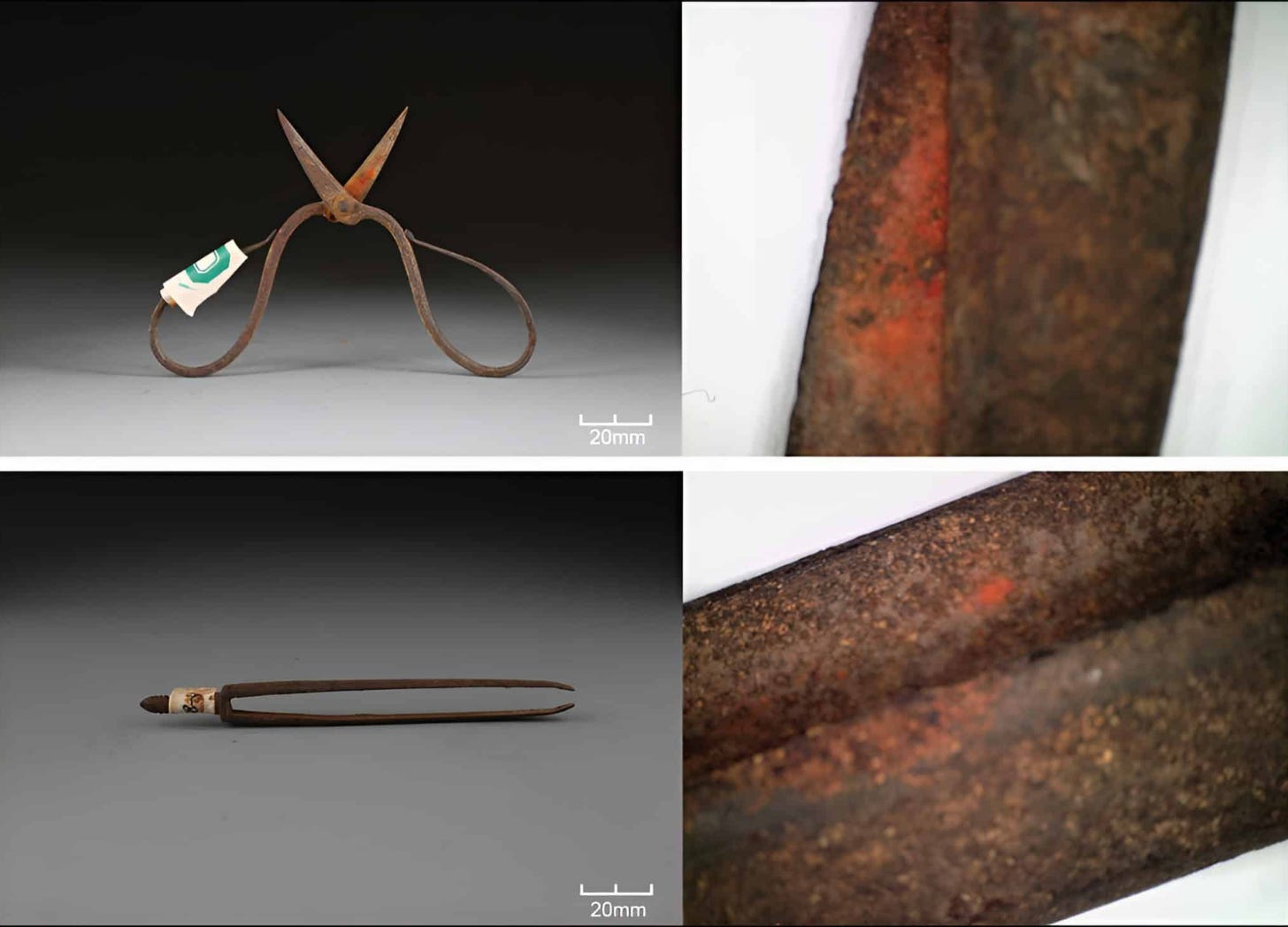
More than 600 years ago, a Chinese physician was buried with the tools of his profession: iron scissors and tweezers. At first glance, they look like modest medical instruments from the Ming Dynasty. But microscopic chemical traces on their corroded surfaces may now change how historians understand the early history of surgical pain relief.
A new study published in Antiquity reports that residues preserved on two medical instruments from the tomb of Xia Quan, a physician who lived from 1348 to 1411 CE in Jiangyin, Jiangsu Province, contain chemical signatures consistent with aconitine, a powerful toxic alkaloid derived from Aconitum plants. These plants, commonly known as wolfsbane, monkshood, or aconite, are famous for their danger, but they also have a long history in traditional medicine as pain-relieving substances.
The discovery matters because written sources have long suggested that Chinese physicians used herbal preparations to dull pain during medical procedures. What has been missing is direct physical evidence. These surgical tools may provide exactly that: not just a text describing anesthesia, but chemical residue left on instruments that were actually used or handled in a medical context.
A physician’s tomb with unusual evidence
The instruments came from the tomb of Xia Quan, excavated in 1974 and now associated with the Jiangyin Museum. Because the tomb occupant is identified, the tools can be placed securely in the early Ming period, making the find especially valuable. Archaeological medical tools are rare enough; tools linked to a named practitioner are even rarer.
The objects studied were a pair of iron scissors and tweezers. Researchers focused on small red residues preserved in areas that would have been difficult to clean, such as overlapping parts of the tools and concealed surfaces near working edges. Under a microscope, only tiny amounts of residue were removed, around 2 milligrams from each instrument, because the artifacts had to be preserved.
Elemental analysis showed that both instruments were made mostly of iron, with an average iron content of about 97.1 percent. The study argues that this reflects mature Ming-period ironworking, even though these tools lacked the chromium and nickel that make modern stainless steel resistant to corrosion. In other words, they were not crude objects. They were practical, specialized instruments produced in a society with developed metallurgy and surgical traditions.
How the residue was analyzed
To investigate the residues, the researchers used portable X-ray fluorescence to study the metal composition, then micro-Raman spectroscopy and stimulated Raman scattering microscopy to examine the organic particles. These methods are valuable in archaeology because they can detect chemical signatures in extremely small samples while causing minimal damage to precious artifacts.
The Raman analysis detected peaks linked to cyano groups and methylene groups. These chemical features are important because they match the structure of aconite alkaloids, especially compounds associated with Aconitum plants. The team compared the residue data with reference samples from Aconitum carmichaelii, one of the key plants used in Chinese medicinal traditions. The matching spectral patterns led the authors to conclude that the residues most likely came from an aconitine-based substance.

The result is cautious but significant. The researchers do not claim that an entire ancient anesthetic recipe has been recovered. Instead, they argue that the tools preserve probable chemical evidence of an aconitine-related compound, consistent with the historical use of Aconitum as a topical anesthetic in Ming surgery.
Poison transformed into medicine
Aconite is one of those substances that sits on the dangerous border between poison and medicine. In raw form, Aconitum can be highly toxic. Yet Chinese medical texts described ways to reduce its danger, including processing methods involving vinegar, mung beans, black soybean decoctions, and other preparations. By the Ming Dynasty, physicians appear to have understood that the plant’s potency had to be controlled carefully.
Historical records mention anesthetic powders such as Caowu San and related formulas. The study found 19 historical Chinese anesthetic prescriptions in which Aconitum species played an important role. This textual background is crucial: the chemical traces on the tools do not stand alone. They align with a documented medical tradition in which poisonous plants were processed and applied in controlled ways to reduce pain.
The likely method was topical application. The anesthetic was probably applied to the skin or affected area before a procedure, rather than used as a general anesthetic that rendered a patient unconscious. The residue pattern supports this idea: the red corrosion and organic material appear in functional areas of the instruments, consistent with transfer during medical use or splashing from a medicinal liquid.
What kind of surgery were these tools used for?
The scissors and tweezers suggest procedures involving cutting, gripping, trimming, or removing diseased tissue. The researchers compare the ancient scissors to modern straight operating scissors used for precise cutting in superficial procedures. The tweezers, with inward-curved gripping tips, may have functioned somewhat like tissue forceps.
Ming medical records describe surgical contexts in which scissors and tweezers were used alongside medicines. One cited text explains that a numbing agent could be applied before trimming skin. Another refers to the use of paste and tweezers in dental-related procedures. These records make it plausible that the instruments came into direct or indirect contact with anesthetic or medicinal compounds.
This does not mean Ming surgeons were performing surgery in the modern hospital sense. Their understanding of infection, asepsis, and microbial disease was limited compared with later medicine. But the instruments and residues show a practical medical culture that understood tool design, pain control, drug preparation, and procedural control better than many people might assume.
Why this discovery is different
The history of anesthesia is full of ancient claims, lost recipes, and difficult-to-verify traditions. In China, the famous physician Hua Tuo is traditionally associated with mafeisan, an anesthetic said to have been used for surgery around 1,800 years ago, but the original recipe has not survived and its exact composition remains debated.
That is why the Xia Quan tools are important. They do not merely repeat a legendary story. They preserve a chemical trace on physical surgical instruments from a datable tomb. The evidence is not just literary; it is archaeological and chemical.
Modern surgical anesthesia is usually associated with the 19th century, especially the famous public ether demonstration at Massachusetts General Hospital on October 16, 1846. That event helped transform surgery by making pain-free operations widely demonstrable in modern medicine. But the Ming Dynasty evidence shows that long before ether, some physicians were already experimenting with controlled pain relief using powerful plant chemistry.
The careful wording matters
The discovery should not be exaggerated. It is not proof that ancient Chinese medicine had modern anesthesia. It is not proof of safe general anesthesia in the modern clinical sense. And it is not evidence that aconite was harmless. Aconitine is dangerous, and the point of the study is that Ming physicians likely used careful processing, topical application, and controlled procedures to manage that danger.
The strongest claim is this: the tools may represent the earliest direct chemical evidence of an anesthetic substance on ancient surgical instruments. The study’s authors describe the residue as probable aconitine and argue that it provides tangible evidence for surgical anesthesia in Ming China.
That distinction is important for public reporting. Ancient texts can tell us what physicians claimed to do. Archaeological chemistry can show us what materials actually touched tools, vessels, bodies, or workspaces. In this case, the two lines of evidence meet: Ming prescriptions describe anesthetic use of Aconitum, and the instruments preserve chemical traces consistent with that plant.
A small residue with a large historical message
The most striking part of the discovery is its scale. The evidence came from tiny red particles clinging to old iron. Yet those particles open a window onto a medical world where surgery, herbal chemistry, metallurgy, and risk management intersected.
Xia Quan’s scissors and tweezers do not look spectacular like gold masks, imperial tomb goods, or monumental architecture. But they may preserve something more intimate: an attempt to control pain during treatment. They suggest that Ming physicians were not simply relying on courage, restraint, or ritual. They were using processed plant compounds in ways that required knowledge, caution, and procedural discipline.
Six centuries later, modern lasers have read what the eye could not see. A trace of poison on a surgeon’s tools may turn out to be one of the earliest chemical fingerprints of anesthesia in world medical history.