Ancient Chinese Brewing Recipe Revealed by Sealed Bronze Bottle Found in Qin Tomb
A sealed bronze bottle discovered in an ancient tomb in northwestern China has given researchers a rare look at what people were brewing more than 2,000 years ago.
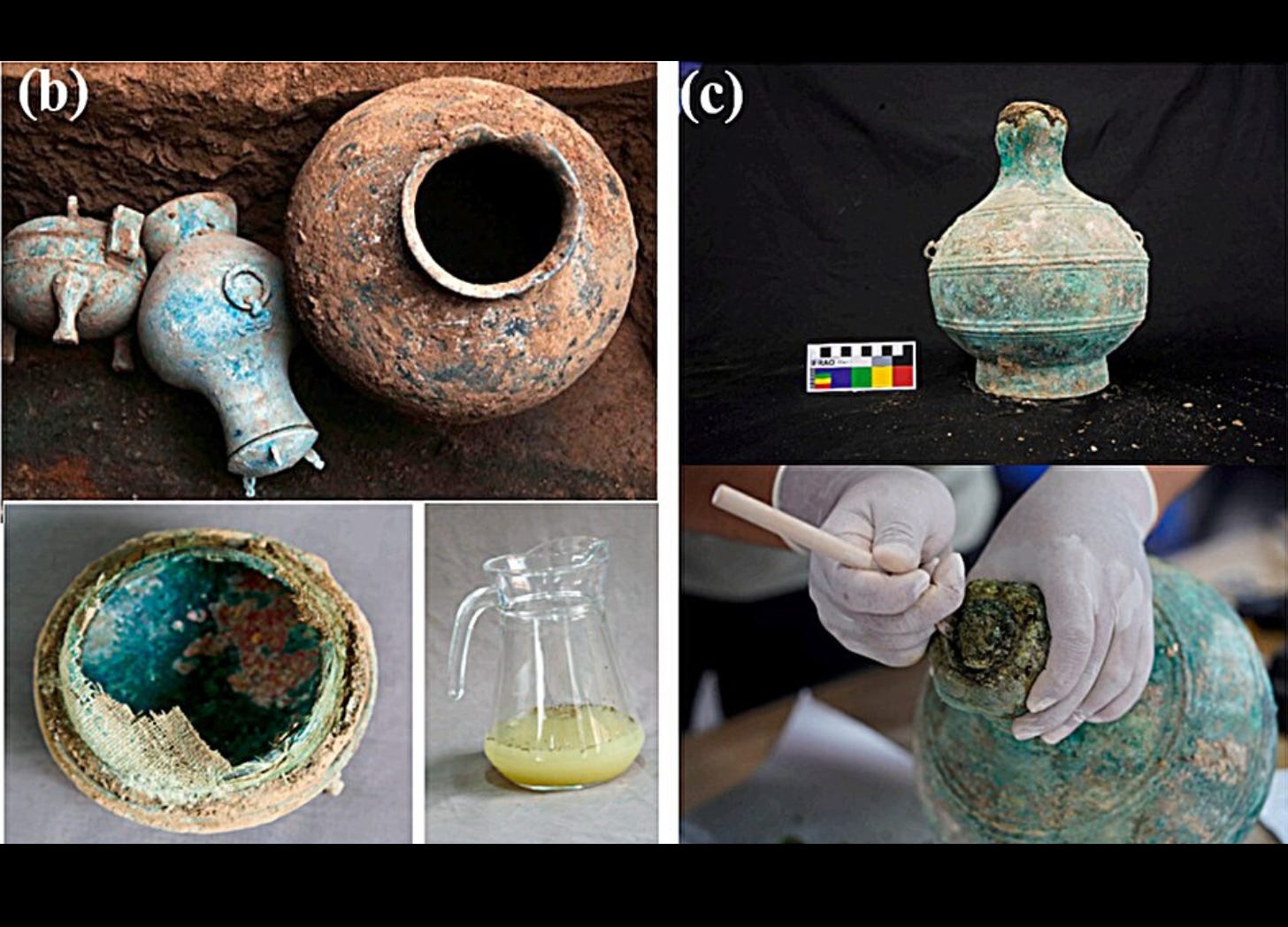
Different archaeological sites and bronze vessels discussed in this paper. (a) Excavation site of ancient alcoholic beverages; (b) Ancient alcoholic beverage at Yancun cemetery; (c) Ancient alcoholic beverage at Shanjiabao cemetery. Credit: Journal of Archaeological Science: Reports (2026). DOI: 10.1016/j.jasrep.2026.105738
The vessel was found at the Shanjiabao cemetery in Guyuan, Ningxia Hui Autonomous Region, a site linked to the Qin state during the Warring States period. Inside the bottle, archaeologists recovered about 3.7 liters of a pale blue-green, odorless liquid that had remained sealed for roughly 2,300 years. Laboratory analysis has now shown that the liquid was not groundwater, medicine, or fruit wine, but a cereal-based alcoholic beverage made mainly from broomcorn millet, with smaller traces of wheat or barley.
The discovery is especially important because ancient alcohol is usually studied through residues left on pottery or bronze vessels. In this case, researchers had access to the actual preserved liquid and sediment inside the container. That made it possible to examine the drink’s chemistry, microscopic plant remains, and fermentation evidence in far greater detail.
The bronze bottle was found in tomb M39 at Shanjiabao cemetery, which contained 183 excavated tombs. Most of them belonged to people associated with Qin culture. The cemetery was located near the Qin Great Wall and is thought to have served both local residents and garrison troops. The bottle itself had a garlic-shaped mouth, a form known from ancient Chinese vessels connected with alcoholic beverages.
When researchers opened the vessel, they found that it had been carefully protected by a two-layer sealing system. Textile material was placed inside the mouth of the bottle, while mud mixed with organic matter was used on the outside. This sealing method likely helped prevent contamination and evaporation, allowing the liquid to survive for more than two millennia. Similar sealing techniques are known from other ancient Chinese sites, suggesting that Qin communities understood how to preserve liquids with practical and effective methods.
Archaeological sites and bronze vessels analyzed in the study: (a) excavation location where ancient alcoholic beverages were recovered; (b) preserved alcoholic beverage from Yancun Cemetery; (c) preserved alcoholic beverage from Shanjiabao Cemetery. Credit: Journal of Archaeological Science: Reports, 2026. DOI: 10.1016/j.jasrep.2026.105738
To identify the liquid, the research team used several scientific techniques, including Fourier-transform infrared spectroscopy, mass spectrometry, high-resolution liquid chromatography, metabolomics, and microfossil analysis. They also compared the vessel’s contents with nearby soil samples to test whether the liquid could have been infiltrated groundwater. The results strongly rejected that possibility.
The liquid contained more than 2,400 organic compounds. These included amino acids, peptides, sugars, organic acids, carbohydrates, fatty acids, alcohol-related compounds, and other chemical markers. This complex chemical signature was far richer than the surrounding soil, showing that the substance inside the bottle was an authentic ancient organic residue.
One of the key clues came from the acids found in the sample. The liquid had high levels of lactic acid and oxalic acid, which are commonly associated with cereal fermentation. At the same time, it had very little tartaric acid, a compound often linked to grape or fruit wine. This pattern indicated that the drink was made from grains rather than fruit.
Microscopic analysis added more evidence. Researchers identified more than 100,000 starch grains in the sediment. Most of them came from broomcorn millet, while a smaller percentage belonged to wheat or barley. The millet made up the dominant ingredient, while the wheat or barley may have played a special role in the fermentation process.
The team also found thousands of yeast cells in the sample. Their size and shape were consistent with yeast used in fermentation, strengthening the conclusion that the liquid was an alcoholic beverage. The presence of yeast suggests that the Qin brewers used an effective starter culture to transform grains into alcohol.
This points toward the use of qu, a traditional Chinese fermentation starter made from moldy grains or herbs. In ancient Chinese brewing, qu helped convert starches into fermentable sugars and supported the growth of microorganisms needed for alcohol production. Another method, known as nie, used sprouted grains. The Shanjiabao evidence suggests that Qin brewers may have relied on qu technology, possibly involving wheat or barley as part of the starter.
This detail matters because written sources do not always preserve the full diversity of ancient brewing. Historical texts describe rules for alcohol production, including the importance of proper grain, good water, clean preparation, quality vessels, correct timing, and controlled heat. Yet the actual ingredients found in the Shanjiabao bottle differ from what might be expected from later textual traditions. Instead of rice or sorghum, the beverage was mainly made from broomcorn millet, with wheat or barley in smaller amounts.
That difference shows why archaeology is so important. Texts can preserve ideals, recipes, and elite traditions, but physical evidence reveals what people actually used in a specific region, period, and community. The Shanjiabao drink suggests that Qin brewing was more varied and technically developed than written records alone might imply.
The flavor profile may also have been more complex than a simple grain drink. The presence of amino acids and peptides points to fermentation processes that could have produced sweet, bitter, and savory notes. While the liquid is not drinkable today, its chemical remains suggest that Qin brewers were not simply producing alcohol for intoxication. They were controlling ingredients, fermentation, and preservation in ways that shaped taste and quality.
The find also offers a glimpse into the social role of alcohol in the Warring States period. Alcoholic beverages in ancient China were used in ritual, burial, hospitality, political display, and everyday social life. Placing a sealed vessel of drink inside a tomb suggests that alcohol was part of funerary belief and practice. It may have been intended as an offering, a provision for the afterlife, or a symbolic marker of identity and status.
What makes the Shanjiabao discovery especially valuable is the combination of context and preservation. The bottle was not an isolated object. It came from a cemetery connected with the Qin frontier world, near military and civilian communities. Its contents reveal not only a recipe, but also a technology: cereal selection, grain processing, fermentation starters, sealing methods, and long-term storage.
The discovery also fits into a much older Chinese brewing tradition. Evidence for fermented beverages in China goes back thousands of years before the Qin state, including early Neolithic examples connected with rice, honey, fruit, millet, and other ingredients. The Shanjiabao bottle does not mark the beginning of Chinese alcohol production, but it gives researchers a rare direct sample from a historically important period shortly before Qin unification.
By the end of the Warring States period, the Qin state would become the power that unified China under the first emperor. Finds like this show that Qin society was not only defined by armies, walls, and administration. It also had sophisticated food and drink technologies rooted in local agriculture and microbial knowledge.
A bronze bottle from a tomb has therefore preserved more than an ancient drink. It has preserved evidence of a brewing tradition, a regional recipe, and a practical understanding of fermentation that belonged to the people of Qin more than 2,000 years ago.
The real importance of the discovery is not simply that archaeologists found ancient alcohol. It is that they found a sealed chemical archive of everyday technology. Inside one bronze vessel was a story of grain, yeast, craft, burial, and memory, still readable after 23 centuries underground.