


At one of the world's oldest known human burial sites, a skeleton that has lain in scientific collections for decades has just given up a new secret. A fresh examination of the individual known as Qafzeh 25, recovered from Qafzeh Cave in Israel and dated to between 92,000 and 145,000 years ago, has revealed a thin, healed wound on the jaw consistent with a blow from a sharp object, among the oldest documented cases of interpersonal violence in our species.
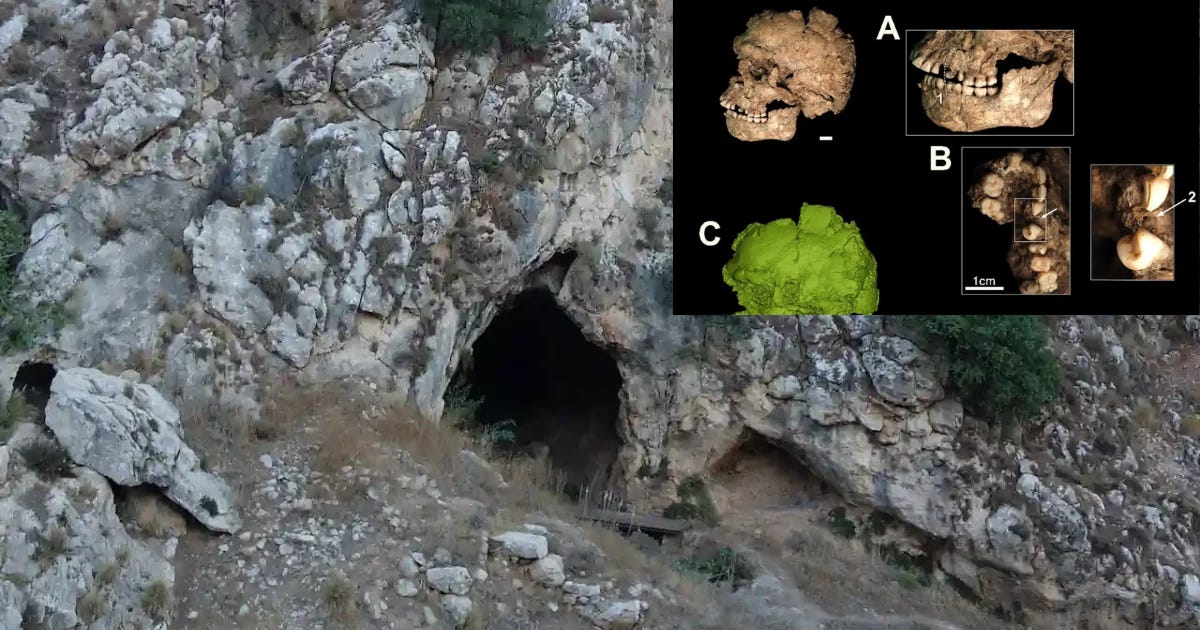
Entrance to Qafzeh Cave. Photo credit: LS via Wikimedia Commons.
The study, published in Scientific Reports on June 30, 2026, was led by researchers from Spain’s National Research Center on Human Evolution, known as CENIEH, working with colleagues from Tel Aviv University. Its lead author, Ana Pantoja-Pérez, has worked on questions of ancient violence before, having previously contributed to the analysis of a 430,000-year-old skull from Spain’s Sima de los Huesos site widely interpreted as evidence of one of the earliest known homicides in the human fossil record.
A wound written on the bone
Violence, the care of the sick and injured, and funerary behavior rank among the hardest aspects of the deep human past to reconstruct, since the physical evidence is often faint, ambiguous, or destroyed entirely by time. To get past those limits with Qafzeh 25, the team combined macroscopic and microscopic examination with high-resolution micro-computed tomography, allowing them to study the bones and teeth in far finer detail than earlier analyses of the same remains had achieved.
The scans revealed a thin, linear lesion on the left side of the lower jaw, reaching into one of the lower premolar teeth. Its shape and morphology matched damage caused by a sharp object striking living bone, rather than any of the processes, weathering, carnivore gnawing, or accidental breakage, that typically account for postmortem damage on fossils this old. Crucially, the wound also showed clear signs of healing, localized bone porosity and thickening around its margins indicating that new bone had begun to form. Whoever this person was, they survived the injury and lived on for some time afterward.
Cases of confirmed sharp-force trauma from the Middle Paleolithic are exceedingly rare. Qafzeh 25 now joins a very small group of human remains from this period bearing similar evidence, deepening what researchers can say about the presence, and the survivability, of interpersonal violence deep in our species’ history.
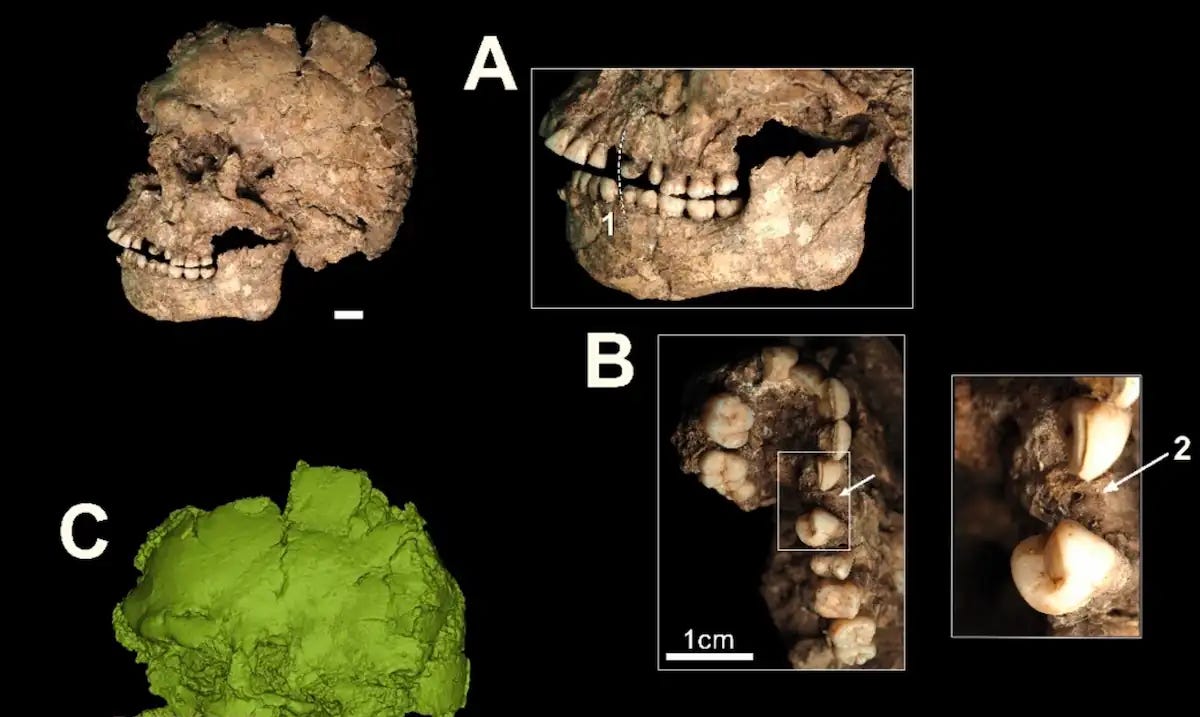
MicroCT analysis of the left maxillary region. (A) Three-dimensional reconstruction of the left mandibular and maxillary region showing the proposed trajectory of the traumatic injury (1). (B) Close-up of the root of the left upper canine (2), preserved in situ and still covered by sediment. (C) CT reconstruction highlighting fractures affecting the left maxillary dentition. Credit: A. Pantoja-Pérez et al., 2026.
A mouth that told its own story
The micro-CT scans turned up more than the jaw wound alone. Researchers identified a previously hidden cavity inside one of the lower premolars, along with enamel defects scattered across several other teeth, dental problems that earlier studies of the same individual had missed entirely. These findings echo similar reports of cavities and tooth abnormalities already documented in other fossils from Qafzeh, suggesting the population as a whole dealt with real, ongoing health burdens tied to diet, genetics, or the pressures of daily life in the Middle Paleolithic Levant.
Ruling out an accident of decay
Because ancient bone can mislead as easily as it can inform, the team also carried out a full taphonomic reassessment, tracing how the skeleton had changed in the tens of thousands of years since burial. Their results rule out the possibility that the observed alterations came from carnivore activity or from the body lying exposed on the surface for an extended period before burial. Instead, the state of anatomical preservation across the skeleton is consistent with deliberate, intentional burial, exactly the kind of careful treatment of the dead that Qafzeh Cave has long been recognized for.
A fuller portrait of one ancient life
Qafzeh Cave already ranks among the most important sites anywhere for understanding the earliest funerary behavior of Homo sapiens, and this new evidence reinforces that standing rather than complicating it. Taken together, the healed jaw wound, the dental pathologies, and the confirmation of deliberate burial sketch a fuller and more human picture of the individual behind Qafzeh 25, someone who suffered a violent injury and survived it, lived with ongoing dental trouble, and was, in the end, laid to rest by a community that treated the dead with evident care. For researchers piecing together how violence, illness, and grief were handled at the very dawn of our species, that combination of trauma survived and burial performed offers a rare and valuable window all at once.
Support Independent Ancient Content. Your support helps me create more archaeology posts, articles, and mini history videos:
Sources. CENIEH (July 2026); Phys.org; Archaeology News Online Magazine. Pantoja-Pérez, A., Martín-Francés, L., May, H., et al. (2026). “A taphonomic reassessment of Qafzeh 25 and its implications for violence, health and funerary practices.” Scientific Reports. doi.org/10.1038/s41598-026-58670-0
Claims of earliest, and oldest always give me a chuckle. This planet has a long history, with only a tiny fraction of it readily understandable by modern man. To boast earliest seems less scientific, and more egotistic.
I believe God created the world about 7 or 8 thousand years ago. Every single historical book up until the mid-1800’s attests to this (even Aristotle agreed that there had to be a ‘first mover’) and then the Freemason’s like Smellie, Darwin et al by way of destroying what humans knew since the beginning created the lie that is evolution, the Big Bang etc and the enemies of God have continued to perpetuate these lies and many others for the last 2 centuries.