


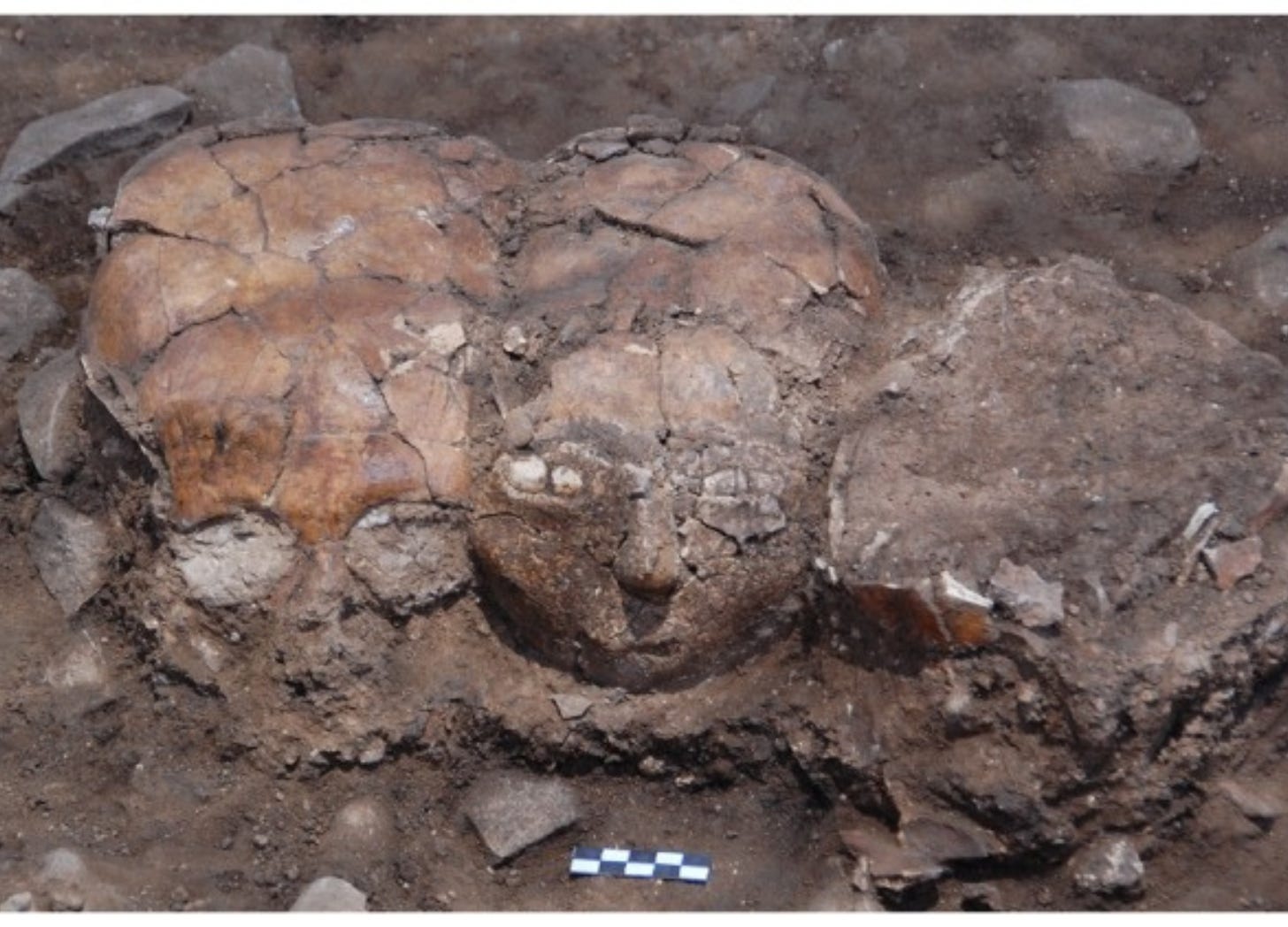
The plastered skulls are facing west (L4187, open area 402).
One of the important examples comes from Yiftahel in the Lower Galilee, in present-day Israel. Archaeologists recovered three plastered skulls from the site, dating to the Pre-Pottery Neolithic B period, roughly 9,000 to 8,500 uncalibrated years before present. This was a period of major social change, as communities were shifting from mobile hunter-gatherer lifeways toward settled agricultural villages.
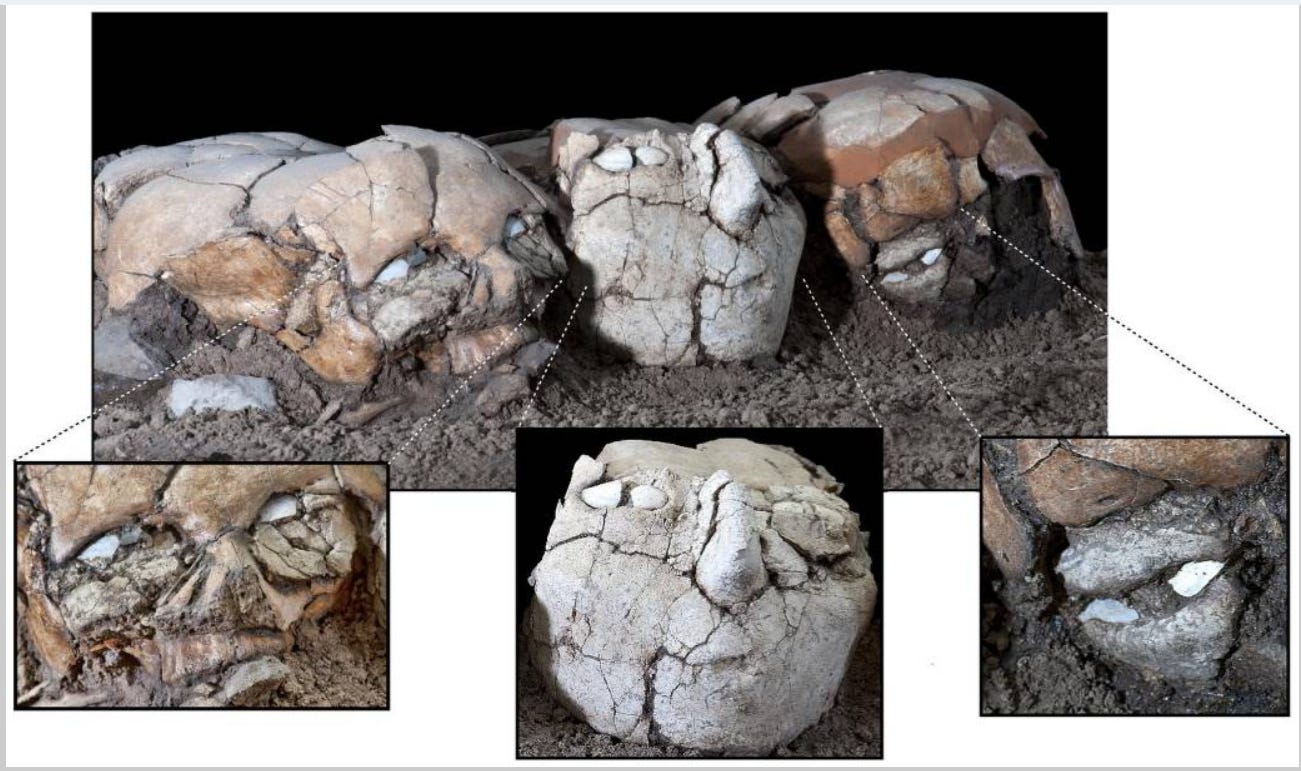
The three plastered skulls, following reconstruction and preservation processes.
The Yiftahel skulls show that death rituals in these early communities required planning, skill, and repeated attention. The dead were first buried. Later, the skulls were retrieved, altered, and transformed into objects with modeled facial features. This process suggests that memory, ancestry, and identity played an important role in village life.
The practice formed part of a wider Levantine tradition. Plastered or otherwise remodeled skulls have been found at several Pre-Pottery Neolithic B sites, including Jericho, Beisamoun, ‘Ain Ghazal, Kfar Hahoresh, Tell Ramad, Tell Aswad, and Nahal Hemar. Jericho remains especially important because it produced one of the largest known groups of these remains, including skulls with plastered faces and shell-inlaid eyes.
The technique varied from place to place. Some communities used full plaster masks. Others focused on the eye area or added pigment, shell, asphalt, or other materials. At Yiftahel, CT scans helped researchers study how the skulls were modeled. The analysis showed differences in the plastering methods used on the three individuals, suggesting that local styles and choices mattered.
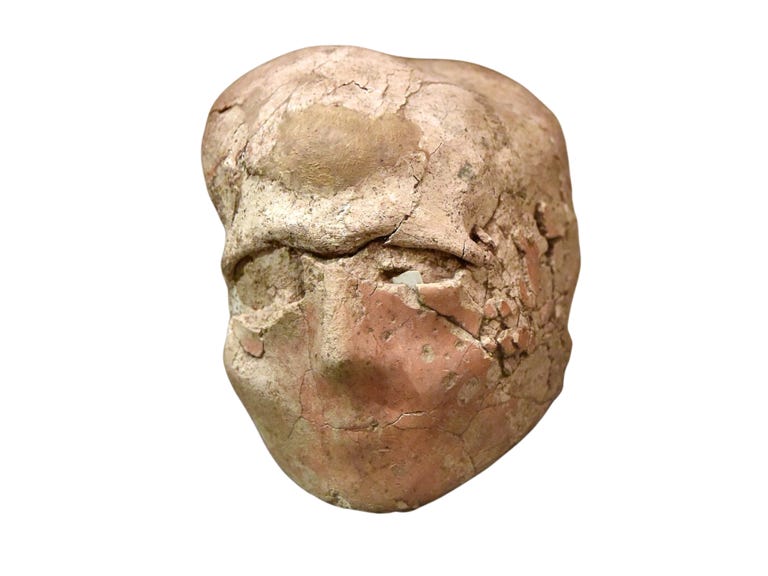
Around 9,000 years ago, communities in the Levant covered human skulls with plaster as a way to honor and remember their dead.
The three Yiftahel skulls belonged to adults. Researchers suggested that two were likely male and one likely female, while also noting the difficulty of assigning sex and age from damaged and modified skulls. The skulls were found together in a row, facing west. Their arrangement may have carried social or ritual meaning, especially because the central skull had a broader, more complete plaster mask than the two placed beside it.
In many examples from the Levant, the lower jaw was removed before the skull was remodeled. Plaster could then be added to create a stable base, chin, nose, mouth, and facial surface. Shells were sometimes placed into the eye sockets to give the skull a more lifelike appearance. At Yiftahel, one skull even preserved evidence of shell used in the eye area.
These objects were more than treated bones. They were physical tools of remembrance. Long before photography, portraits, or written family histories, plastered skulls may have allowed communities to keep selected dead individuals present among the living. The modeled face could turn a buried person into an ancestor, a remembered figure, or a symbol of group continuity.
Researchers have proposed several interpretations. The skulls may have been linked to ancestor veneration, household memory, land claims, status, ritual display, or wider religious beliefs about death and regeneration. In settled farming communities, ancestry could become especially meaningful. A family or group that could point to its dead may also have been asserting a deeper connection to a house, a village, or a landscape.
The practice also reflects the technological skill of Neolithic artisans. Producing lime plaster required knowledge of materials, heat, timing, and modeling. Rebuilding a face over a skull demanded both technical control and social intention. These were carefully made objects, created during a period when communities were also building plaster floors, permanent structures, and increasingly complex settlements.
The Yiftahel skulls show how varied this tradition could be. They share broad similarities with examples from Jericho and Kfar Hahoresh, yet their facial modeling and arrangement are distinctive. This balance of shared regional customs and local variation is one of the reasons plastered skulls are so valuable for understanding the Pre-Pottery Neolithic B.
The wider evidence points to an evolving ritual world across the Levant. Communities were experimenting with new ways to live together, build together, farm together, and remember together. The treatment of skulls was one part of that transformation.
A 9,000-year-old plastered skull, then, stands as evidence of death and reveals how early villagers shaped memory, ancestry, identity, and belonging at the dawn of settled life.
Source:
Slon, Sarig, Hershkovitz, Khalaily & Milevski, PLOS ONE study on the three plastered skulls from Yiftahel, including CT analysis, dating, restoration, and interpretation.