


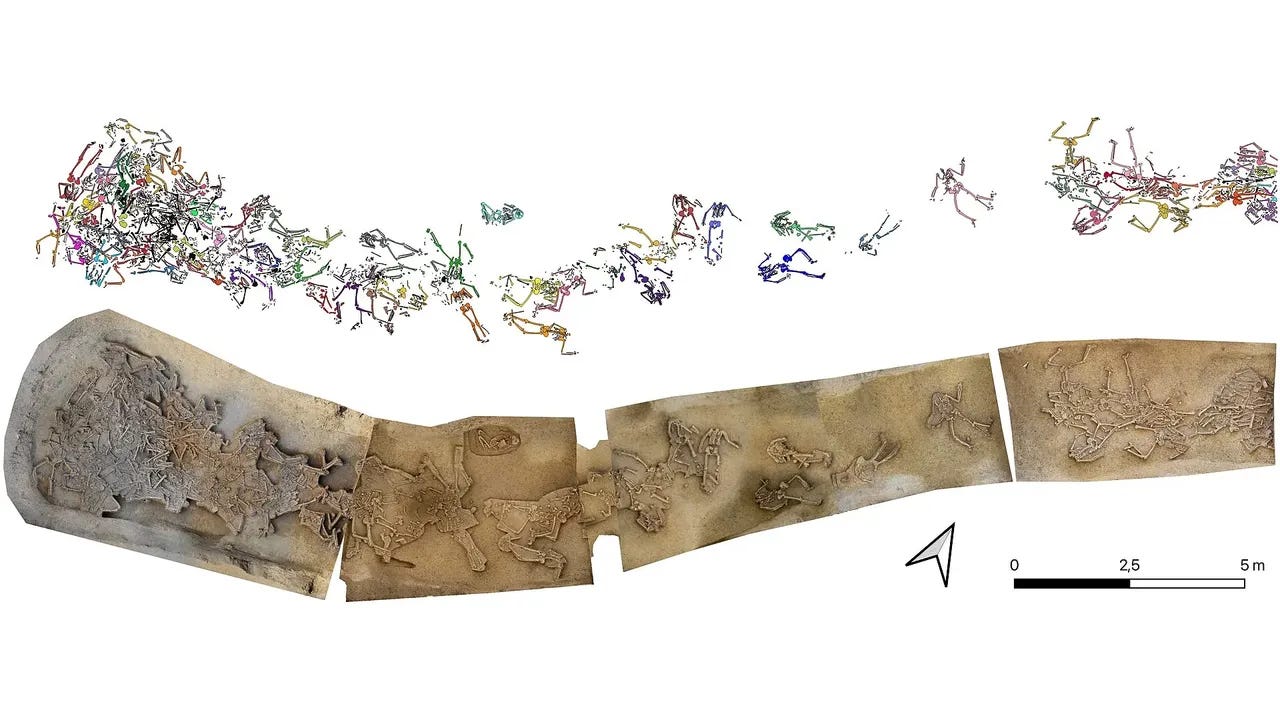
The mass burial of skeletons in the settlement ditch (below) with drawings of the individual skeletons (above).(Image credit: Katharina Fuchs, Agnes Heitmann, Nils Müller-Scheeßel, Till Kühl)
Archaeologists studying the early Neolithic settlement of Vráble-Veľké Lehemby in southwestern Slovakia have uncovered one of the most unusual burial contexts known from the Linear Pottery culture. The site contains dozens of human skeletons placed in a ditch near the entrance of a prehistoric settlement. Most of them are missing their heads.
The discovery was first reported after excavations in 2022, when archaeologists identified a mass deposition of around three dozen headless bodies. Continued fieldwork has since changed the scale of the find. New research published in 2026 records at least 78 individuals in the area, including 77 headless skeletons and one young child whose skull remained in place.
Vráble-Veľké Lehemby is not a small or isolated site. It was one of the largest known settlements of the Linear Pottery culture, also called LBK, in Central Europe. This early farming culture spread across large parts of the continent during the sixth millennium BCE. The settlement at Vráble existed for several centuries, roughly between 5250 and 4950 BCE.
The site was made up of more than 300 house outlines grouped into three separate neighborhoods. At certain points, up to 80 buildings may have been occupied at the same time. This makes Vráble important not only for the study of burial practices but also for understanding how some of Europe’s earliest farming communities organized space, labor, households, and social boundaries.
One of the three settlement areas was surrounded by a ditch. Archaeologists believe this ditch probably marked a boundary around that neighborhood. Human remains had already been found in the area during earlier excavations, but the scale of the discovery became clearer after fieldwork resumed in 2022.
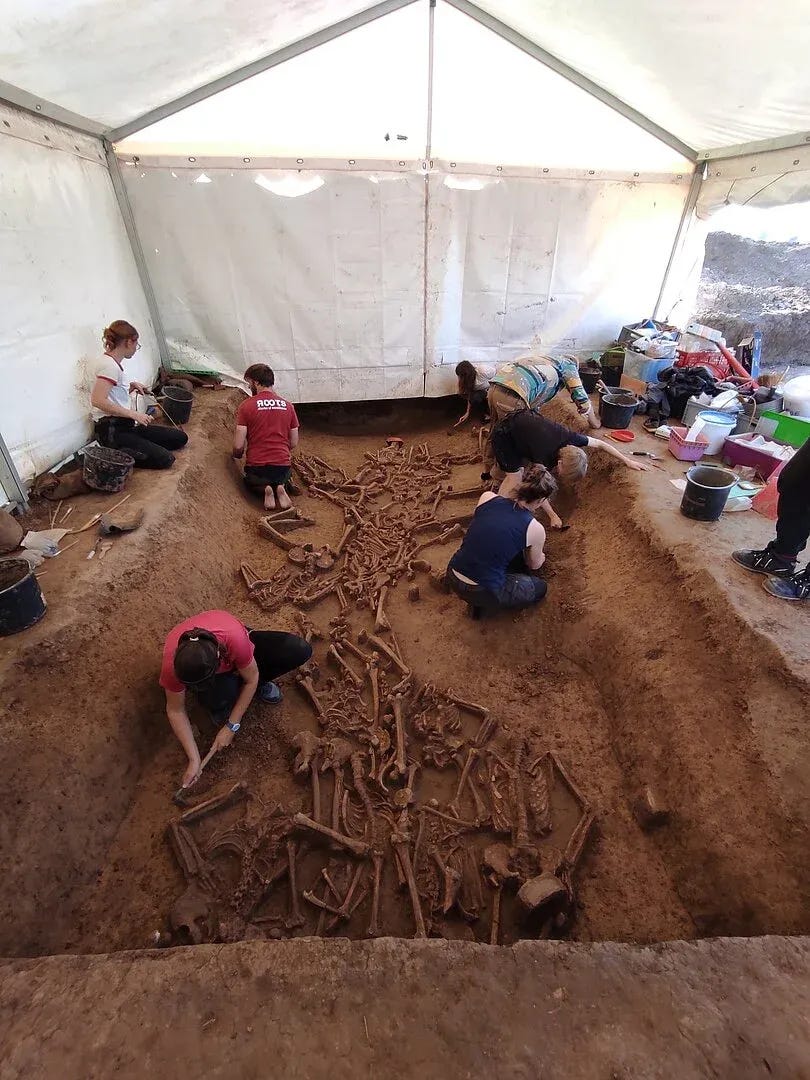
Archaeologists excavating skeletons at the site of Vráble in Slovakia. Image credit: Katharina Fuchs
The skeletons were found near an entrance into the enclosed part of the settlement. They were not arranged like normal graves. Bodies lay in different positions, some on their backs, some face down, others twisted or overlapping. There was no clear pattern in their orientation. Some had limbs bent or spread, while others were partly covered by additional bones.
This irregular arrangement initially raised dramatic questions. Were these people victims of a massacre? Were they executed? Were they killed during conflict between groups? Were the bodies part of a sacrifice? These possibilities have not been fully dismissed, but the latest research suggests that the situation is more complex than a simple episode of violence.
The absence of heads is the central mystery. Of the 78 individuals currently recorded in the mass deposition, 77 were missing skulls. Only one skeleton, belonging to a young child, still had its head. This detail is important because it shows that the missing skulls were not the result of random destruction in the soil. The pattern points to deliberate treatment of the bodies.
Preliminary observations indicate that many of the bodies were placed in the ditch before advanced decomposition had taken place. In several cases, the neck vertebrae were still aligned. Hands and feet, which often separate early during decomposition, were also preserved in ways that suggest the bodies were still relatively intact when deposited.
Researchers also observed cut marks on cervical vertebrae. These early findings suggest that the heads were removed with sharp tools rather than by rough chopping or blunt-force damage. This points to controlled body manipulation, not simply chaotic violence. However, more detailed forensic and osteological work is still needed before archaeologists can say exactly how the heads were removed and whether the people died violently.
The missing heads have not yet been found. Only a small number of skull fragments were recovered from the ditch. This raises another major question: where did the heads go? They may have been placed elsewhere in the settlement, stored, displayed, buried separately, or removed from the site entirely. At the moment, archaeologists do not have enough evidence to choose one explanation with confidence.
The ditch itself seems to have played a special role. The bodies were not spread randomly across the settlement. Many were concentrated near the entrance area, where people would have passed into and out of the enclosed neighborhood. This suggests that the deposition was connected to the boundary of the settlement, the entrance, or the social meaning of the enclosed space.
The finds also included objects and materials mixed among the bones, although archaeologists do not describe them as typical grave goods. A complete LBK vessel was found in the ditch fill. Other finds included a bone needle, pieces of grinding stone, potsherds, flint and obsidian tools, stone pebbles, a stone axe head, and perforated teeth. The pebbles are especially interesting because they do not naturally occur in the loess soil at the site, meaning they were brought there from another location.
These details matter because they show that the ditch was not simply a place where bodies were discarded. The deposition may have been part of a repeated practice with social or ritual meaning. The presence of pebbles and selected objects may point to structured actions around the dead, although their exact meaning remains unclear.
The discovery also fits into a broader pattern seen at some other late LBK sites in Central Europe, where human remains appear in ditches, pits, or unusual burial contexts. In the past, such finds were often interpreted mainly as signs of crisis, violence, or warfare. The Vráble evidence is forcing researchers to take a more careful view.
The settlement itself may have gone through social tension before it was abandoned. Earlier research suggested that Vráble developed increasing internal divisions over time. The construction of the enclosure around one neighborhood may have marked a shift in how the community organized itself, possibly separating one group from the others. Human remains along the ditch may reflect these changing social relationships.
This does not mean violence played no role. A massacre, sacrifice, or conflict-related event remains possible for at least part of the evidence. But the pattern of head removal, repeated deposition, and placement near the ditch entrance may point to a longer practice rather than one sudden event. The bodies may have been involved in rituals connected with death, identity, ancestry, boundaries, or community membership.
One of the challenges is that modern categories do not always fit Neolithic behavior. Today, separating a head from a body is often interpreted immediately through violence or punishment. In Neolithic societies, the head may have carried meanings connected with personhood, kinship, memory, or ritual power. Archaeologists must therefore avoid forcing modern assumptions onto a 7,000-year-old community.
Comparable attention to human heads is known from other prehistoric contexts. In different regions and periods, skulls were removed, kept, modified, displayed, or buried separately. These practices varied widely and cannot be explained by one single rule. At Vráble, the lack of the skulls themselves makes the interpretation even harder.
The discovery is still under study. Researchers are continuing to analyze the bones to determine age, biological sex, injury patterns, cut marks, decomposition processes, diet, mobility, and genetic relationships. DNA and isotope studies may reveal whether the individuals came from the local community or from outside the settlement. This could help determine whether they were insiders, outsiders, captives, relatives, or a mixed group.
For now, Vráble-Veľké Lehemby remains one of the most important Neolithic sites in Central Europe. Its headless skeletons are not only a mystery about death. They also open a wider question about how early farming societies understood the body, the head, the dead, and the boundaries of community life.
Sources:
Live Science, 7,000-year-old mass grave in Slovakia may hold human sacrifice victims, 3 October 2022.
Kiel University, Headless skeletons offer new insights into farming societies 7,000 years ago, 8 June 2026.
Furholt, Cheben, Hukeľová, Wunderlich, Bistáková, Furholt, Kühl, Müller-Scheeßel and Fuchs, Neolithic Bodies in Vráble, Proceedings of the Prehistoric Society, 2026.
Popular Science, 77 headless skeletons found in a field date back 7,000 years, 2026.
European Association of Archaeologists abstract, Headless Skeletons in the Ditch, Vráble-Veľké Lehemby.