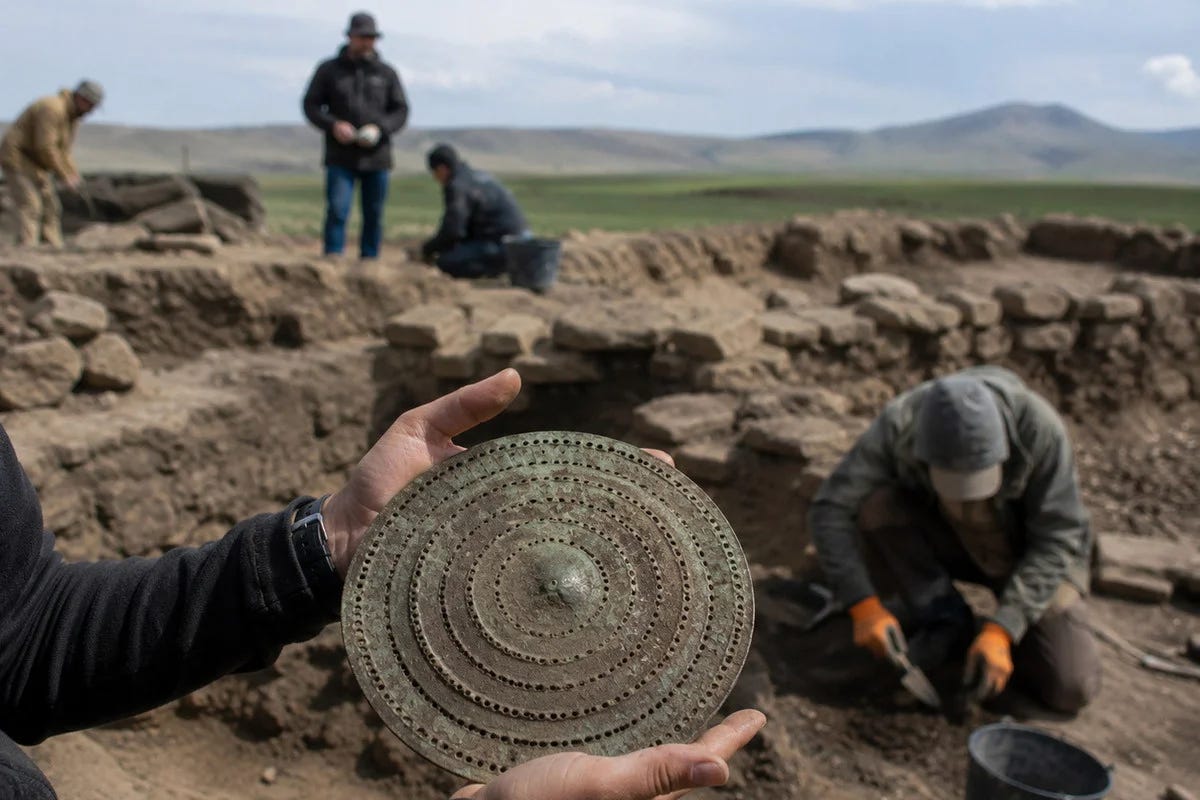
Bronze solar disk decorated with concentric patterns and carefully arranged perforations. Credit: Московский комсомолец
Archaeologists working in southern Georgia have uncovered evidence of an Early Bronze Age settlement on the Javakheti Plateau, a highland region that is now being reinterpreted as a far more important ancient cultural landscape than previously assumed.
The discovery was reported by Vakhtang Licheli, professor at Ivane Javakhishvili Tbilisi State University and head of the archaeological expedition. According to the researchers, the finds indicate that the Kura-Araxes culture was present in this part of Georgia. This is significant because the culture had previously been better documented in other regions, especially Shida Kartli.
Licheli began studying the Javakheti Plateau in 2017. Later, Italian specialists with expertise in Mediterranean and Transcaucasian cultures joined the project. The work was organized in stages. First, researchers mapped the landscape and recorded ancient structures already known in the area. This survey identified around 168 archaeological sites across the plateau.
After the mapping stage, the team moved to direct excavation. Fieldwork focused on the areas of Baraleti Natsargora and Meghreki, within a landscape that includes the modern districts of Aspindza, Akhalkalaki, and Ninotsminda.
The excavations revealed defensive walls, residential buildings, and clay structures dating from the Early Bronze Age through the Iron Age, roughly between 3500 and 500 BC. These remains show that the plateau was not a marginal or empty zone, but a place repeatedly occupied and adapted by ancient communities over thousands of years.
One of the most remarkable finds is a bronze solar disk decorated with concentric patterns and carefully arranged perforations. The precision of its design suggests a developed level of metalworking. Objects of this type are often connected with symbolic or ritual traditions, and similar examples from southern Georgia have sometimes been associated with burial contexts.
Archaeologist Tornike Chilingarashvili, who took part in the excavations, explained that the settlement contains several chronological layers. The materials recovered from the site suggest that the area was already well used during the Early Bronze Age. The presence of Kura-Araxes cultural traces strengthens the idea that this highland region formed part of wider networks of movement, settlement, and exchange.
Researchers have also identified areas that may contain ancient burials. These possible graves have not yet been excavated. Chilingarashvili said that the team plans to study them in future stages of the project, which may help reveal more about the people who lived, worked, and were buried on the plateau.
The wider research shows that Javakheti was more than a remote mountain zone. The documented sites include fortifications, settlements, and necropolises, suggesting a landscape shaped by defense, seasonal movement, domestic life, and funerary traditions.
At Baraleti Natsargora, whose name is often translated as “hill of ashes,” excavations uncovered repeated occupation layers and traces of burning. This indicates that the site was used, damaged, rebuilt, or returned to many times across a long period.
Further east, Meghreki Fortress has provided another important sequence. Archaeologists found evidence of occupation from the Early Bronze Age Kura-Araxes period through the Iron Age and into the medieval period. The site includes perimeter walls, storage areas, and domestic spaces.
At Meghreki, researchers also discovered fired clay plaques decorated with incised and painted geometric designs. Some preserve traces of red, white, and dark blue pigments. Such objects are unusual in the South Caucasus and may have marked special domestic spaces, possibly connected with ritual activity or social status.
Taken together, the discoveries are changing how archaeologists view the Javakheti Plateau. Instead of an isolated highland frontier, the region now appears to have been a dynamic cultural crossroads where people adapted to difficult environmental conditions while maintaining strong settlement, symbolic, and social traditions.
Future excavations, radiocarbon dating, ceramic studies, and environmental analysis are expected to clarify the chronology of the sites and reveal more about the ancient communities that lived in this part of Georgia thousands of years ago.


