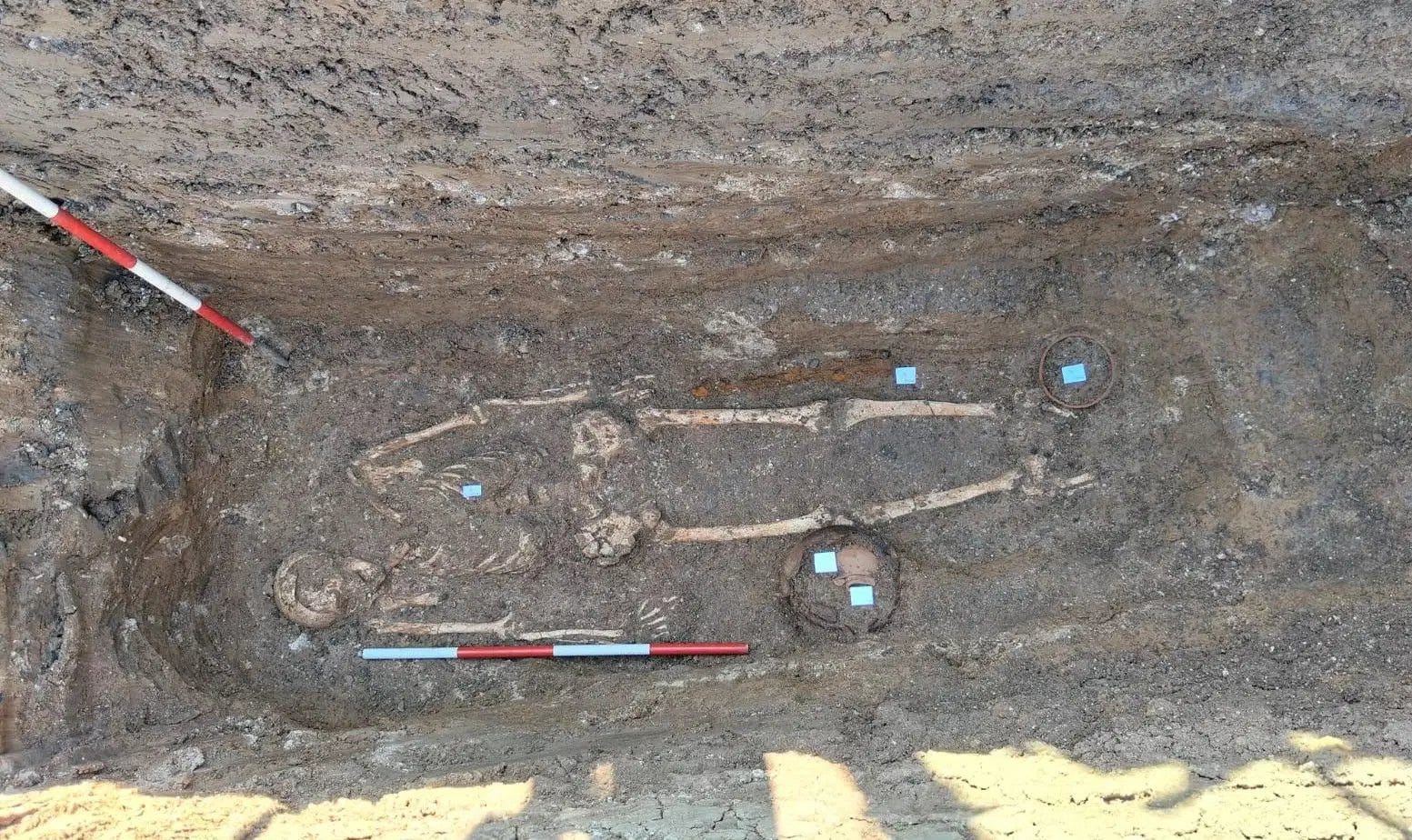
Burial uncovered at the Punta Penna pre-Roman necropolis in Vasto, Italy. Credit: Ministero della Cultura
A major pre-Roman burial ground has been uncovered in Vasto, southern Abruzzo, during archaeological checks connected to the construction of a photovoltaic plant in the industrial area of Punta Penna. The discovery has opened a new window into the funerary customs of Italic communities who lived along the central Adriatic before the region was fully absorbed into the Roman world.
The site lies in the northern part of the municipality of Vasto, in the province of Chieti. Today, Punta Penna is associated with industry, roads, and the nearby Adriatic coastline. In antiquity, however, this landscape belonged to a much older network of coastal routes, inland connections, and local communities whose identity was shaped before Roman political control became dominant.
The find was announced by the Soprintendenza Archeologia, Belle Arti e Paesaggio for the provinces of Chieti and Pescara. According to the heritage authority, the burial ground was identified during preventive archaeological investigations required as part of the authorization process for the planned solar plant. These investigations were financed by the company proposing the project and carried out under the scientific supervision of the Soprintendenza, which remained present at the construction site.
Archaeologists have preliminarily dated the funerary nucleus to between the 5th and 4th centuries BC. This places the burials in a crucial phase of pre-Roman central Italy, when Italic peoples maintained their own local traditions while also interacting with wider Mediterranean cultural and economic networks. The official statement describes the context as archaeologically significant, though researchers have stressed that the work is still at an early interpretive stage.
The excavations revealed numerous graves. Early documentation and Ministry of Culture image captions indicate that the necropolis includes different burial arrangements, including stone-filled grave pits, burials with tile beds, and a tile-box burial containing a bronze belt. Other graves reportedly contained ceramic vessels, iron and bronze objects, and personal ornaments connected to funerary practice.
These grave goods are especially important because they can help reconstruct the social world of the people buried there. Objects placed with the dead may reveal clues about status, age, gender, household identity, ritual behavior, and local traditions. Weapons, belts, ornaments, pottery, and metal objects do not simply decorate a burial; they can preserve traces of how a community remembered its dead and expressed belonging.
Local reporting has described the cemetery as a Frentani necropolis and has suggested that roughly 60 graves have already been identified, with the possibility of more. That number should be treated carefully, because the official statement has not fixed a final count. Still, the scale of the discovery appears substantial, especially when compared with smaller funerary finds previously known in the Vasto area.
The historical setting matters. Ancient Vasto was known as Histonium, a major settlement associated with the Frentani, an Italic people linked to the Samnite cultural sphere. Treccani identifies Histonium as one of the most important settlements of the Frentani, later becoming a Roman municipium after the Social War. The newly discovered necropolis, however, belongs to an earlier horizon, before Roman civic structures fully reshaped the region.
The municipality of Vasto also notes the importance of Punta Penna in the area’s ancient history, describing how the Frentani strengthened the early harbor and how Oscan inscriptions and amphora finds point to maritime traffic in the Gulf of Vasto. This background makes the new necropolis more than an isolated cemetery; it may belong to a broader settlement and coastal exchange landscape that connected local Italic communities to the Adriatic world.
semple of stone covering of a tomb as identifiable from the ground level. The pits, whose fill consists almost entirely of stones, may have depositional planes at very different elevations and mutual interference, as can be seen from the cuts of the other burials visible in the image. Photo: Ministry of Culture
The excavation also uncovered the remains of a structure whose function and date are not yet clear. The Soprintendenza has stated that the available evidence is not sufficient for a definitive interpretation. Surface finds, however, may indicate that the area continued to be frequented in the Hellenistic-Roman period, suggesting a longer history of use at Punta Penna beyond the initial pre-Roman funerary phase.
This is one of the most important aspects of the discovery. Cemeteries often mark more than death; they can reveal how ancient landscapes were organized. A burial ground placed near movement corridors, coastal zones, or settlement areas may show how communities structured territory, memory, and identity. If later Hellenistic or Roman activity is confirmed, Punta Penna may preserve evidence of changing land use across several centuries.
Example of burial under excavation with deposition plan in tile bed . Some elements of the grave goods and the osteological remains of the individual can be glimpsed, as well as the residual stones from the grave fill. Photo: Ministry of Culture
The Soprintendenza has emphasized that the site was kept confidential during the work to protect the archaeological context and the objects recovered from it. This caution was also linked to safety concerns, because the area remains an active construction zone with controlled access and operational restrictions. Officials warned that early press coverage risked weakening the protective measures that had been maintained during excavation.
The excavation and documentation phase has now produced data considered scientifically important, but the research is far from complete. Further investigations are expected, with direct financial support from Italy’s Ministry of Culture. These future campaigns aim to clarify the chronology, size, internal organization, and character of the archaeological context.
Restoration work has also been planned for the grave goods recovered from the burials. Before the artifacts can be properly studied and displayed, they must be cleaned, stabilized, catalogued, and analyzed. This process may eventually allow archaeologists to identify workshop traditions, material sources, burial patterns, and possible social distinctions inside the cemetery.
A selection of the most significant finds is expected to be displayed in a renewed museum route being planned at Palazzo d’Avalos in Vasto. This is important because it would keep the objects connected to the territory where they were found, allowing the public to understand the necropolis not as an isolated discovery, but as part of Vasto’s deeper archaeological landscape.
The discovery also highlights the value of preventive archaeology. Modern infrastructure projects often expose buried histories that would otherwise remain unknown. In this case, a planned renewable energy project revealed a funerary landscape more than 2,300 years old, showing how development and heritage protection can intersect in unexpected ways.
For Vasto, the Punta Penna necropolis strengthens the evidence that the area held major importance before and during Romanization. The burials may help researchers better understand the Italic communities of southern Abruzzo, their social structures, funerary customs, and relationship with the Adriatic coast. What began as preliminary work for a solar plant has become a significant archaeological opportunity.
The dead of Punta Penna were buried before Rome became the dominant political force in the region. Their graves now re-emerge beside a modern industrial landscape, reminding us that beneath contemporary infrastructure, older worlds can still survive. The next phase of research may reveal whether this was simply a cemetery, part of a larger settlement zone, or evidence of a longer-lived sacred and social landscape on the Adriatic edge of pre-Roman Italy.


