


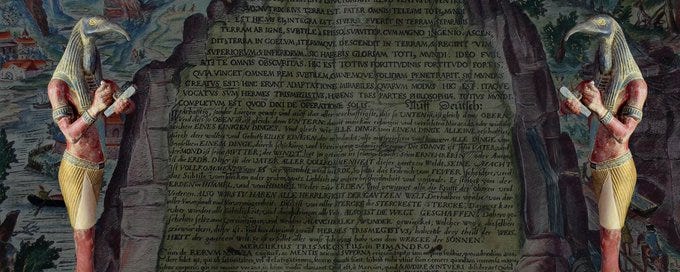
There are few texts in the history of ideas more overmarketed, more mythologized, or more persistently misunderstood than the Emerald Tablet. In popular culture it is often presented as a relic from Atlantis, a surviving fragment of pre-flood revelation, or a secret manual of cosmic power hidden by ancient priests. That is the version that still circulates most aggressively online. The historical record, however, points to something subtler and, in many ways, far more interesting: not a stone voice from vanished Atlantis, but a compact Hermetic text that became a moving center of intellectual gravity across Egypt, the late antique Mediterranean, the medieval Islamic world, Renaissance Europe, and the early history of modern science.
To understand why the Emerald Tablet acquired such authority, one has to begin with Thoth. In Egyptian religion, Thoth was the god of writing, learning, reckoning, and wisdom, the divine scribe and interpreter of the gods. Greek authors eventually identified Thoth with Hermes, and by the Hellenistic period that identification had hardened into the figure later known as Hermes Trismegistus, the thrice-great Hermes. This was not a simple one-to-one borrowing. It was a fusion, Greek, Egyptian, philosophical, and religious, built in a world where revelation, cosmology, magic, and natural inquiry were not yet separated into neat modern disciplines.
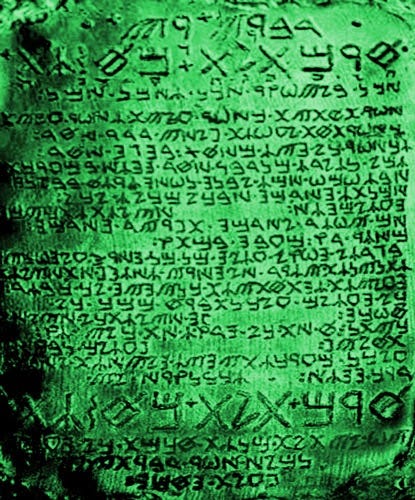
That fusion matters because Hermeticism was never just one book. The writings associated with Hermes Trismegistus formed a broader textual tradition, usually divided by scholars into technical Hermetica, dealing with astrology, alchemy, and related arts, and learned Hermetica, dealing with theology and philosophy. The major Greek and Latin Hermetic writings were composed not in pharaonic deep antiquity, but largely between the 1st and 3rd centuries AD. In other words, the Hermetic tradition is ancient, but not in the way modern mythmakers usually mean. It belongs above all to the Greco-Egyptian and Roman-era world, where Egyptian sacred authority and Greek philosophical language merged into a prestige discourse of revealed wisdom.
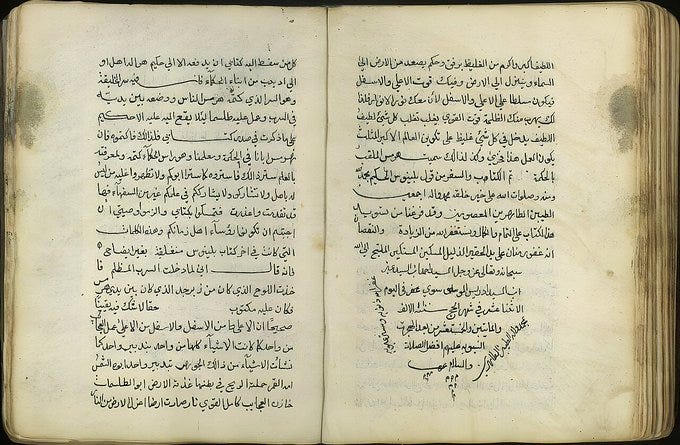
The Emerald Tablet itself appears later than many people assume. According to current standard reference accounts, the earliest known version survives in Arabic, in a work called the Book of the Secret of Creation, usually dated to around the 9th century AD. Another version appears in works associated with Jābir ibn Ḥayyān, and yet another in the Secret of Secrets, a pseudo-Aristotelian text that became enormously influential. Britannica is explicit on the central point: no reliable evidence supports an origin for the Emerald Tablet earlier than the medieval Arabic period. Oxford’s Cabinet likewise notes that, contrary to Renaissance belief, the text does not come from remote pharaonic antiquity but can be traced to an early Arabic textual environment.
This is where the story becomes more, not less, important. The Emerald Tablet was not powerful because it was long. It was powerful because it was dense. Its language is compressed, symbolic, and adaptable. Medieval readers could treat it as a coded guide to alchemical practice. Later readers could interpret it cosmologically, metaphysically, or psychologically. The famous maxim as above, so below became a portable formula for correspondence between levels of reality, between heaven and earth, macrocosm and microcosm, matter and spirit. What made the text durable was precisely that it could survive translation, commentary, and ideological reuse without losing its aura of hidden depth.
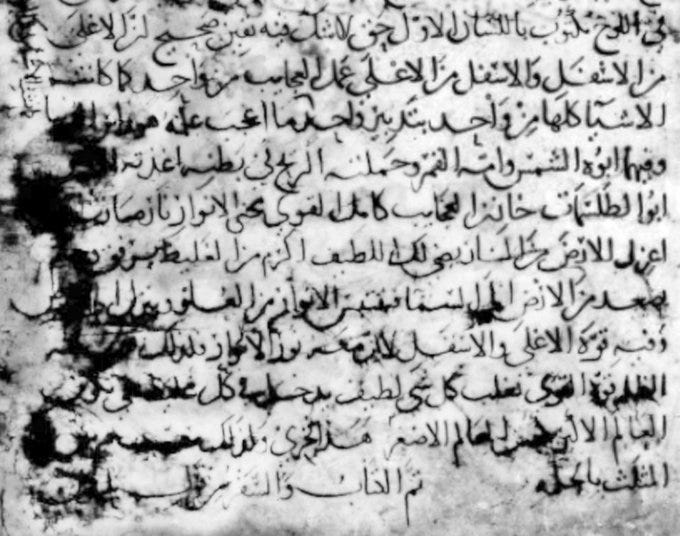
The Arabic phase of the story is crucial and too often minimized in modern retellings. The Emerald Tablet did not simply leap from ancient Egypt into modern occult publishing. It moved through the intellectual laboratories of the medieval Islamicate world, where Greek, Persian, Syriac, and Egyptian materials were translated, reworked, and integrated into new syntheses. In that context, Hermetic lore became part of a larger conversation about nature, causation, transformation, medicine, cosmology, and the possibility that the universe was intelligible because it was structured by hidden correspondences. When the Tablet later entered Latin Europe, it did so not as an isolated miracle text but as part of a larger transfer of Arabic learning.
That transmission mattered enormously. Britannica notes that the Book of the Secret of Creation was translated into Latin in the 12th century, but even more influential was the Tablet’s appearance through the Secret of Secrets, which became one of the most widely read books of the Latin Middle Ages. By the 13th century many European readers approached the Emerald Tablet as an authoritative but enigmatic relic of primordial wisdom, often interpreting it as a cryptic guide to producing the philosopher’s stone. This is the moment when the Tablet stopped being merely one Hermetic fragment and became a prestige object in the medieval imagination of hidden knowledge.
The Renaissance did not invent interest in Hermetic wisdom, but it radicalized it. Marsilio Ficino’s translations of Plato, Neoplatonic texts, and the Corpus Hermeticum helped create a climate in which Hermetic material could be read not only as occult doctrine but as ancient theology, a primordial wisdom tradition thought to anticipate Christianity and preserve truths older than Greece. This was historically mistaken in its chronology, but culturally transformative in its effect. The Renaissance elevation of Hermes Trismegistus made Hermeticism intellectually glamorous, philosophically elastic, and spiritually respectable for elites who wanted antiquity, metaphysics, and revelation in a single frame.
That prestige carried forward into the early modern period, including figures later absorbed into the triumphalist history of science. Isaac Newton did indeed translate the Emerald Tablet into English and left substantial alchemical papers behind. The Newton Project documents a large body of his alchemical manuscripts, and its chronology notes his belief that true natural philosophy represented a recovery of prisca sapientia, ancient wisdom. Robert Boyle, too, engaged seriously with alchemical material, enough that the Royal Society can point to a 1676 alchemical paper of his in Philosophical Transactions. None of this means modern physics or chemistry were simply derived from Hermetic doctrine. It does mean that the wall modern audiences like to build between science and esotericism is far less stable in the 17th century than popular narratives suggest.
Atlantis is an even later and weaker layer. The historical Emerald Tablet is tied to Hermetic and alchemical traditions in Arabic and Latin transmission, not to any verifiable Atlantean archive. Modern Atlantis-centered versions belong to a very different world: 19th and 20th century occultism, Theosophical speculation, pseudo-history, and commercial esotericism. Maurice Doreal’s neo-Theosophical milieu is part of that later afterlife, not the ancient core of the tradition. That distinction is essential. Once it is blurred, every later embellishment starts masquerading as original revelation.
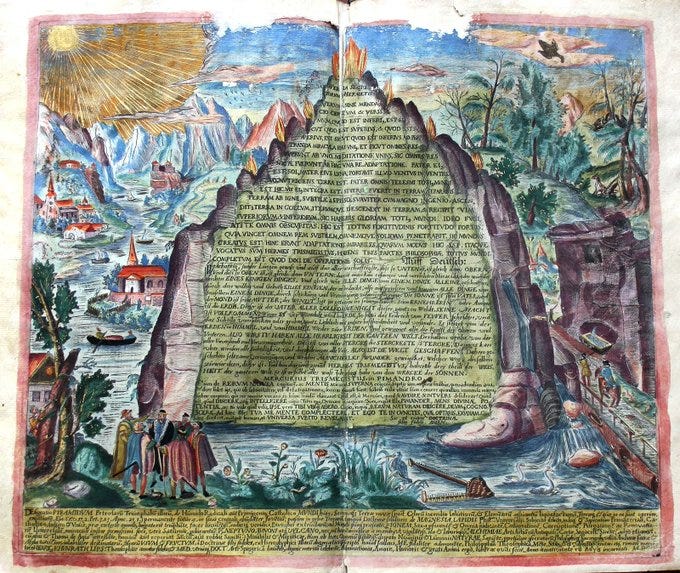
And yet the reason the legend survives is not simply fraud. It survives because the Emerald Tablet speaks to an enduring human temptation: the belief that reality is not chaos but pattern, that the universe is layered but intelligible, and that transformation in matter somehow mirrors transformation in the self. Medieval alchemists could read it in the laboratory. Renaissance thinkers could read it as cosmology. Jung could read it as psychic integration. Internet mystics read it as lost vibration science. The text keeps surviving because each age finds its own reflection inside its brevity.
So the real secret of the Emerald Tablet is not that it proves Atlantis, nor that it hands over a forgotten formula for immortality. Its real power lies in how it became a machine for cultural reinvention. A short Arabic Hermetic text, attributed to a Greco-Egyptian sage who embodied the merger of Thoth and Hermes, was repeatedly reclassified as theology, alchemy, philosophy, science, occult revelation, and psychological allegory. The result is one of the clearest examples in intellectual history of how authority is manufactured: not by age alone, but by transmission, reinterpretation, and the hunger of each generation to believe that somewhere, behind the noise of history, a first wisdom still waits.
Thanks for reading.